

Sheet music
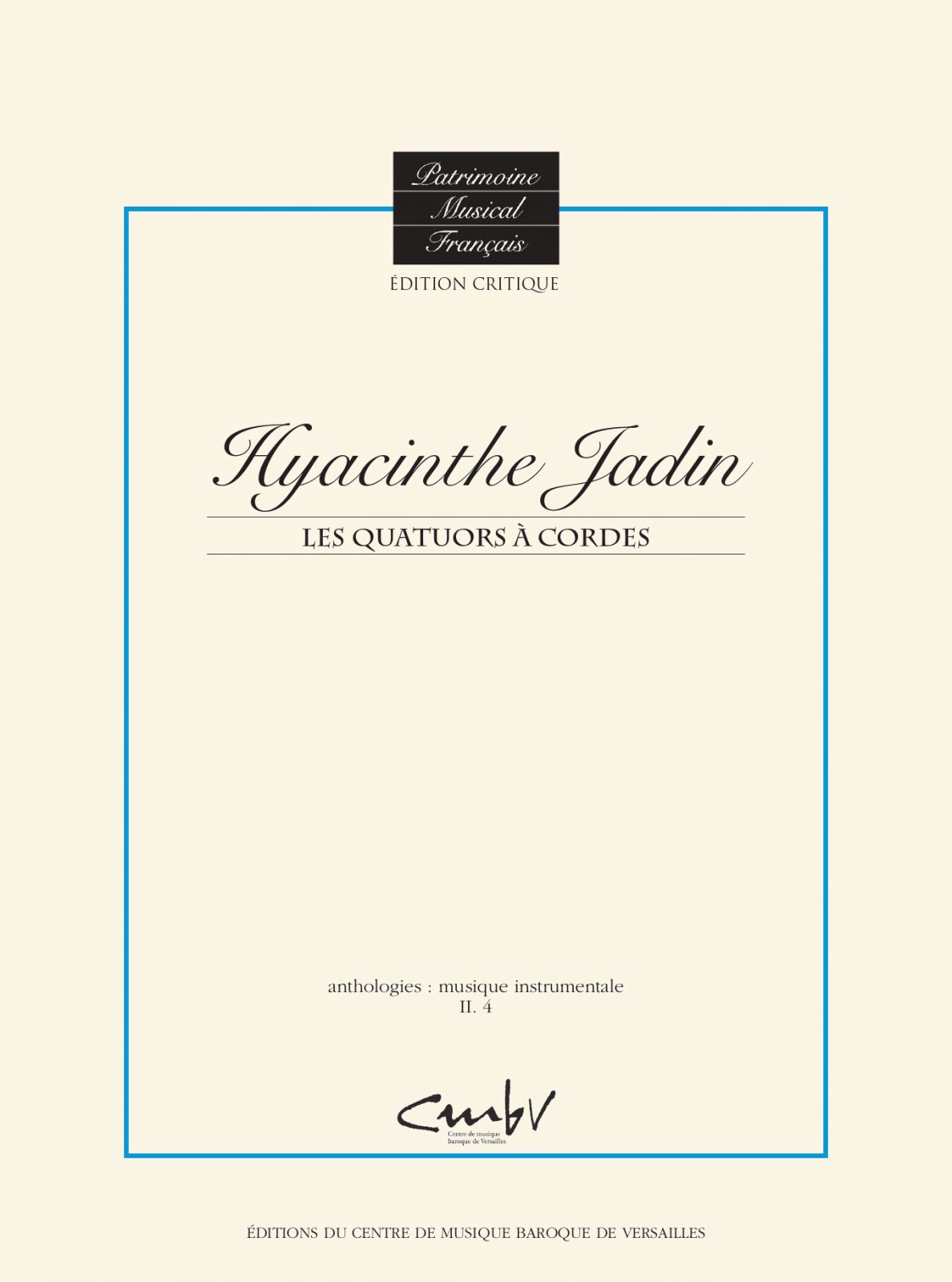
Les Quatuors à cordes
Hyacinthe JADIN
(1776-1800)


Reference: CMBV_062
Format:
23x31 cm
Binding: Paperback
100,00 € TTC
In stock
Hyacinthe JADIN
(1776-1800)
Editor(s):
Philippe OBOUSSIER
Collection:
Anthology series
Instrumental music
Type of publication:
Critical edition
Publisher:
Editions du Centre de musique baroque de Versailles
Presintation:
Éditions du Centre de musique baroque de Versailles publishes the String Quartets by Hyacinthe Jadin. This new critical volume is edited by Philippe Oboussier in the Anthologies: musique instrumentale collection, dedicated to the discovery of outstanding French works from the 17th and 18th centuries. It joins Grétry’s Quatuors op. III, Dauvergne’s Concerts de symphonies and Rigel’s Symphonies .
Hyacinthe Jadin was born in Versailles in 1776. His musical training probably came from his father, who was Ordinaire de la Musique du Roi. In 1792, aged just 16, he succeeded his brother Louis-Emmanuel as harpsichordist at the Théâtre Feydeau in Paris. Also a renowned pianist, he was appointed professor at the new Paris conservatory at the age of 19, and composed numerous sonatas and three concertos for his instrument. Although he died prematurely of an illness in 1800, he nonetheless left an abundant and highly mature body of work, which won him the support of an ever-growing musical community.
In his 12 string quartets, Hyacinthe Jadin cultivated a refined style of writing, largely inspired by the Viennese style, which was not much in vogue in France at the time. These works crystallise all the composer’s qualities: intensity of writing and expressive power. He used a remarkable harmonic palette, exceptionally broad for the period. Although serious and demanding, they do not present any great playing difficulties.
Following an overview of Jadin’s life and career, Philippe Oboussier discusses the context in which the string quartet genre evolved in France between 1780 and 1790. He highlights Jadin’s contribution and originality, which place the French composer in the tradition of the two most famous exponents of the Viennese style: Haydn and Mozart. The study is supported by a comparison of Mozart’s "Dissonance" Quartet in C KV.465 with Jadin’s beautiful String Quartet in E-flat op. 2 no. 1, whose many similarities suggest a homage to the earlier work. Accompanied by facsimile reproductions, the introduction (in French and English) is followed by the music of all 12 string quartets, as well as abundant critical notes. Each of the quartets is available in separate parts for performance.
Philippe Oboussier, a graduate of King’s College Cambridge, directed and taught in music schools for 25 years. In the 1970s, he edited and performed Lalande’s grands motets and discovered new petits motets by François Couperin. While exploring French chamber music of the late 18th century, he came across the quartets of Hyacinthe Jadin. He revealed them to the public during a symposium in Lyon in 1989, and devoted his doctoral thesis to them, at Exeter University in 2005.
Hyacinthe Jadin was born in Versailles in 1776. His musical training probably came from his father, who was Ordinaire de la Musique du Roi. In 1792, aged just 16, he succeeded his brother Louis-Emmanuel as harpsichordist at the Théâtre Feydeau in Paris. Also a renowned pianist, he was appointed professor at the new Paris conservatory at the age of 19, and composed numerous sonatas and three concertos for his instrument. Although he died prematurely of an illness in 1800, he nonetheless left an abundant and highly mature body of work, which won him the support of an ever-growing musical community.
In his 12 string quartets, Hyacinthe Jadin cultivated a refined style of writing, largely inspired by the Viennese style, which was not much in vogue in France at the time. These works crystallise all the composer’s qualities: intensity of writing and expressive power. He used a remarkable harmonic palette, exceptionally broad for the period. Although serious and demanding, they do not present any great playing difficulties.
Following an overview of Jadin’s life and career, Philippe Oboussier discusses the context in which the string quartet genre evolved in France between 1780 and 1790. He highlights Jadin’s contribution and originality, which place the French composer in the tradition of the two most famous exponents of the Viennese style: Haydn and Mozart. The study is supported by a comparison of Mozart’s "Dissonance" Quartet in C KV.465 with Jadin’s beautiful String Quartet in E-flat op. 2 no. 1, whose many similarities suggest a homage to the earlier work. Accompanied by facsimile reproductions, the introduction (in French and English) is followed by the music of all 12 string quartets, as well as abundant critical notes. Each of the quartets is available in separate parts for performance.
Philippe Oboussier, a graduate of King’s College Cambridge, directed and taught in music schools for 25 years. In the 1970s, he edited and performed Lalande’s grands motets and discovered new petits motets by François Couperin. While exploring French chamber music of the late 18th century, he came across the quartets of Hyacinthe Jadin. He revealed them to the public during a symposium in Lyon in 1989, and devoted his doctoral thesis to them, at Exeter University in 2005.
Pages:
LXIII-243
Publication date:
2010-09
Illustrations, facsimiles (number):
8
Introduction (language):
French/English
ISMN 979-0-707034-62-0
The works
Genre:
quatuor à cordes
Key:
Si bémol Majeur
Duration:
entre 40' et 49'
Genre:
quatuor à cordes
Key:
La Majeur
Duration:
entre 30' et 39'
Genre:
quatuor à cordes
Key:
fa mineur
Duration:
entre 20' et 29'
Genre:
quatuor à cordes
Key:
Mi bémol Majeur
Duration:
entre 30' et 39'
Genre:
quatuor à cordes
Key:
si mineur
Duration:
entre 20' et 29'
Genre:
quatuor à cordes
Key:
Do Majeur
Duration:
entre 40' et 49'
Genre:
quatuor à cordes
Key:
Do Majeur
Duration:
entre 40' et 49'
Genre:
quatuor à cordes
Key:
Mi Majeur
Duration:
entre 20' et 29'
Genre:
quatuor à cordes
Key:
la mineur
Duration:
entre 30' et 39'
Genre:
quatuor à cordes
Key:
Sol Majeur
Duration:
entre 20' et 29'
Genre:
quatuor à cordes
Key:
Fa Majeur
Duration:
entre 30' et 39'
Genre:
quatuor à cordes
Key:
Ré Majeur
Duration:
entre 30' et 39'


