

Sheet music
Cantate Domino… quia mirabilia fecit
Nicolas BERNIER
(1665-1734)


Reference: CAHIERS-189
Format:
19,4x24,1 cm
Binding: Paperback
24,00 € TTC
In stock
Nicolas BERNIER
(1665-1734)
Collection:
Choir and orchestra
Type of publication:
Full score
Publisher:
Editions du Centre de musique baroque de Versailles
Presintation:
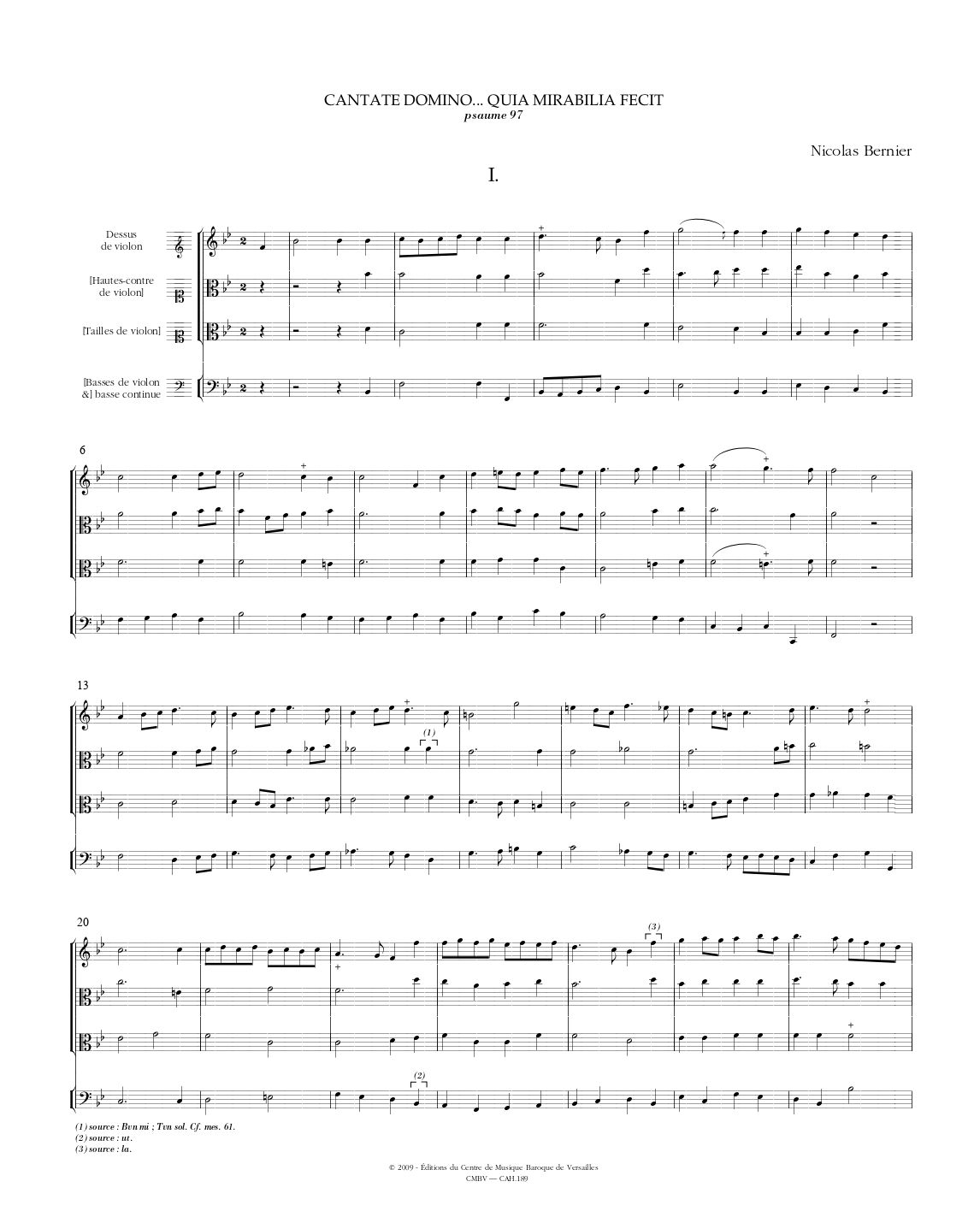
Éditions du Centre de Musique Baroque de Versailles presents a third grand motet by Nicolas Bernier. The Cantate Domino... qui mirabilia fecit, the second motet to have come down to us with all the instrumental parts, uses a French-style orchestra in 4 parts: Dessus de violon (sometimes divided), hautes-contres, tailles and basses de violon for the strings, with flutes and basso continuo.
Nicolas Bernier is one of the great French composers of the 17th and 18th centuries.
Born in 1665 in Mantes-sur-Seine (today Mantes-la-Jolie), he was probably trained at the town’s collegiate church and at Evreux cathedral. He also travelled to Rome to study with Antonio Caldara. His presence in Paris, where he worked as harpsichord master, is attested as early as 1692. His first official post was at Chartres Cathedral in 1694, which he left 4 years later for Saint-Germain-l'Auxerrois in Paris, opposite the Château du Louvre. In 1704, he resigned to succeed Marc-Antoine Charpentier at the Sainte-Chapelle in Paris. He also frequented the circle of Abbé Mathieu, the parish priest of Saint-André-des-Arts, who brought together ultramontane parishioners; that of Philippe d'Orléans, the future regent and patron of the arts, for whom he was also music master; and that of the Duchesse du Maine, for whom he composed Les Nuits de Sceaux. In 1712, he married Marie Catherine Marais, daughter of composer Marin Marais. Finally, at the age of 58, he was appointed sous-maître at the Chapelle Royale in Versailles, alongside Lalande, Gervais and Campra. Throughout his career, he enjoyed the protection of numerous personalities whose graces he was able to win through his talent. He died in Paris in July 1734 at the age of 69.
Nicolas Bernier’s setting of Psalm 97 highlights the text’s jubilant, laudatory character. The "motet à numéro" (motet in separate movements) became firmly established at the Chapelle Royale in Versailles, structuring the musician’s discourse and creating strong contrasts between movements to treat each verse according to its character. Particularly noteworthy are the bass recitative accompanied by flutes and violins in no. IV Recordatus est, and the beautiful chorus in no. VI Jubilate Deo. The latter plays on mass effects to broaden the musician’s palette, treating the chorus in two ways: in 5 parts, in its original arrangement, and in three parts - divided dessus and haute-contre.
Nicolas Bernier is one of the great French composers of the 17th and 18th centuries.
Born in 1665 in Mantes-sur-Seine (today Mantes-la-Jolie), he was probably trained at the town’s collegiate church and at Evreux cathedral. He also travelled to Rome to study with Antonio Caldara. His presence in Paris, where he worked as harpsichord master, is attested as early as 1692. His first official post was at Chartres Cathedral in 1694, which he left 4 years later for Saint-Germain-l'Auxerrois in Paris, opposite the Château du Louvre. In 1704, he resigned to succeed Marc-Antoine Charpentier at the Sainte-Chapelle in Paris. He also frequented the circle of Abbé Mathieu, the parish priest of Saint-André-des-Arts, who brought together ultramontane parishioners; that of Philippe d'Orléans, the future regent and patron of the arts, for whom he was also music master; and that of the Duchesse du Maine, for whom he composed Les Nuits de Sceaux. In 1712, he married Marie Catherine Marais, daughter of composer Marin Marais. Finally, at the age of 58, he was appointed sous-maître at the Chapelle Royale in Versailles, alongside Lalande, Gervais and Campra. Throughout his career, he enjoyed the protection of numerous personalities whose graces he was able to win through his talent. He died in Paris in July 1734 at the age of 69.
Nicolas Bernier’s setting of Psalm 97 highlights the text’s jubilant, laudatory character. The "motet à numéro" (motet in separate movements) became firmly established at the Chapelle Royale in Versailles, structuring the musician’s discourse and creating strong contrasts between movements to treat each verse according to its character. Particularly noteworthy are the bass recitative accompanied by flutes and violins in no. IV Recordatus est, and the beautiful chorus in no. VI Jubilate Deo. The latter plays on mass effects to broaden the musician’s palette, treating the chorus in two ways: in 5 parts, in its original arrangement, and in three parts - divided dessus and haute-contre.
Pages:
62
Publication date:
2009-09
Introduction (language):
French
ISMN 979-0-56016-189-1
The works
Text language:
Latin
Genre:
motet
Liturgical season:
Psaume 97
Key:
Si bémol Majeur
Duration:
entre 40' et 49'
Recommendations


26€
Available in a digital version


