

Cum invocarem


Born in 1660, André Campra studied music with Guillaume Poitevin, maître de chapelle at the Saint-Sauveur choir school of the cathedral of Aix-en-Provence, where he trained several renowned musicians (including Jean Gilles). After leaving Aix-en-Provence, Campra, whose life seems to have been eventful, obtained several appointments in the south of France. In 1694, he moved to Paris and was appointed to the maîtrise of Notre-Dame Cathedral. He resigned in 1700 to devote himself freely to an equally exceptional operatic career, which led him to become director of the Académie royale de musique in 1730. In 1723, Philippe d’Orléans entrusted him with one of the quarters of the Chapelle royale, replacing Lalande. Campra composed or reworked most of the great motets that have come down to us. He died in 1744.
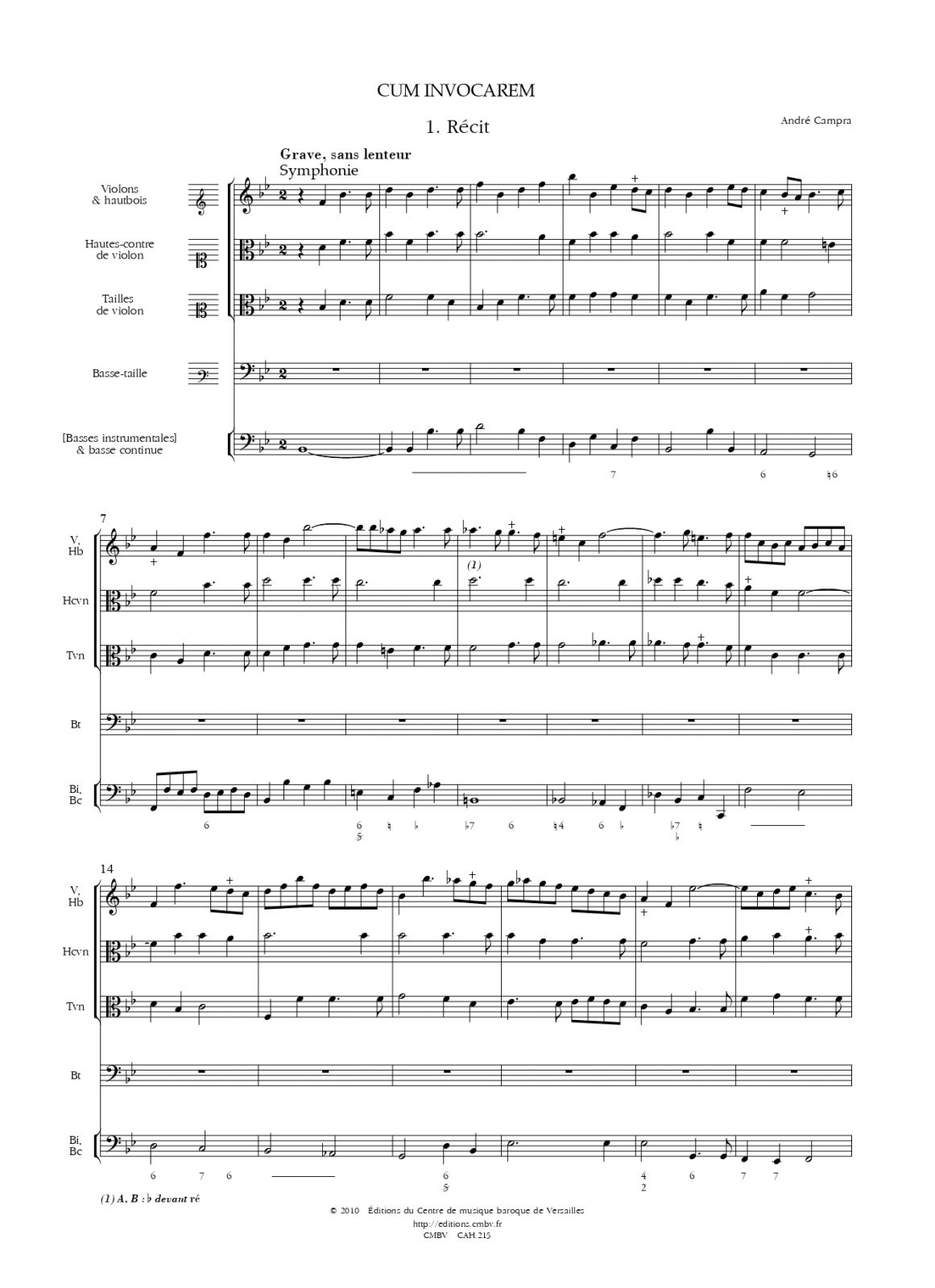
This grand motet, which Campra dated to 1734, belongs to the collection of the Chapelle royale de Versailles. It takes as its text Psalm 4, Cum invocarem, a profession of faith in the form of a prayer to a merciful God. The composer had already published a petit motet based on this psalm, for two upper voices and continuo. Although it uses the same text, the musical material here is entirely new, with the exception of the opening bars of the chaconne in verse 7. This grand motet is intended for a large ensemble comprising 4 soloists (dessus, haute-contre, taille and basse-taille), a 5-part choir in the French style, with the dessus divided for a few bars, and an orchestra of woodwinds and strings (4 parts in the French style) and basso continuo. Note, for example, the superb Sacrificate sacrificium justitiæ, a dialogue between the soprano and a two-voice choir above, accompanied by flutes, violins and basses.
Signatum est (vs F-Pn/H 407)
The works
Recommendations


