

Sheet music
Messe des morts
New edition
André CAMPRA
(1660-1744)




Reference: CAHIERS-60
Format:
21x29,7 cm
Binding: Paperback
45,00 € TTC
In stock
André CAMPRA
(1660-1744)
Editor(s):
Louis CASTELAIN
Collection:
Choir and orchestra
Type of publication:
Full score
Publisher:
Editions du Centre de musique baroque de Versailles
This reference includes:
1 ex. Conducteur
1 ex. Notes critiques (version numérique)
Presintation:
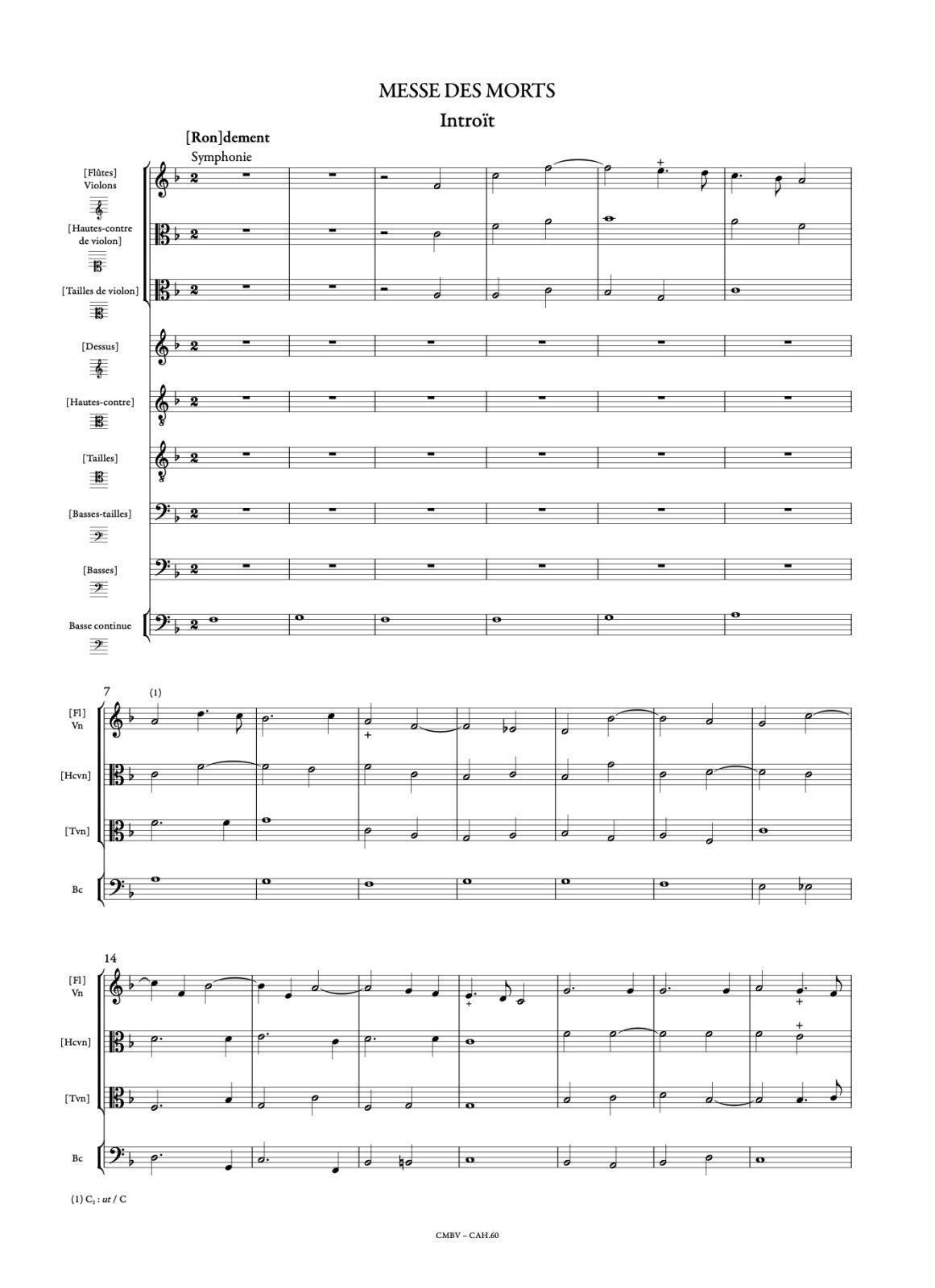
Editing Campra’s Requiem poses problems related to the evolution of musical practices at the beginning of the eighteenth century. There are two known sources: an autograph manuscript by Campra, quite late and with gaps, and an even later source preserved in the collection of the choir where Campra learned music, which enables us to fill the gaps in the autograph manuscript. The editor, Louis Castelain, has sought to restore the work as closely as possible to the composer’s intention. The format of the edition is modified: the full score presents the methodology and the sources, with a preface by Bénédicte Hertz, a researcher at the Centre de musique baroque de Versailles, who takes stock of the genealogy of the work and its fortune in the provinces. The critical notes, which point out editorial choices and differences between sources, are published separately in digital format and are available for download.
Born in 1660, André Campra studied music with Guillaume Poitevin, maître de chapelle at the Saint-Sauveur choir school of the cathedral of Aix-en-Provence, where several renowned musicians (including Jean Gilles) were trained. After leaving this post, and having taken the priesthood, Campra obtained several appointments in the south of France. In 1694, he moved to Paris and obtained the position of maître de musique at the cathedral of Notre-Dame. He resigned in 1700 to devote himself freely to an equally exceptional operatic career, which led him in the direction of the Académie royale de musique in 1730. In 1723, Philippe d’Orléans entrusted him with one of the quarters of the Chapelle royale to replace Lalande. Campra composed or reworked most of the grands motets that have come down to us. He died in 1744.
The Centre de musique baroque de Versailles is republishing André Campra’s famous Requiem. Along with Jean Gilles’ Messe des morts and Michel-Richard de Lalande’s Te Deum, Campra’s Messe des morts is one of the most emblematic liturgical works of the special ceremonies celebrated in France during the eighteenth century. This new edition seeks to get closer to the original spirit of the work.
Editing Campra’s Requiem poses problems related to the evolution of musical practices at the beginning of the eighteenth century. There are two known sources: an autograph manuscript by Campra, quite late and with gaps, and an even later source preserved in the collection of the choir where Campra learned music, which enables us to fill the gaps in the autograph manuscript. The editor, Louis Castelain, has sought to restore the work as closely as possible to the composer’s intention. The format of the edition is modified: the full score presents the methodology and the sources, with a preface by Bénédicte Hertz, a researcher at the Centre de musique baroque de Versailles, who takes stock of the genealogy of the work and its fortune in the provinces. The critical notes, which point out editorial choices and differences between sources, are published separately in digital format and are available for download.
Born in 1660, André Campra studied music with Guillaume Poitevin, maître de chapelle at the Saint-Sauveur choir school of the cathedral of Aix-en-Provence, where several renowned musicians (including Jean Gilles) were trained. After leaving this post, and having taken the priesthood, Campra obtained several appointments in the south of France. In 1694, he moved to Paris and obtained the position of maître de musique at the cathedral of Notre-Dame. He resigned in 1700 to devote himself freely to an equally exceptional operatic career, which led him in the direction of the Académie royale de musique in 1730. In 1723, Philippe d’Orléans entrusted him with one of the quarters of the Chapelle royale to replace Lalande. Campra composed or reworked most of the grands motets that have come down to us. He died in 1744.
Pages:
128
Publication date:
2024-05
Introduction (language):
French/English
ISMN 979-0-56016-060-3
The works
Text language:
Latin
Genre:
messe
Liturgical calendar
Défunts
Key:
Fa Majeur
Duration:
entre 40' et 49'
Organisation:
Moyen/Difficile
General level:
Moyen
Commentary:
Cette œuvre nécessite des solistes expérimentés et un chœur bien fourni en voix d'hommes. Celui-ci ne présente pas de difficultés particulières.
Counterpoint:
Moyen
Rhythm:
Moyen/Difficile
Ranges:
Facile
Recommendations


27€
Available in a digital version


28€
Available in a digital version


