

La Musique religieuse


Alongside Lully, Jean-Philippe Rameau is probably the most popular French Baroque composer. His operatic works, which are regularly performed throughout the world, are practically all successes, and his qualities as musician and theorist no longer need any excuses. This central figure of French music has obviously to feature in the catalogue of the Centre de Musique Baroque de Versailles. There are, curiously, however, very few religious works by Jean-Philippe Rameau. As the son of an organist from Dijon, he, like his contemporaries, underwent rigorous training from an early age in the canons of ecclesiastical counterpoint, and practised sacred music on a daily basis. His first official posts were as organist in Dijon, Lyon and Clermont-Ferrand. Despite this, only four religious works have come down to us, not for organ but for voice. And of these, only one in an autograph manuscript.
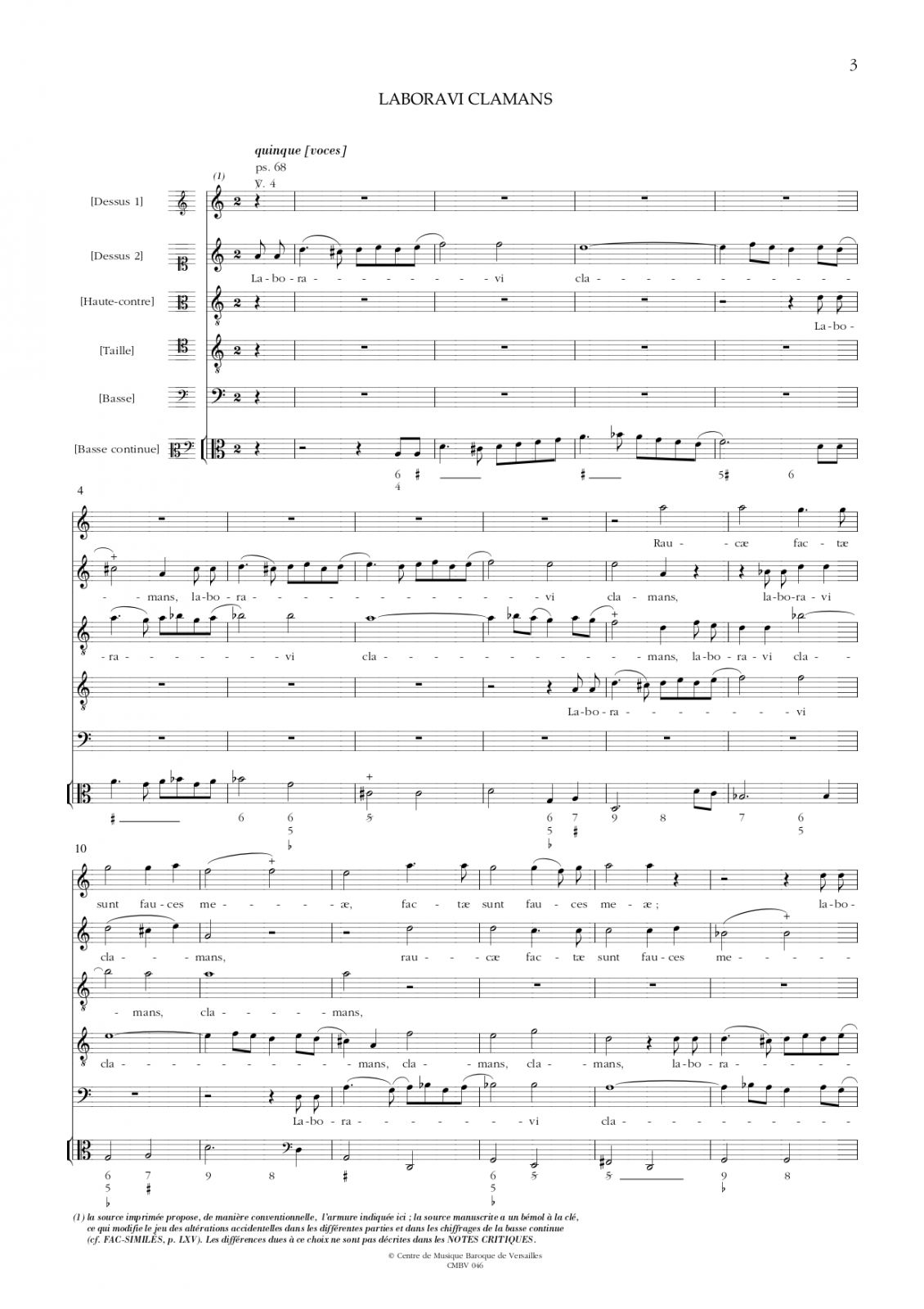
These motets all display the traits of Jean-Philippe Rameau’s writing: from the astonishing austerity of the motet for 5 voices and basso continuo, Laboravi clamans, included in his famous treatise on harmony, to the extreme finesse of In convertendo, repeatedly reworked for the Concert Spirituel, and whose compositional stages are revealed by Jean Duron, scholarly director of the Centre de Musique Baroque de Versailles and editor of the present work. The other two motets are known to us only from later copies, reflecting a different musical practice. Here again, Jean Duron proposes a restoration of the works more in keeping with the period of their first performance, while leaving the performers free to choose one version or the other.
These pieces used only to be available in the Camille Saint-Saëns version published by Durand. Thanks to this new edition, these magnificent works can be heard again in concert. In addition to the exceptional qualities of these pieces for soloists, choir and orchestra, the solo airs for women’s and men’s voices are among the finest in French church music. Of particular note are the first number of the Quam dilecta tabernacula, numbers 3, "Et enim passer", and 6, "Domine Deus virtutum", from the same motet, and number 3, "Converte Domine captivitatem nostram", from theIn convertendo, all of which are indispensable repertoire for singers.
The volume contains a bilingual (French/English) introduction illustrated with several facsimile examples, Rameau’s four motets, critical notes and appendices. The introduction by Jean Duron reviews the catalogue of Jean-Philippe Rameau’s religious works, the sources used for the edition and the principles that led to the restoration of the works.
6 variants of the motet In Convertendo Dominus


