

Sheet music
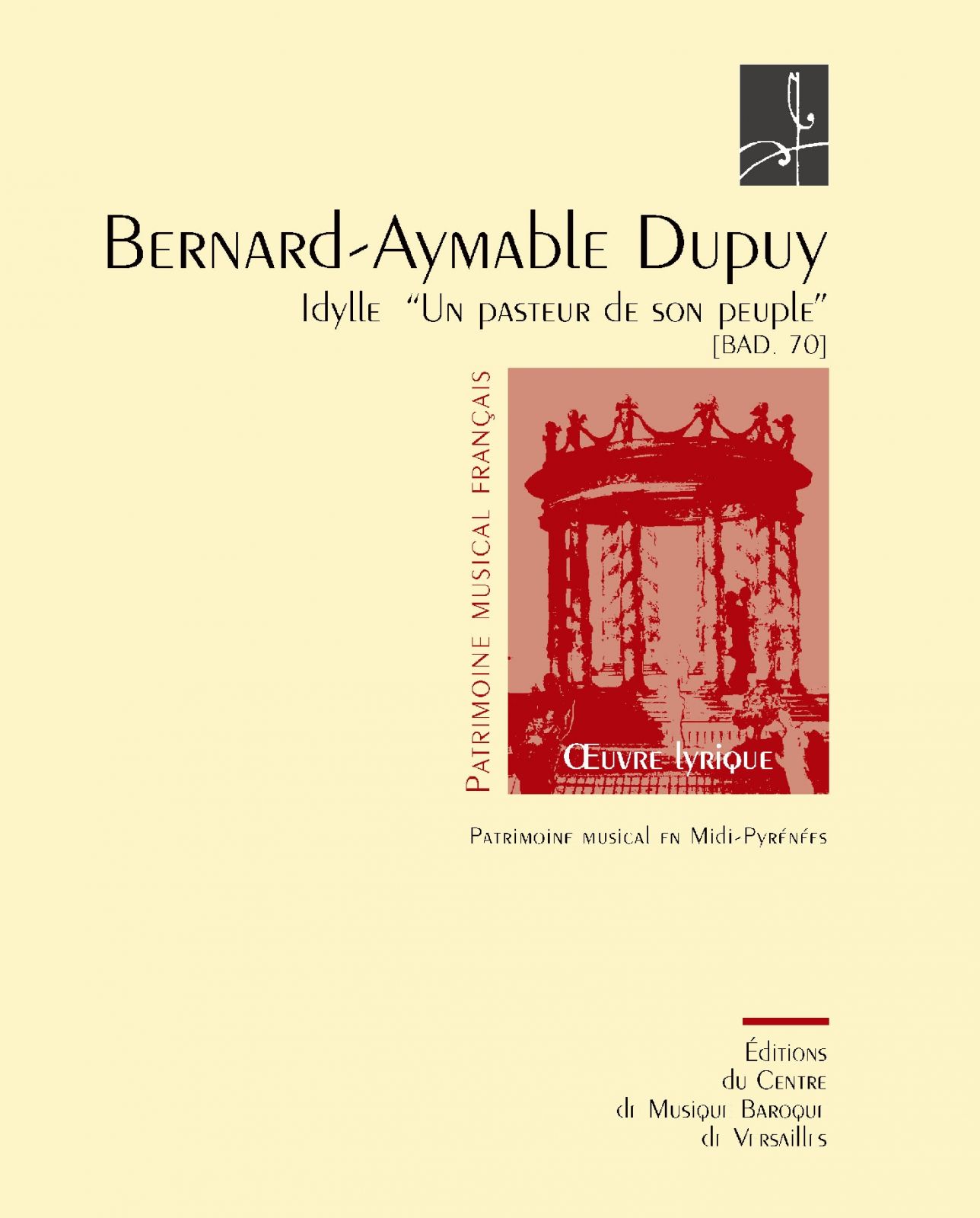
Idylle "Un pasteur de son peuple"
Bernard-Aymable DUPUY
(1707-1789)


Reference: CAHIERS-178
Format:
19,4x24,1 cm
Binding: Paperback
22,50 € TTC
In stock
Bernard-Aymable DUPUY
(1707-1789)
Editor(s):
Françoise TALVARD
Collection:
Lyric work
Type of publication:
Full score
Publisher:
Editions du Centre de musique baroque de Versailles
Presintation:
Bernard-Aymable Dupuy had been Master of Music at Toulouse’s Saint-Sernin collegiate church for 6 years when he composed this secular work. It is an original idea: a musical portrait of Monseigneur Dillon to celebrate his appointment to the archbishopric of Toulouse. This high prelate was, among other things, Archbishop and Primate of Narbonne and, as such, the last President-born of the États of Languedoc.
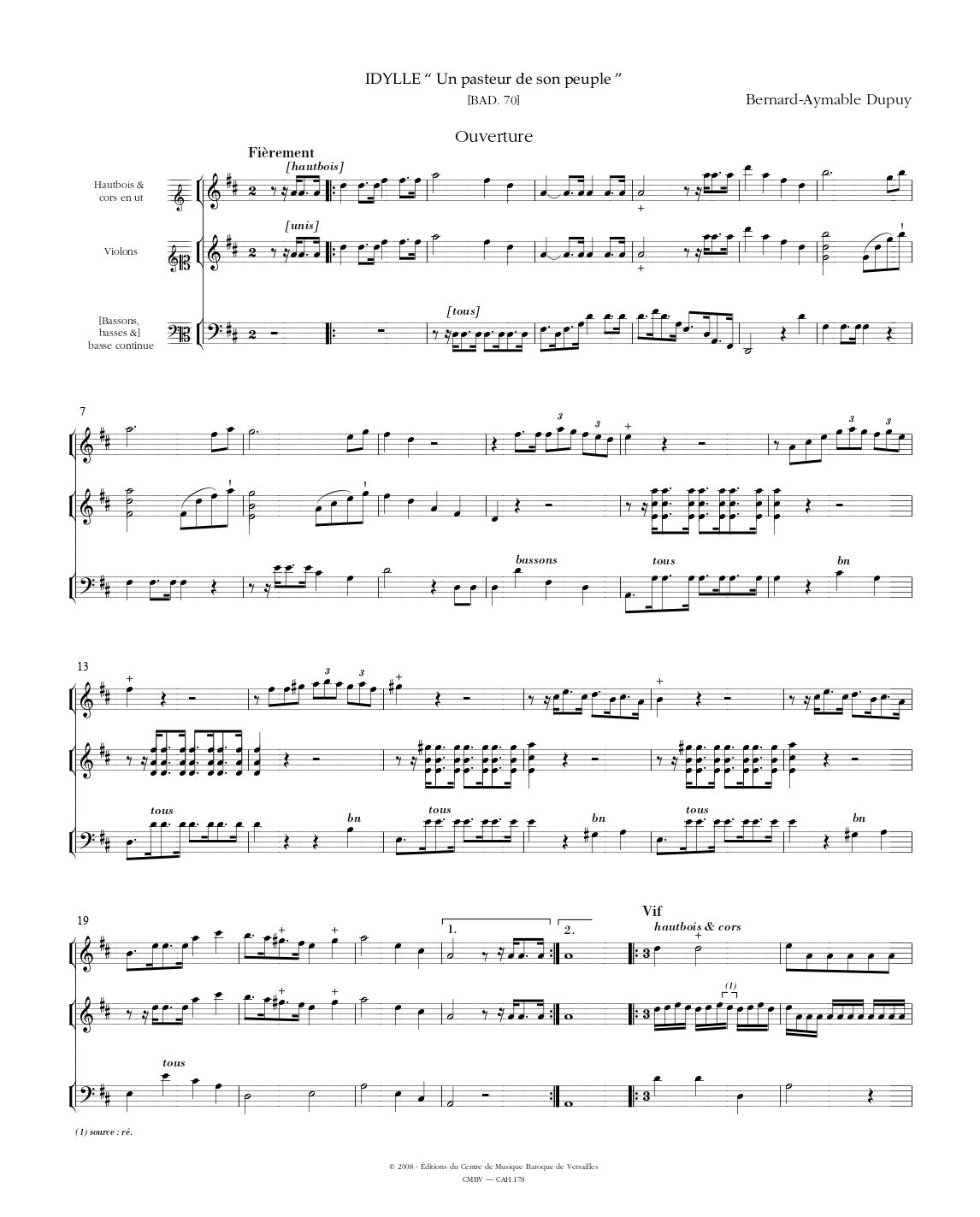
This little opera was performed in Toulouse at the Collège de la Compagnie de Jésus on 11 May 1761. The work, which opens with a majestic overture, is divided into 3 main parts, separated by instrumental movements. Each part evokes a different aspect of the dedicatee’s personality: the grand seigneur of the Ancien Régime, his strength of character inherited from the Dillon family’s glorious military past, and his qualities as a man of the church.
The music is extremely varied and lively, playing on the tonality of the different sections, as well as on the diversity of musical forms, both instrumental (overtures, rondeaux, airs, dances) and vocal (recitatives, arias, duets and choruses). At the heart of the piece, an arietta for soprano, full of freshness and frivolity, illuminates the portrait with a barely disguised allusion to the prelate’s interest in his little niece, Mademoiselle de Rothe, an excellent singer in her own right. Dupuy counterbalances this light-hearted moment with the expressive serenity of the soprano/haute-contre duet "Par luy la sagesse dicte ses leçons...".
The composer achieves a perfect balance between Italian vivacity and French intelligibility and elegance, whose musical quality goes far beyond the conventional, circumstantial aspect one might expect from such a piece. Though musically close to the Baroque aesthetic, Classicism pervades the melodic line and phrasing.
The overall qualities of this work - its variety and lightness, its duration and the orchestral forces used (woodwinds/horns/three-part strings, without viola) - make it suitable for a variety of uses, in particular as a complete concert bringing together all the disciplines of a music school (singing/choir/orchestra/dance/drama/history), whatever the level.
This edition is part of the "Patrimoine musical en Midi-Pyrénées" series, presented by Françoise Talvard. Clarinettist, conservatoire music teacher, researcher and associate editor of the Centre de Musique Baroque de Versailles (CMBV), her work focuses on musicians active in the Midi-Pyrénées region in the 18th century. She is currently preparing an article on Jacques Foncès for the Revue de Musicologie (SFM-France), and is also collaborating with the CHEC under the direction of Bernard Dompnier.
This little opera was performed in Toulouse at the Collège de la Compagnie de Jésus on 11 May 1761. The work, which opens with a majestic overture, is divided into 3 main parts, separated by instrumental movements. Each part evokes a different aspect of the dedicatee’s personality: the grand seigneur of the Ancien Régime, his strength of character inherited from the Dillon family’s glorious military past, and his qualities as a man of the church.
The music is extremely varied and lively, playing on the tonality of the different sections, as well as on the diversity of musical forms, both instrumental (overtures, rondeaux, airs, dances) and vocal (recitatives, arias, duets and choruses). At the heart of the piece, an arietta for soprano, full of freshness and frivolity, illuminates the portrait with a barely disguised allusion to the prelate’s interest in his little niece, Mademoiselle de Rothe, an excellent singer in her own right. Dupuy counterbalances this light-hearted moment with the expressive serenity of the soprano/haute-contre duet "Par luy la sagesse dicte ses leçons...".
The composer achieves a perfect balance between Italian vivacity and French intelligibility and elegance, whose musical quality goes far beyond the conventional, circumstantial aspect one might expect from such a piece. Though musically close to the Baroque aesthetic, Classicism pervades the melodic line and phrasing.
The overall qualities of this work - its variety and lightness, its duration and the orchestral forces used (woodwinds/horns/three-part strings, without viola) - make it suitable for a variety of uses, in particular as a complete concert bringing together all the disciplines of a music school (singing/choir/orchestra/dance/drama/history), whatever the level.
This edition is part of the "Patrimoine musical en Midi-Pyrénées" series, presented by Françoise Talvard. Clarinettist, conservatoire music teacher, researcher and associate editor of the Centre de Musique Baroque de Versailles (CMBV), her work focuses on musicians active in the Midi-Pyrénées region in the 18th century. She is currently preparing an article on Jacques Foncès for the Revue de Musicologie (SFM-France), and is also collaborating with the CHEC under the direction of Bernard Dompnier.
Pages:
79
Publication date:
2008-11
Introduction (language):
French
ISMN 979-0-56016-178-5
The works
Author of text:
ANONYME
Text language:
Français
Genre:
divertissement
Key:
Sol Majeur (ouverture en Ré Majeur)
Duration:
entre 40' et 49'
Recommendations


34€
Available in a digital version


27€
Available in a digital version


28€
Available in a digital version

