

CD
Raoul Barbe-bleue
Comedy in three acts and in prose
André-Ernest-Modeste GRETRY
(1741-1813)
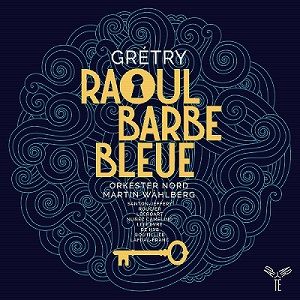

Reference: AP214
18,00 € TTC
In stock
André-Ernest-Modeste GRETRY
(1741-1813)
Publisher:
Aparté
Presintation:
This world-premiere recording of a long-forgotten Grétry score was born from a collaboration between the Norwegian Barokkfest festival and the Centre de musique baroque de Versailles. Performed a few weeks before the French Revolution, Raoul Barbe-bleue is an unclassifiable opéra-comique, whose astonishing musical and dramatic implications would inspire Offenbach.
Medieval and mythical worlds coexist in this retelling of Perrault’s tale, which already foreshadows, both through its writing and its taste for horror, the Romanticism to come. Far from the norm in the genre, Raoul Barbe-bleue presents a deliberately political fresco and depicts a cruel nobility, sometimes rendered grotesque by the mixture of tragic and comic elements, from cross-dressing to the scapegoat valet.
The drama, shrouded in a mysterious atmosphere (one thinks of Weber’s Singspiel), benefits from musical writing that sustains the suspense, and has little in common with the naive simplicity of the composer’s early works. Grétry’s elegance and refinement lend a dramatic power reminiscent, in the opening, of the introit of Mozart’s Requiem.----
Recorded in the magnificent Trondheim Theatre (Norway), and performed by a brilliant cast under the baton of Martin Wahlberg, Raoul Barbe-bleue possesses a surprising richness, both for the novice and the specialist.
RAOUL BARBE-BLEUE, OPERA COMIQUE IN MARCH 1789
Recent theatrical revivals have allowed us to reassess the nature of Grétry’s legacy. In the work of this composer of family comic operas, a favorite of the Queen, the stage and recordings are gradually revealing completely unexpected elements. For example, Céphale & Procris, which expresses itself in Gluck-like language even before Gluck’s first French work had been performed; and Andromaque, borrowing from Racine’s verses and adding a small wind-instrument choir to its heroine’s recitatives. Another example is William Tell, slipping astonishingly bawdy undertones into a piece with a generally edifying and familial tone (the neighbour who "quickly gets involved", the Sicilienne of La Noisette, etc).
Raoul Barbe-bleue is among these surprises. The opéra comique, a form derived from vaudevilles and opera parodies at Parisian fairs, which could not present plays set entirely to music because of the privileges of the Académie royale de musique, specialised in lightweight moral plays in which the goodness of ordinary people was rewarded. Sedaine, the emblematic librettist of this period (from the 1750s with Philidor, then the 1760s with Monsigny, to the 1780s and 1790s with Grétry), was renowned for his sense of naturalness (and his French-language faults in the mouths of simple characters), adapting very well to the shift in comic opera in the 1760s, less sarcastic, more sensitive to pathos, even to the "taste for tears". Typical of this period is Le Déserteur, which he wrote for Monsigny in 1769, in which a brave young man, through a nasty misunderstanding, must say goodbye to his family in his dungeon before his execution.
For Raoul Barbe-bleue, Sedaine drew very closely on Perrault’s tale. The only significant deviations lie, on the one hand, in the jewel scene, where Isaure’s steadfastness – who had promised herself to Vergy – falters before the gifts of Seigneur Raoul, the wealthy multiple-widower, with which she is a little too eager to adorn herself; and, on the other hand, in the buffoonish disguise of Vergy, the ultimately abandoned lover, who sneaks into Raoul’s castle to see the newly married Isaure, disguised as his deceased sister – Anne, of course.
For the post-1789 audience, it is difficult not to be struck by the shift in perceptions of the aristocracy – in traditional comic opera, the great lord is often a charmer of peasant women, but this great criminal, slain on stage, exceeds the bounds of what is ordinarily appropriate for the genre. Certainly, Raoul is a monstrous character (albeit without a blue beard), but his political protest ("if his vassals lost him, they would all light bonfires"), right up to the final chorus of rejoicing ("This execrable tyrant, / This abominable monster / Expires beneath our blows"), received the censor’s approval with impressive ease. Operatic publications were actually very free at the time – similarly, in the summer of 1787, Beaumarchais’s Tarare (music by Salieri), where Nature explains with scientific care that aristocrats are the only ones to believe in their superiority, where the ridiculous tyrant is overthrown by popular revolt... also received the censor’s approval, without even choosing the alternative ending that preserved the monarch’s life.
Generally speaking, the highly integrated nature of the numbers distinguishes Raoul from other opéras comiques of the time. This is evidenced by the "scene" (i.e. a section more melodic than a recitative but which does not obey any traditional closed form, and follows the action very closely) of Raoul’s return after his young wife’s disobedience, a series of highly crafted recitatives, full of beautiful vocal melodies and orchestral contrasts like a Mozart finale, or Isaure’s aria which, passes from melancholy over her lost love to the torments of curiosity (with insinuating violin swirls) to move on, without interruption, to the discovery of women, in an epic (potentially parodic) tone that exaggeratedly evokes Gluck (the opening storm of Iphigénie en Tauride, for example). Thus romance, deliberation and dramatic outburst are juxtaposed in a single aria, whose form follows no predefined pattern, only the plot.
Contents 2 CD.
Total duration: 1:27:22
Medieval and mythical worlds coexist in this retelling of Perrault’s tale, which already foreshadows, both through its writing and its taste for horror, the Romanticism to come. Far from the norm in the genre, Raoul Barbe-bleue presents a deliberately political fresco and depicts a cruel nobility, sometimes rendered grotesque by the mixture of tragic and comic elements, from cross-dressing to the scapegoat valet.
The drama, shrouded in a mysterious atmosphere (one thinks of Weber’s Singspiel), benefits from musical writing that sustains the suspense, and has little in common with the naive simplicity of the composer’s early works. Grétry’s elegance and refinement lend a dramatic power reminiscent, in the opening, of the introit of Mozart’s Requiem.----
Recorded in the magnificent Trondheim Theatre (Norway), and performed by a brilliant cast under the baton of Martin Wahlberg, Raoul Barbe-bleue possesses a surprising richness, both for the novice and the specialist.
RAOUL BARBE-BLEUE, OPERA COMIQUE IN MARCH 1789
Recent theatrical revivals have allowed us to reassess the nature of Grétry’s legacy. In the work of this composer of family comic operas, a favorite of the Queen, the stage and recordings are gradually revealing completely unexpected elements. For example, Céphale & Procris, which expresses itself in Gluck-like language even before Gluck’s first French work had been performed; and Andromaque, borrowing from Racine’s verses and adding a small wind-instrument choir to its heroine’s recitatives. Another example is William Tell, slipping astonishingly bawdy undertones into a piece with a generally edifying and familial tone (the neighbour who "quickly gets involved", the Sicilienne of La Noisette, etc).
Raoul Barbe-bleue is among these surprises. The opéra comique, a form derived from vaudevilles and opera parodies at Parisian fairs, which could not present plays set entirely to music because of the privileges of the Académie royale de musique, specialised in lightweight moral plays in which the goodness of ordinary people was rewarded. Sedaine, the emblematic librettist of this period (from the 1750s with Philidor, then the 1760s with Monsigny, to the 1780s and 1790s with Grétry), was renowned for his sense of naturalness (and his French-language faults in the mouths of simple characters), adapting very well to the shift in comic opera in the 1760s, less sarcastic, more sensitive to pathos, even to the "taste for tears". Typical of this period is Le Déserteur, which he wrote for Monsigny in 1769, in which a brave young man, through a nasty misunderstanding, must say goodbye to his family in his dungeon before his execution.
For Raoul Barbe-bleue, Sedaine drew very closely on Perrault’s tale. The only significant deviations lie, on the one hand, in the jewel scene, where Isaure’s steadfastness – who had promised herself to Vergy – falters before the gifts of Seigneur Raoul, the wealthy multiple-widower, with which she is a little too eager to adorn herself; and, on the other hand, in the buffoonish disguise of Vergy, the ultimately abandoned lover, who sneaks into Raoul’s castle to see the newly married Isaure, disguised as his deceased sister – Anne, of course.
For the post-1789 audience, it is difficult not to be struck by the shift in perceptions of the aristocracy – in traditional comic opera, the great lord is often a charmer of peasant women, but this great criminal, slain on stage, exceeds the bounds of what is ordinarily appropriate for the genre. Certainly, Raoul is a monstrous character (albeit without a blue beard), but his political protest ("if his vassals lost him, they would all light bonfires"), right up to the final chorus of rejoicing ("This execrable tyrant, / This abominable monster / Expires beneath our blows"), received the censor’s approval with impressive ease. Operatic publications were actually very free at the time – similarly, in the summer of 1787, Beaumarchais’s Tarare (music by Salieri), where Nature explains with scientific care that aristocrats are the only ones to believe in their superiority, where the ridiculous tyrant is overthrown by popular revolt... also received the censor’s approval, without even choosing the alternative ending that preserved the monarch’s life.
Generally speaking, the highly integrated nature of the numbers distinguishes Raoul from other opéras comiques of the time. This is evidenced by the "scene" (i.e. a section more melodic than a recitative but which does not obey any traditional closed form, and follows the action very closely) of Raoul’s return after his young wife’s disobedience, a series of highly crafted recitatives, full of beautiful vocal melodies and orchestral contrasts like a Mozart finale, or Isaure’s aria which, passes from melancholy over her lost love to the torments of curiosity (with insinuating violin swirls) to move on, without interruption, to the discovery of women, in an epic (potentially parodic) tone that exaggeratedly evokes Gluck (the opening storm of Iphigénie en Tauride, for example). Thus romance, deliberation and dramatic outburst are juxtaposed in a single aria, whose form follows no predefined pattern, only the plot.
Contents 2 CD.
Total duration: 1:27:22
Chantal Santon-Jeffery, Isaure
François Rougier, Vergy
Matthieu Lécroart, Raoul
Manuel Núñez Camelino, Osman
Eugénie Lefebvre, Jeanne, une Bergère
Enguerrand de Hys, Le Vicomte de Carabi
Jérôme Boutillier, Le Marquis de Carabas
Marine Lafdal-Franc, Jacques
Orkester Nord
Martin Wåhlberg (dir.)
contenu :
CD 1.
1-19.Acte I
20-35.Acte II
CD 2.
1-12.Acte III
François Rougier, Vergy
Matthieu Lécroart, Raoul
Manuel Núñez Camelino, Osman
Eugénie Lefebvre, Jeanne, une Bergère
Enguerrand de Hys, Le Vicomte de Carabi
Jérôme Boutillier, Le Marquis de Carabas
Marine Lafdal-Franc, Jacques
Orkester Nord
Martin Wåhlberg (dir.)
contenu :
CD 1.
1-19.Acte I
20-35.Acte II
CD 2.
1-12.Acte III
Publication date:
2019-11
Introduction (language):
French/English


