

Sheet music
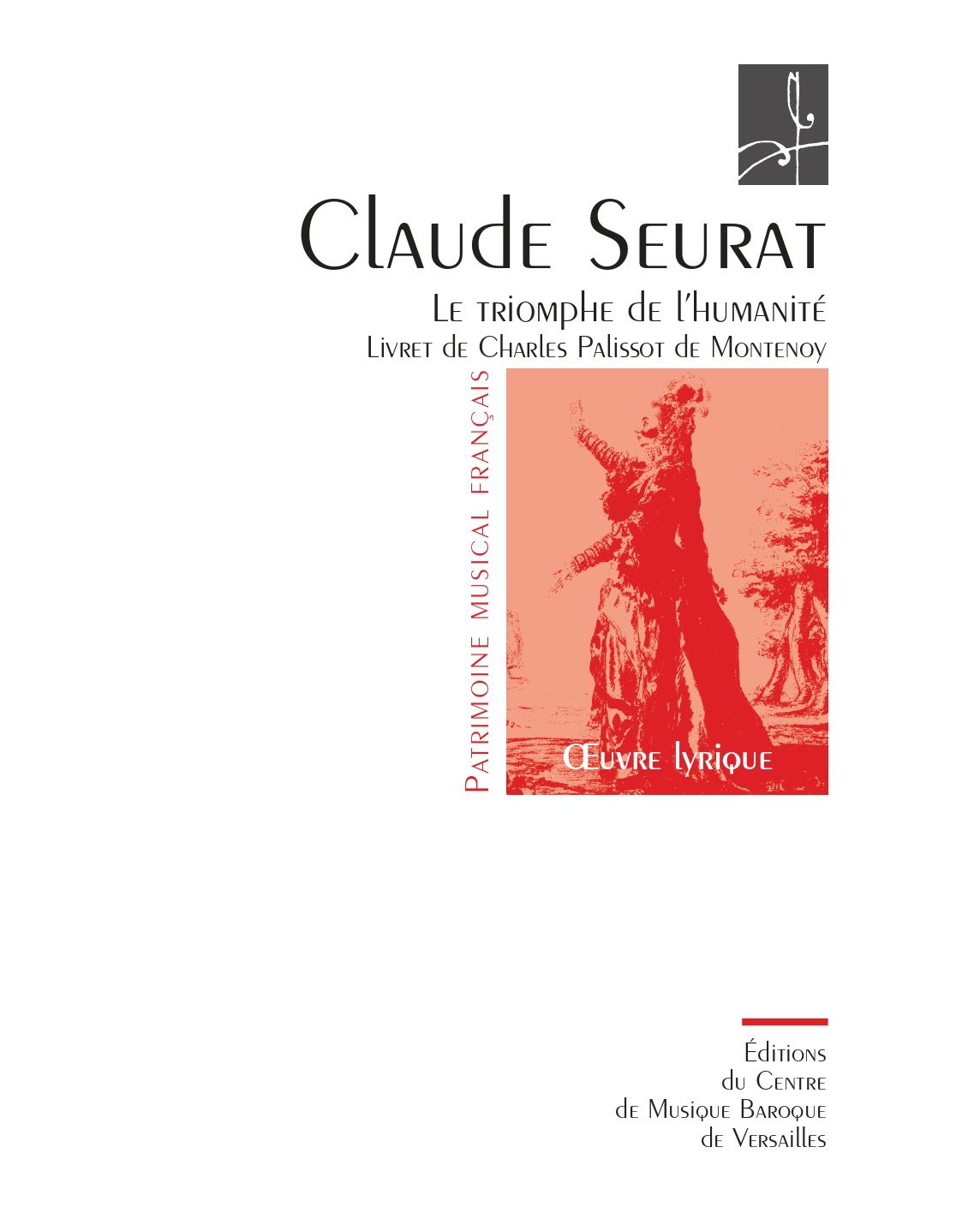
Le Triomphe de l'Humanité
Claude SEURAT
(1...-1756)
Libretto by Charles PALISSOT DE MONTENOY


Reference: CAHIERS-121
Format:
19,4x24,1 cm
Binding: Paperback
28,00 € TTC
In stock
Claude SEURAT
(1...-1756)
Collection:
Lyric work
Type of publication:
Full score
Publisher:
Editions du Centre de musique baroque de Versailles
Presintation:
Of the life and work of Claude Seurat, very little has come down to us, at least according to the current state of our knowledge. Only two dates shed light on his life: 1743, when he entered into service as Maître de musique at the primatial church of Nancy, and 1756, the year of his death. As for his musical output, despite the position he held for nearly thirteen years – a role that would normally imply a substantial output – only this divertissement is known today. Yet, it reveals great talent: lively and spirited instrumental pieces, well-crafted recitatives and airs, and two fine choral movements.
The work was commissioned for the inauguration of the statue of Louis XV in Nancy in 1755. It served as a prologue to a play, Les Originaux – later retitled Le Cercle – whose author, a poet from the city, was the librettist. That day marked a major turning point in the career of Charles Palissot de Montenoy, for although once a friend of the philosophers, he would soon become one of their fiercest opponents.
The work features Glory and Minerva in a dialogue portraying Stanislas I and Louis XV as new gods or heroes who make humanity happier than their Greco-Roman predecessors. It is a piece written for a special occasion, yet it possesses both charm and contemporary resonance.
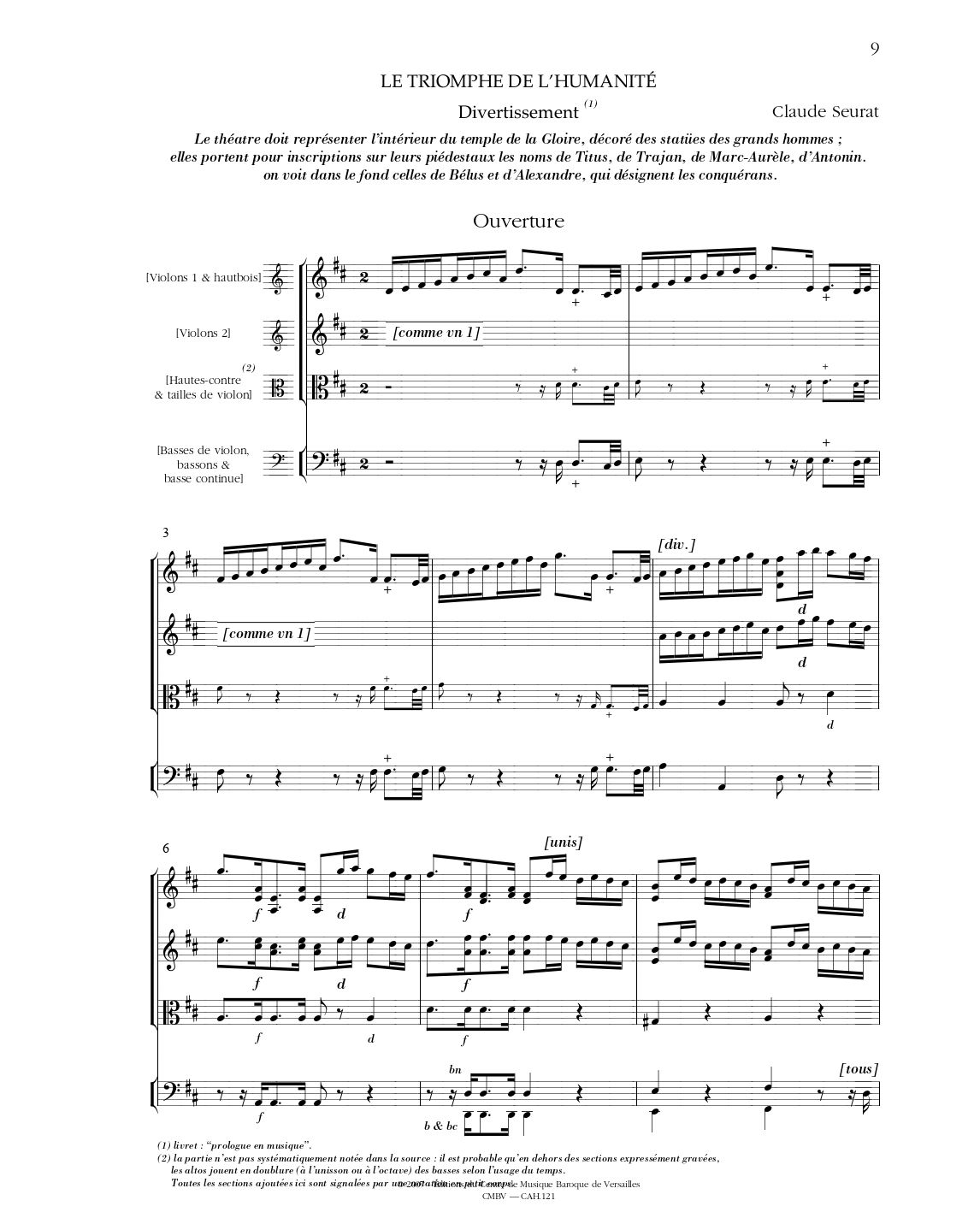
Scored for four soprano soloists (two of whom have the principal roles), the divertissement employs a four-part chorus (Dessus, hautes-contre, tailles and basses), with the top three parts occasionally divided. The orchestra, however, requires flutes, oboes, and bassoons, along with a four-part French string ensemble (dessus de violons I & II, hautes-contre, tailles and basses de violons), plus basso continuo. There is, however, a noticeable equivocation between French and Italian structural models – one might even interpret the use of the taille de violon as merely a temporary division of the viola section.
Overall, the work is closer in style to the baroque divertissements of composers such as Dauvergne, Mondonville, or Francœur than to the emerging symphonic forms of Gossec or Blainville.
The work was commissioned for the inauguration of the statue of Louis XV in Nancy in 1755. It served as a prologue to a play, Les Originaux – later retitled Le Cercle – whose author, a poet from the city, was the librettist. That day marked a major turning point in the career of Charles Palissot de Montenoy, for although once a friend of the philosophers, he would soon become one of their fiercest opponents.
The work features Glory and Minerva in a dialogue portraying Stanislas I and Louis XV as new gods or heroes who make humanity happier than their Greco-Roman predecessors. It is a piece written for a special occasion, yet it possesses both charm and contemporary resonance.
Scored for four soprano soloists (two of whom have the principal roles), the divertissement employs a four-part chorus (Dessus, hautes-contre, tailles and basses), with the top three parts occasionally divided. The orchestra, however, requires flutes, oboes, and bassoons, along with a four-part French string ensemble (dessus de violons I & II, hautes-contre, tailles and basses de violons), plus basso continuo. There is, however, a noticeable equivocation between French and Italian structural models – one might even interpret the use of the taille de violon as merely a temporary division of the viola section.
Overall, the work is closer in style to the baroque divertissements of composers such as Dauvergne, Mondonville, or Francœur than to the emerging symphonic forms of Gossec or Blainville.
Pages:
98
Publication date:
2007-07
Introduction (language):
French
ISMN 979-0-56016-121-1
The works
Text language:
Français
Genre:
divertissement
Key:
Ré Majeur
Duration:
plus de 50'


