

Sheet music
Messe à 4 parties
Pierre DESVIGNES
(1764-1827)


Reference: CAHIERS-91
Format:
21x29,7 cm
Binding: Paperback
16,40 € TTC
In stock
Pierre DESVIGNES
(1764-1827)
Editor(s):
Michel CUVELIER
Collection:
Choir
Type of publication:
Full score
Publisher:
Editions du Centre de musique baroque de Versailles
Presintation:
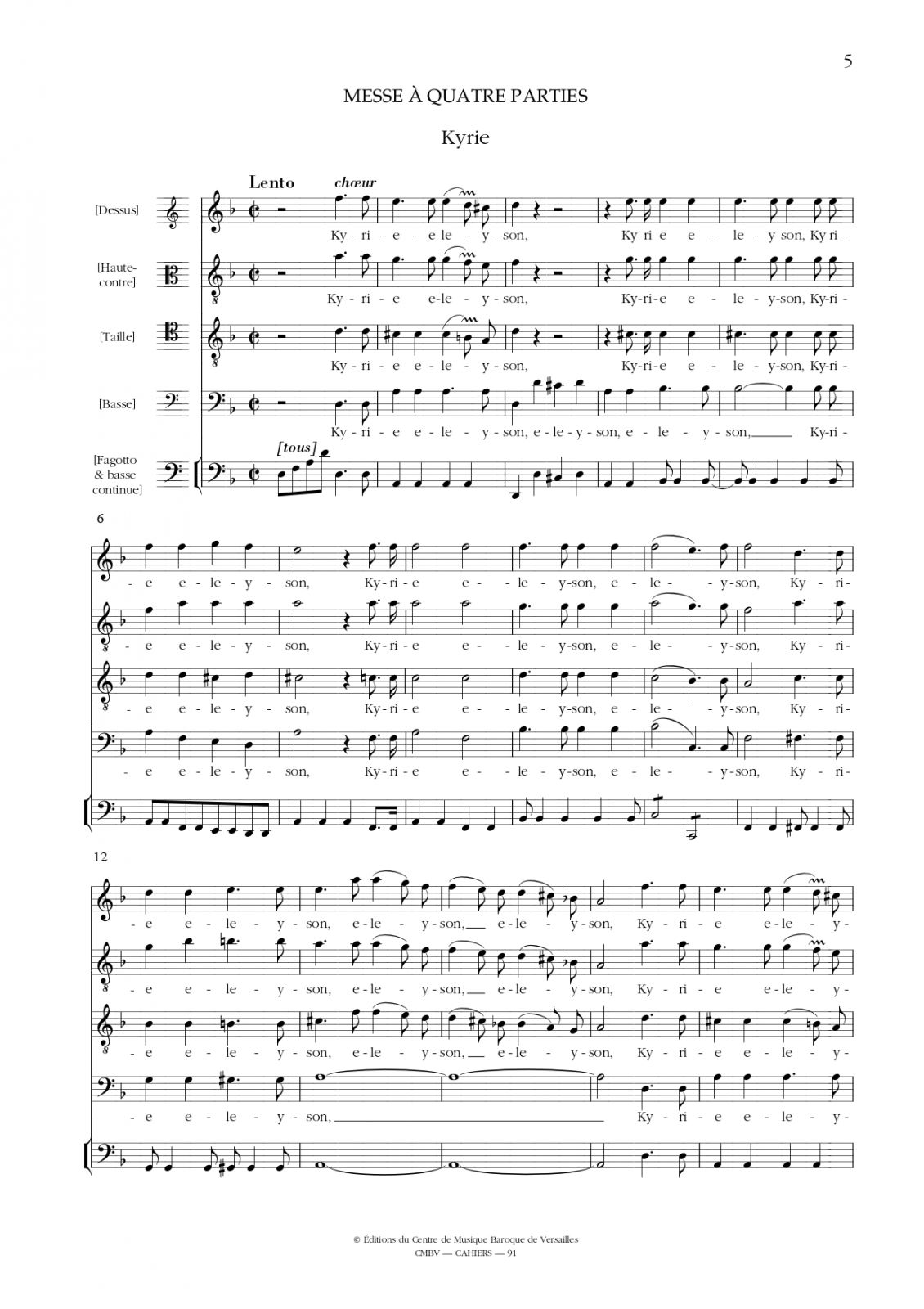
This is the work of a very young composer, Pierre Desvignes (1764–1827), who offered his first composition to the chapter in 1780, following his years of training with the choir of Dijon’s Cathédrale Saint-Étienne. The modest size of this mass (4 soloists – dessus, haute-contre, taille and basse; a 4-part choir – dessus divisé, haute-contre, taille and basse; concertante bassoon and basso continuo) calls for musicians of the highest calibre: the different registers are exploited throughout their range in solos, duos and trios; effects abound, between ornaments, forte-piano, pianissimo and fortissimo, rhythmic breaks and continuous modulations. The composer, with a rare sense for expressive phrasing, also proposes cuts when the tessitura is too extreme (high C for the sopranos). The work is truly astonishing, torn between the conservatism of the scoring and the modernity of the composition. Desvignes went on to enjoy a distinguished musical career: appointed professor at the newly-founded Paris Conservatoire de Musique in 1793, he became maître de chapelle at Notre-Dame de Paris during the Restoration and chef adjoint de la chapelle for Napoleon I; he also tried his hand at secular music, in particular opera.
Pages:
40
Publication date:
2005-03
Introduction (language):
French
ISMN 979-0-56016-091-7
The works
Text language:
Latin
Genre:
messe
Liturgical season:
Messe
Key:
ré mineur
Duration:
entre 20' et 29'
Organisation:
Difficile
General level:
Difficile
Commentary:
Cette messe, très fraîche d'inspiration, composée dans un style classique très pur, est la première œuvre connue d'un des plus grands maîtres de la musique religieuse du temps de Beethoven.
En l'absence de basson, on pourra opter pour un violoncelle ; pour la basse continue, on préférera l'orgue, bien que le clavecin convienne aussi. La fugue "allegro" sur Quoniam tu solus sanctus est du meilleur effet.
Counterpoint:
Moyen
Rhythm:
Moyen
Ranges:
Difficile
Recommendations


28€
Available in a digital version


27€
Available in a digital version

34€
Available in a digital version


