

Sheet music
Sacris solemniis (Expodcast#1)
Jean VEILLOT
(16..-1662)


Reference: CAHIERS-145
Format:
21x29,7 cm
Binding: Paperback
12,60 € TTC
In stock
Jean VEILLOT
(16..-1662)
Collection:
Choir and orchestra
Type of publication:
Full score
Publisher:
Editions du Centre de musique baroque de Versailles
Presintation:
Singer at the Chapelle royale, then master of music at Notre-Dame Cathedral in Paris, following in Henry Frémart’s footsteps, Jean Veillot was appointed Sous-maître de la Chapelle royale in 1643. He was also Maître de musique to the Benedictine nuns of Montmartre, succeeding Antoine Boesset.
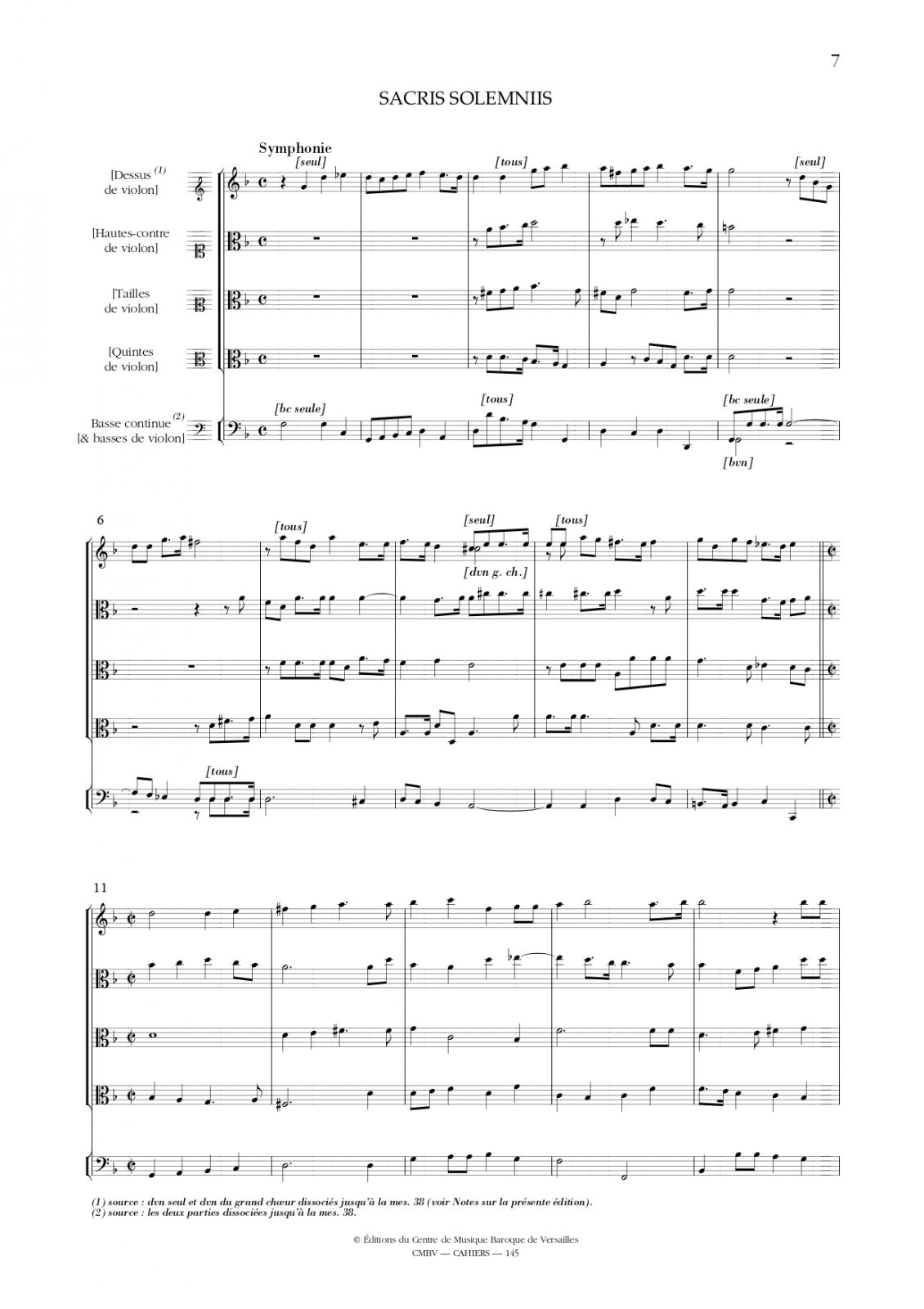
The motet Sacris solemniis, the most imposing and innovative of the composer’s surviving works, is one of the earliest known motets to feature a 5-part orchestra. In terms of stylistic evolution, it falls between the two-choir works by Nicolas Formé (published by the CMBV), written for the chapel of Louis XIII, and the great motets by Henry Du Mont (published by the CMBV) and Pierre Robert, composed during the reign of Louis XIV.
The imposing forces of the work, which brings together a "petit chœur" (dessus, bas dessus, haute-contre, taille, basse-taille and basse), a large 5-part choir (dessus, hautes-contre, tailles, basses-taille and basses) and the 5-part orchestra "à la française" (dessus de violon, including a solo, hautes-contre de violon, tailles de violon, quintes de violon, basses de violon and basso continuo) clearly testifies to the bringing together of the great musical institutions of the court for a special occasion (perhaps the Treaty of the Pyrenees, 1659).
The motet Sacris solemniis, the most imposing and innovative of the composer’s surviving works, is one of the earliest known motets to feature a 5-part orchestra. In terms of stylistic evolution, it falls between the two-choir works by Nicolas Formé (published by the CMBV), written for the chapel of Louis XIII, and the great motets by Henry Du Mont (published by the CMBV) and Pierre Robert, composed during the reign of Louis XIV.
The imposing forces of the work, which brings together a "petit chœur" (dessus, bas dessus, haute-contre, taille, basse-taille and basse), a large 5-part choir (dessus, hautes-contre, tailles, basses-taille and basses) and the 5-part orchestra "à la française" (dessus de violon, including a solo, hautes-contre de violon, tailles de violon, quintes de violon, basses de violon and basso continuo) clearly testifies to the bringing together of the great musical institutions of the court for a special occasion (perhaps the Treaty of the Pyrenees, 1659).
Pages:
27
Publication date:
2005-09
Introduction (language):
French
ISMN 979-0-56016-145-7
The works
Text language:
Latin
Genre:
motet
Liturgical season:
Saint Sacrement
Key:
sol mineur
Duration:
moins de 10'
Recommendations


27€
Available in a digital version


34€
Available in a digital version


