

Sheet music
Confitebor tibi Domine
André CAMPRA
(1660-1744)


Reference: CAHIERS-214
Format:
22,5x31 cm
Binding: Paperback
19,30 € TTC
In stock
André CAMPRA
(1660-1744)
Editor(s):
Louis CASTELAIN
Collection:
Choir and orchestra
Type of publication:
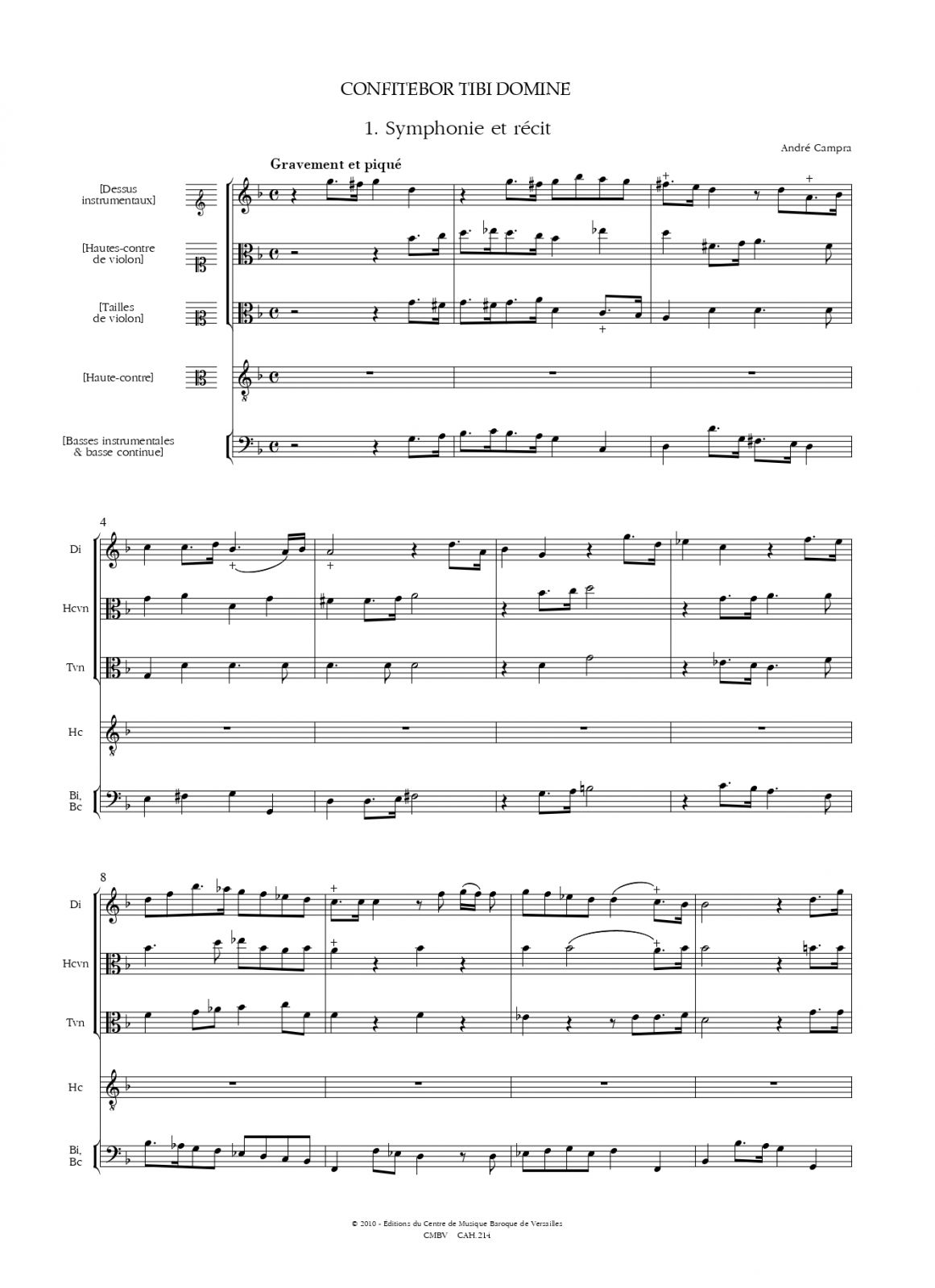
Full score
Publisher:
Editions du Centre de musique baroque de Versailles
This reference includes:
1 ex. Conducteur
Presintation:
Born in 1660, André Campra studied music with Guillaume Poitevin, maître de chapelle at the Saint-Sauveur choir school at the cathedral of Aix-en-Provence, where he trained several renowned musicians (including Jean Gilles). After leaving Aix-en-Provence, Campra, whose life seems to have been eventful, obtained several appointments in the south of France. In 1694, he moved to Paris and was appointed Master of Notre-Dame Cathedral. He resigned in 1700 to devote himself freely to an equally exceptional operatic career, which led him to become director of the Académie royale de musique in 1730. In 1723, Philippe d’Orléans entrusted him with one of the quarters of the Chapelle royale, replacing Lalande. Campra composed or reworked most of the great motets that have come down to us. He died in 1744.
Confitebor tibi Domine is a large motet in G minor, based on Psalm 110, a text of praise. The autograph manuscript of the work is probably a version reworked for the Chapelle Royale in Versailles after 1722, and the reference to 1706 may refer to an earlier version that is now unknown.
Campra distinguishes himself by the use of specific instrumentation, as in No. 4 "Memoriam fecit", where the recitative from above is subtly accompanied by 2 flutes and either the violins (which play the bass) or the basso continuo; or in No. 7 "Redemptionem misit populo suo", where a trio of instrumental tops composed of 2 flutes and an oboe punctuate the vocal duo haute-contre/aille.
The performance of this work features 4 solo singers (dessus, haute-contre, taille and basse-taille), a 5-part "à la française" choir (divided dessus, hautes-contre, tailles, basses-tailles and basses) and a 4-part "à la française" string orchestra (dessus, hautes-contre, tailles and basses de violon) with woodwinds and basso continuo.
Confitebor tibi Domine is a large motet in G minor, based on Psalm 110, a text of praise. The autograph manuscript of the work is probably a version reworked for the Chapelle Royale in Versailles after 1722, and the reference to 1706 may refer to an earlier version that is now unknown.
Campra distinguishes himself by the use of specific instrumentation, as in No. 4 "Memoriam fecit", where the recitative from above is subtly accompanied by 2 flutes and either the violins (which play the bass) or the basso continuo; or in No. 7 "Redemptionem misit populo suo", where a trio of instrumental tops composed of 2 flutes and an oboe punctuate the vocal duo haute-contre/aille.
The performance of this work features 4 solo singers (dessus, haute-contre, taille and basse-taille), a 5-part "à la française" choir (divided dessus, hautes-contre, tailles, basses-tailles and basses) and a 4-part "à la française" string orchestra (dessus, hautes-contre, tailles and basses de violon) with woodwinds and basso continuo.
Pages:
51
Publication date:
2010-04
Introduction (language):
French
ISMN 979-0-56016-214-0
The works
Text language:
Latin
Genre:
motet
Liturgical season:
Psaume 110
Key:
sol mineur
Duration:
entre 20' et 29'
Recommendations


22€
Available in a digital version


