

Cum invocarem


Nicolas Bernier is one of the great French composers at the turn of the 17th and 18th centuries. Born in 1665 in Mantes-sur-Seine (today Mantes-la-Jolie), he was probably trained in the town’s collegiate church and at Evreux Cathedral. He also probably travelled to Rome to study with Antonio Caldara. His presence in Paris is attested as early as 1692, where he worked as harpsichord master. His first official post was at Chartres Cathedral in 1694, which he left 4 years later for Saint-Germain-l’Auxerrois in Paris, opposite the Château du Louvre. In 1704, he resigned to succeed Marc-Antoine Charpentier at the Sainte-Chapelle in Paris. He also frequented the circle of Abbé Mathieu, the parish priest of Saint-André-des-Arts, who brought together ultramontane parishioners; that of Philippe d’Orléans, the future regent and patron of the arts, for whom he was also music master; and that of the Duchesse du Maine, for whom he composed Les Nuits de Sceaux. In 1712, he married Marie Catherine Marais, daughter of composer Marin Marais. Finally, at the age of 58, he was appointed sous-maître de la Chapelle Royale de Versailles, alongside Lalande, Gervais and Campra. Throughout his career, he enjoyed the protection of numerous personalities, whose graces he won through his talent. He died in Paris in July 1734 at the age of 69.
In Les Dons des Enfants de Latone, Jean Serré de Rieux describes this ardent defender of the Italian style as the apostle of "united tastes": "France admires in him the Italic science; / Rome reveres in him the ornament of France". He was also unanimously recognised for his writing skills, particularly fugue. His petits motets were performed both in Saint-Cyr and in Nouvelle-France (French North-American territories). He was also an excellent teacher, and wrote a remarkable treatise on composition.
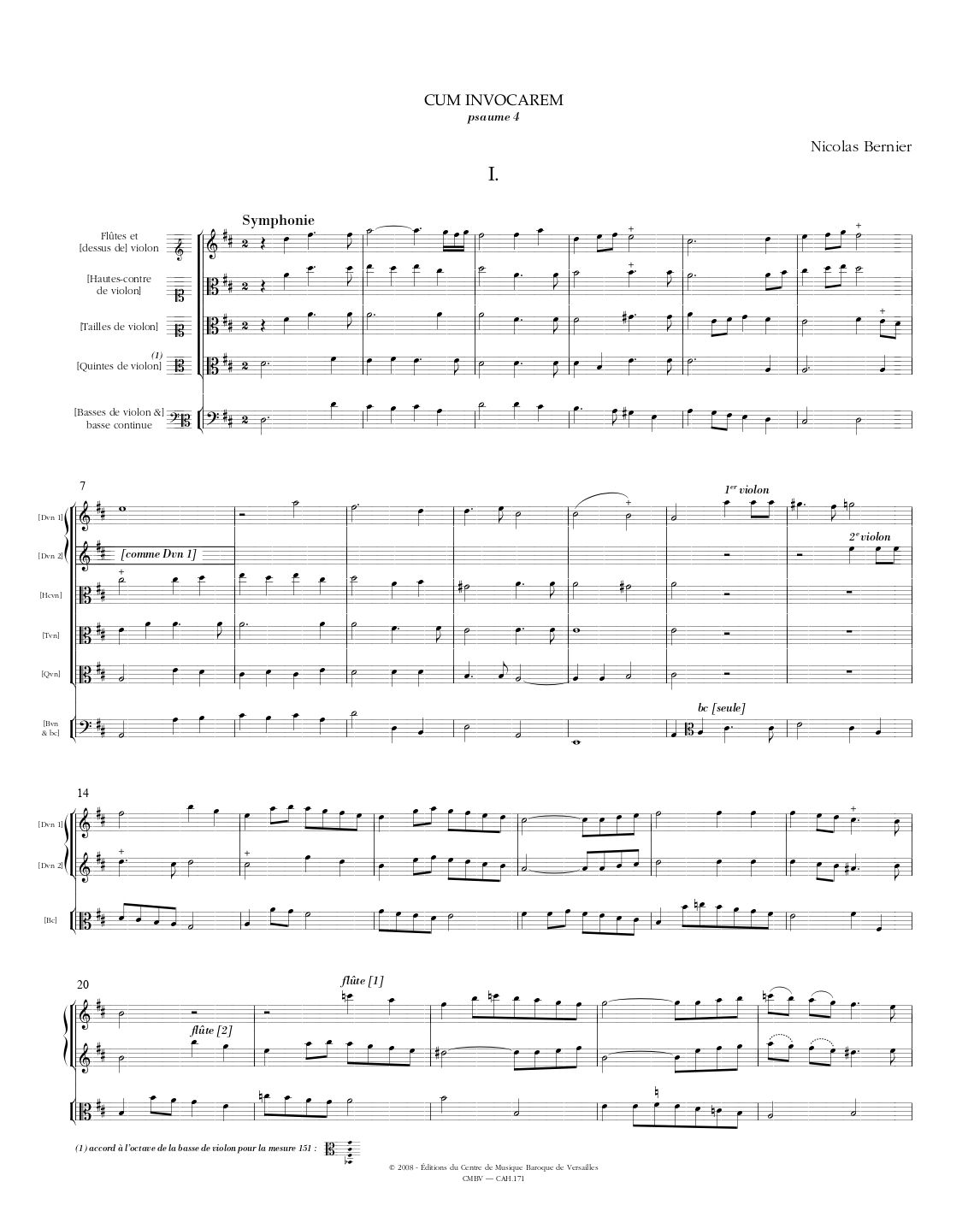
Nicolas Bernier’s grand motet Cum invocarem is one of the few to have survived in its entirety, including the orchestral middle parts (hautes-contre, tailles and quintes de violon). It comes from the collection of the Académie des Beaux-Arts de Lyon, a large part of which is now held by the city’s municipal library. It requires a typically French five-part ensemble, with 6 soloists or petit chœur, the 5-part choir and the orchestra, like the contemporary Lauda Jerusalem by Henry Desmarest.
The works
Recommendations


