

Le Métier du maître de musique d’Église (XVIIe-XVIIIe siècles)
Activités, sociologie, carrières
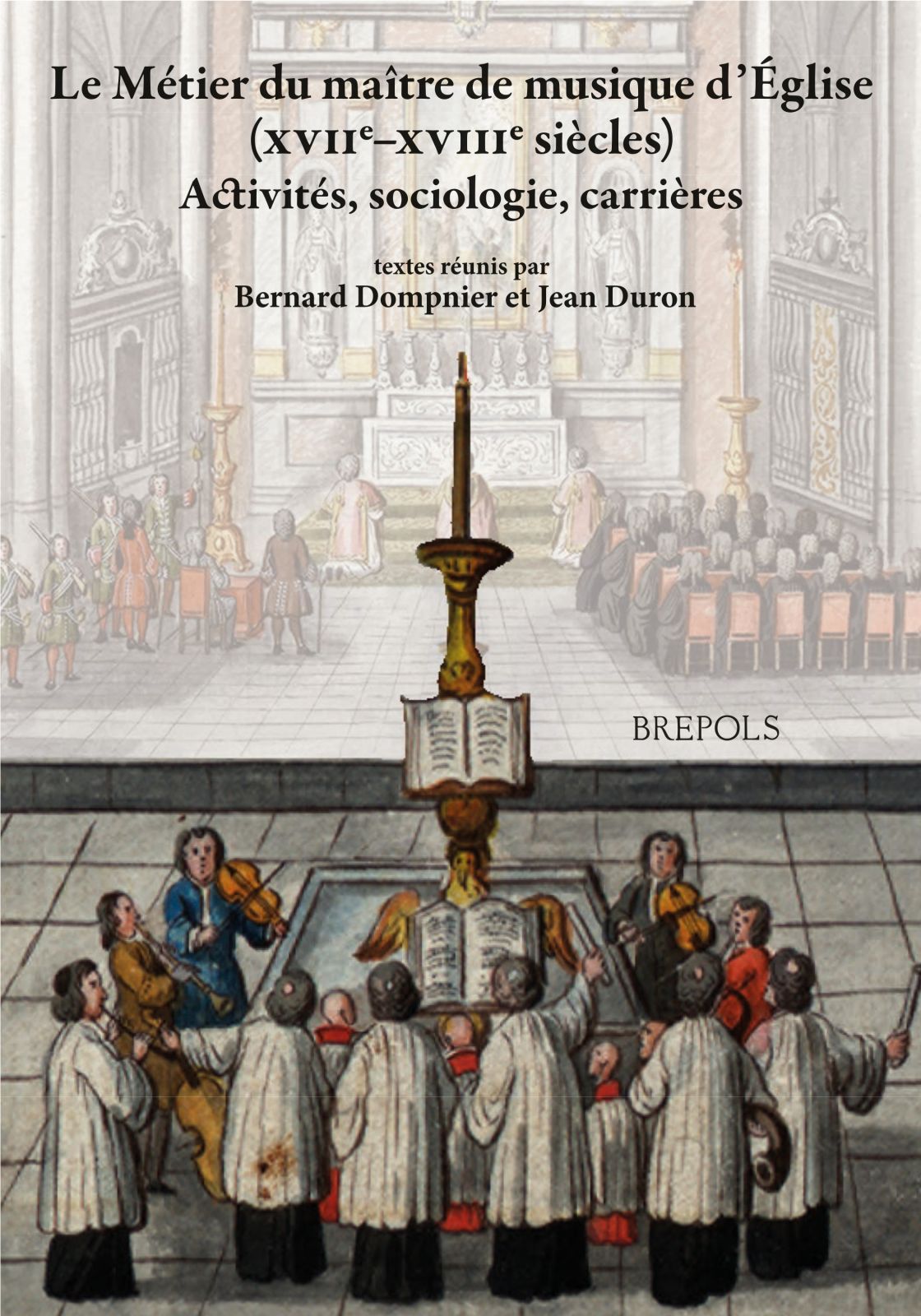
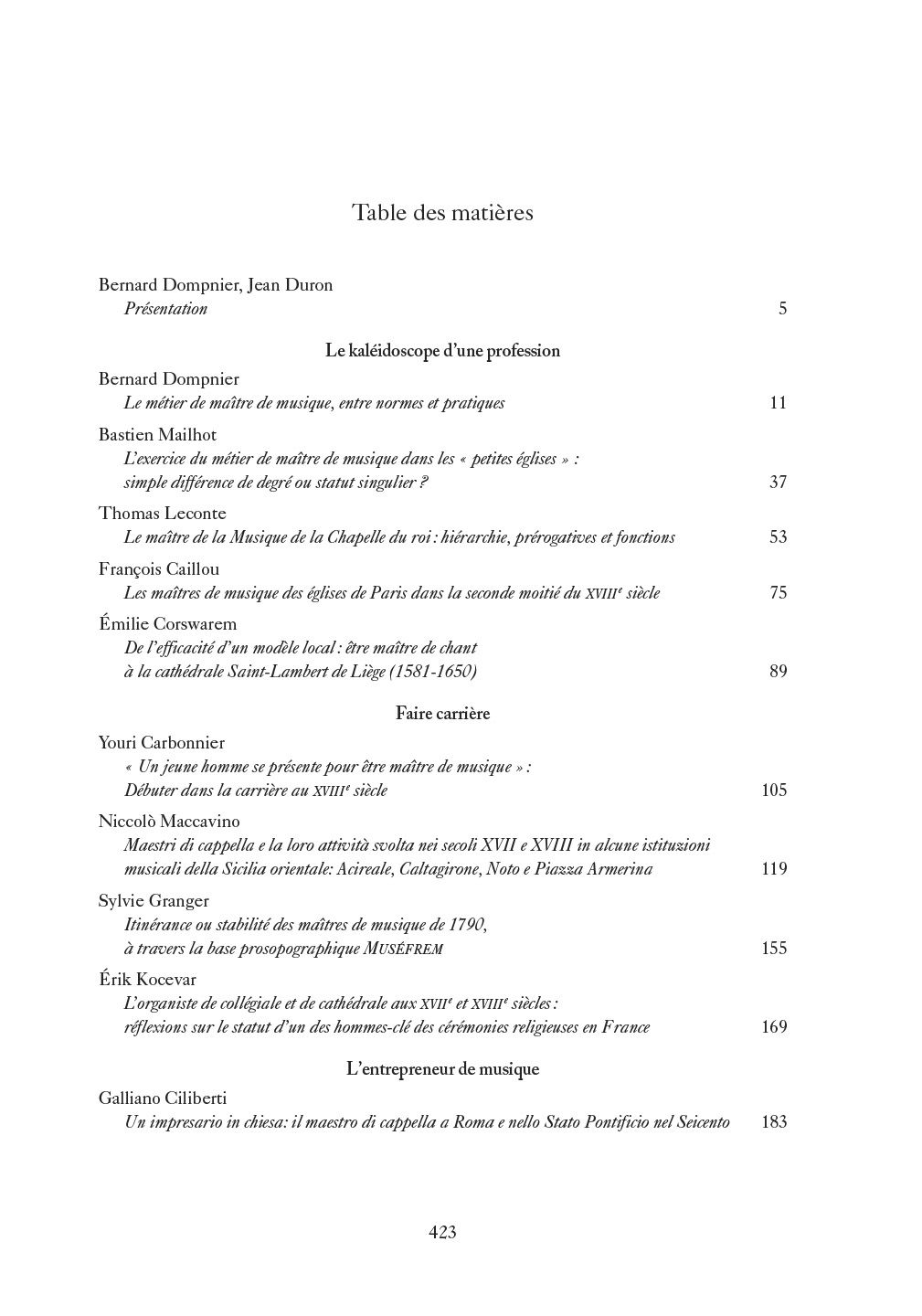
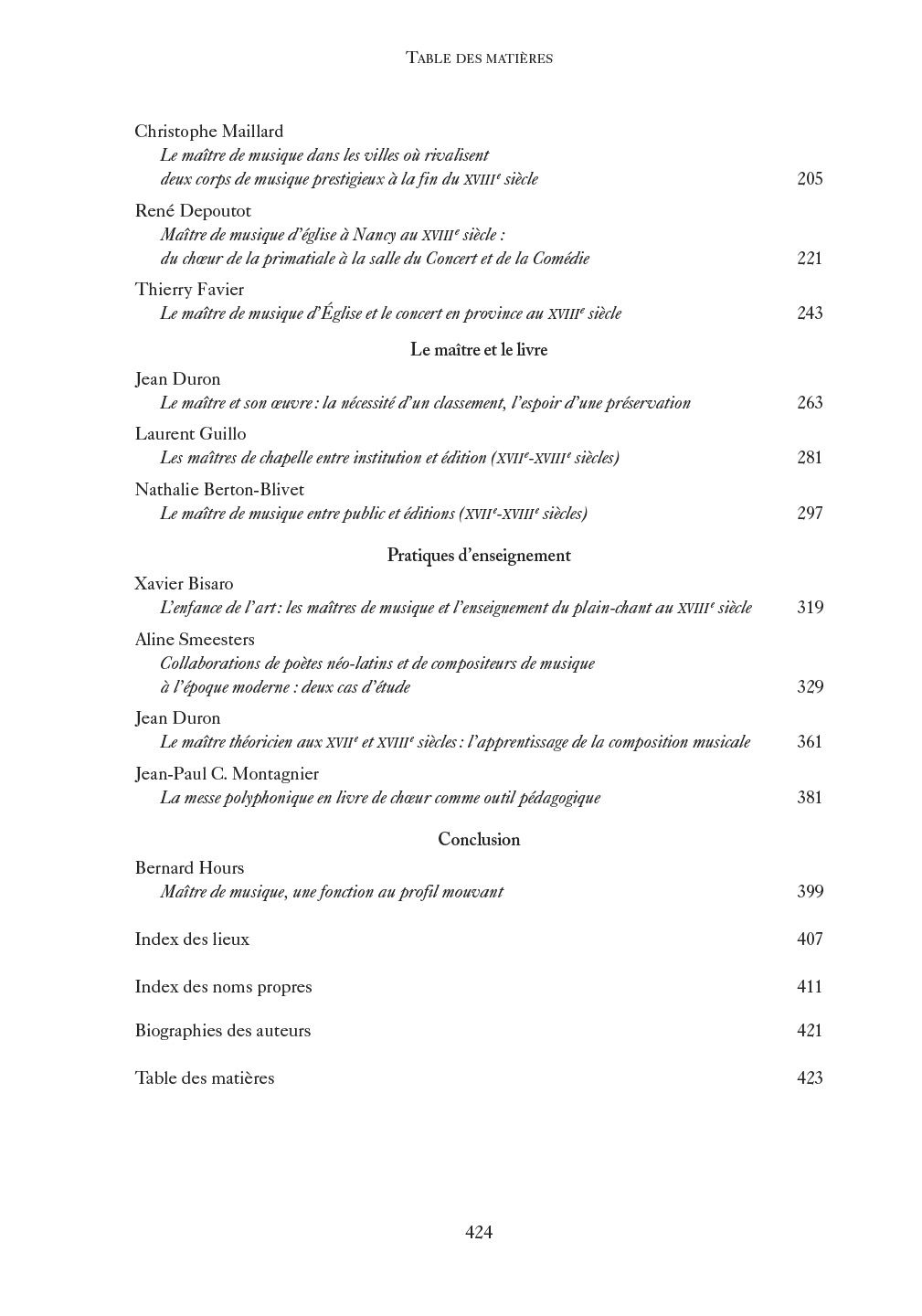


This book proposes, in an original way, a study of the complexity of the profession of music master, which is at the heart of this community of "artisans" of church music, while taking into account the diversity of geographical, historical, and institutional situations, personalities, and career plans. It draws parallels between the conditions of practice of this profession in France, Italy, and the Spanish Netherlands. It addresses artistic subjects such as composition, its preservation
This book proposes, in an original way, to study the complexity of the profession of music master (“maître de musique”), which is at the heart of this community of "artisans" of church music, at the same time taking into account the diversity of geographical, historical, and institutional situations, personalities and career plans. It draws parallels between how this profession was practised in France, Italy and the Spanish Netherlands. It addresses artistic subjects such as composition, its preservation through manuscripts or publication, teaching methods, theory, and the performance of music. Finally, it attempts to analyse the professional relationships that the music master may have had with the Chantres of the “bas chœur”, the choirboys under his care, guest musicians, the chapter, secular and religious institutions, and the organist.
From all this, extremely varied and often very colourful portraits emerge, which allow us better to understand the role of these musicians, the diversity of their practices, the place of the composer in the Ancien Régime, and, above all, open up new avenues for research.
Far from being a musical desert, France at this time was rich in music in its large and medium-sized cities. Ecclesiastical institutions, cathedrals, collegiate churches, even small churches, as well as the Chapelle royale, financed singers and instrumentalists, as well as choir schools, designed to train future musical artists under the direction of a music master. This book is dedicated to this figure, and his various functions.
Combining the roles of teacher, theorist, composer, singer and/or instrumentalist, he was responsible for everything related to the proper performance of music during services, conducting the children’s choir, “bas chœur” singers, and instrumentalists (those from the church, the town, or those visiting). He participated in writing books of plainsong, composed and copied polyphonic masses and motets, and reported to the chapter to which he belongs. Some masters were called upon outside the institution for concerts of sacred or secular music, sometimes even in theatres, more often in nearby religious establishments.
The diversity of careers is astonishing, with some masters remaining their entire lives in the same institution, such as Poitevin. Others, like Gantez, opted for a more nomadic existence, though they rarely adventured beyond the borders; others, like Campra, preferred the lights of the opera stage to the lectern; finally, some sought to leave a trace of their work by publishing masses and motets. However, the specific Frenchness of this profession can only be understood by comparing it with the practice of neighbouring countries, such as Italy or the Spanish Netherlands.
Despite the large amount of scholarly work which has allowed us to identify numerous music masters officiating in French churches during the Ancien Régime, and despite a rich but underexploited body of documentation, we know little about the reality of the profession of these church musicians.
For the most part, no musical works nor traces of their teaching have been preserved; for others, documents exist but still await in-depth analysis. The profession of music master remains difficult to define, due to the diversity of situations that strongly influenced his role and function, whether from a geographical perspective, the size and wealth of the city, the presence in the city of other religious or secular institutions employing musicians, the financial resources devoted to music, the status of the institution, the eras, or the positions he occupied. The functions were fundamentally different, depending on whether the institution had a children’s choir or whether the upper voices were performed by adult castrati, whether it could hire instrumentalists or not. The same applies to the type of music performed during services.
The status of these music masters also varied significantly depending on whether they were priests or lay people, dependent on the chapter, the city, or the court. Their relationships with the “bas chœur” singers or the body of canons also remain difficult to grasp, as do the relationships they may have had with the organist. We scarcely know more about the content of the teaching they provided the children with.
To understand the diverse forms this profession took, the first part of the book presents various situations while avoiding the monotony of a monograph: small churches, Paris, the Court, but also, outside the kingdom, the special case of Nancy and the court of Leopold, that of Liège, and further afield, eastern Sicily or Rome. Then the following are successively addressed: in the second part, how to make a career; in the third part, "entrepreneurship" where the master becomes a recruiter both for the church and also for secular institutions. The fourth part discusses his relationship with the world of publishing; the fifth part, how he taught.
This multidisciplinary work (history of ecclesiastical institutions, musicology, history of pedagogy, musical creation, and the study of the relationship between neo-Latin poets and musicians) follows on from the numerous projects directed by Bernard Dompnier at the CHEC in Clermont-Ferrand, which contributed to the establishment of the archival investigation published on the website Muséfrem.
Bernard Dompnier, Professor Emeritus at the University of Clermont Auvergne (CHEC), specialises in the history of Catholicism in the modern era.
Jean Duron, founder and director (1989-2007) of the Atelier of studies on French music of the 17th & 18th centuries at the CMBV, is a specialist in music from the time of Louis XIV.
Recommandations


