

L'oeuvre profane (Expodcast#2)


This imposing volume follows on from Georgie Durosoir’s critical edition of Pierre Guédron’s Airs de cour, published in 2009, and is part of the Monumentales collection dedicated to Étienne Moulinié, the youngest, after Guédron and Boesset, of the brilliant triad that dominated the French air de cour genre in the first half of the 17th century.
Étienne Moulinié was born on 10 October 1599 in Laure-Minervois, Languedoc. He studied with his brother Antoine, who went on to become a renowned singer at the court of Louis XIII, at the choir school of Narbonne’s Saint-Just cathedral. He moved to Paris in the 1620s, where he published his first airs de cour. Gaston d'Orléans, brother of Louis XIII, appointed him head of his musical establishment in 1627, a post he held until his employer’s death in 1660. He returned to his native region after this date, where he held the position of Maître de la Musique des États du Langedoc. He died in 1676.
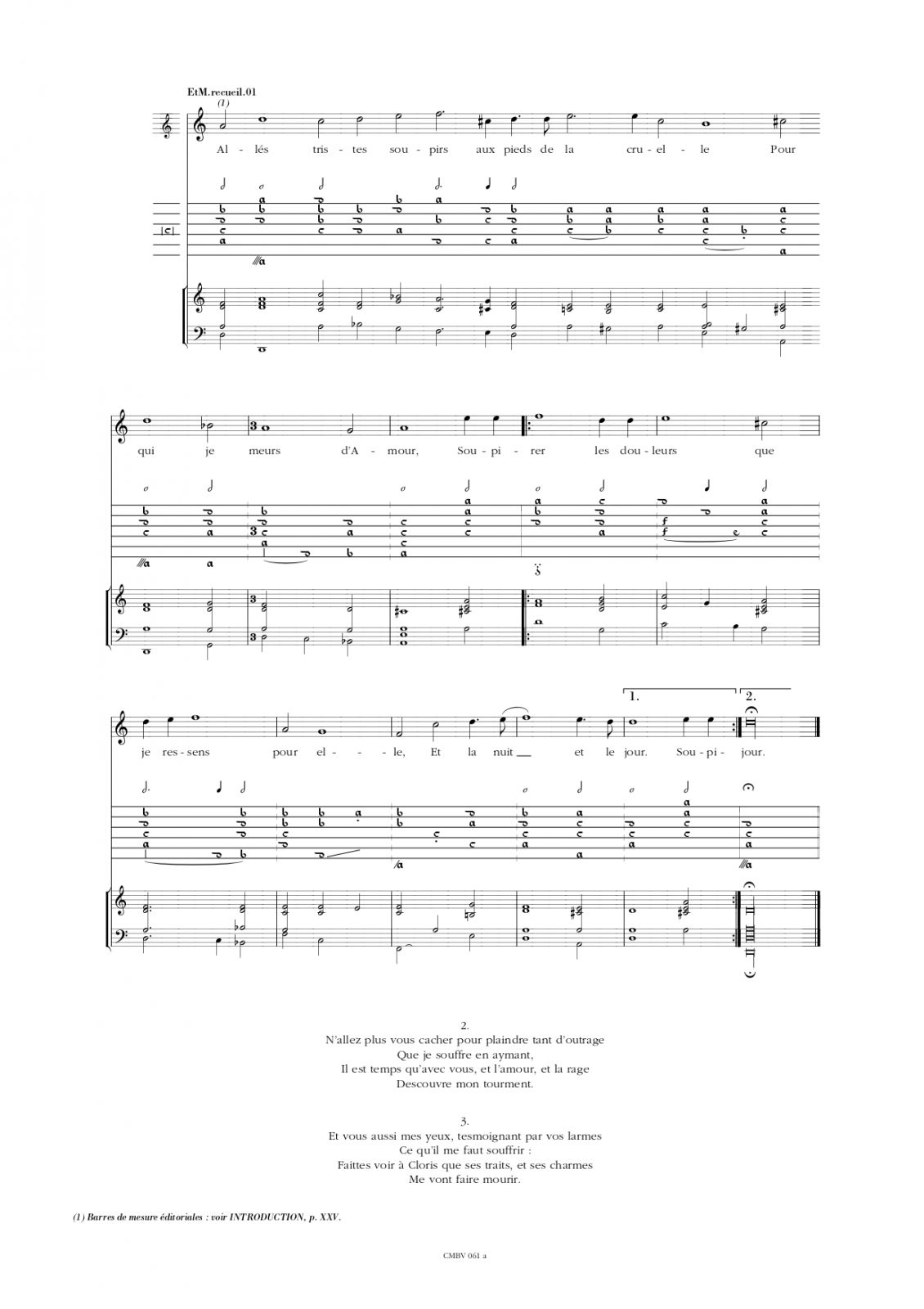
From his first known aria, published in 1623 in the famous collection of Airs de cour et de différents auteurs by the printer Ballard (Étienne Moulinié was only 24 at the time and had only been in Paris for 2 years), to his last collection in 1668, no fewer than 195 secular vocal pieces have come down to us: airs de cour, airs à boire, récits, airs de ballets, dialogues, "exotic" airs in Spanish, Italian and even Gascon, and airs spirituels. Singers and lutenists will find this collection incredibly rich and varied. Those already familiar with the repertoire will find the latest discoveries: newly identified arias, manuscript ornamented versions (doubles), concordant sources, as well as the restitution of a significant proportion of the polyphonic airs. In addition to all the identified pieces, the volume also presents all the poems whose music could not be found, as well as the 3 Fantaisies à quatre for viols, the only example of the composer’s instrumental music. In a rich bilingual (French-English) preface, the scholarly editor presents the composer, the entire secular corpus and its evolution. Each piece, preceded by a descriptive note providing essential bibliographical and contextual information, is presented in its most significant versions – polyphonic versions and/or monodic vocal lines with lute tablature (and transcription of it) – and is accompanied, where appropriate, by the most important variants. All the works in this collection are also available for performance in separate booklets.
Author of a doctoral thesis (Tours, 1991) on the formation of tonal language in France in the first half of the 17th century, exemplified by the works of Étienne Moulinié, Annie Cœurdevey then joined the research team at the Centre d'Études Supérieures de la Renaissance de Tours (CESR), where she developed the online database on the Chanson française (c. 1480-1600), available on the CESR website, and actively contributes to the implementation of numerous musicological editions.
Poésies sans sources musicales :
Ah faut-il endurer les fureurs d'un jaloux
Amants qui faites les discrets
Astre naissant qui fait notre espérance
Au bruit de vos appas les mortels et les dieux
Au moment que vos yeux
Badinons jouons-nous Sylvie
Charmante Iris qu'il est aisé de voir
Cloris c'est trop me découvrir
Cruels gouverneurs de mon sort
Dans ce bienheureux séjour d'allégresse
Divins objets dont mon âme est ravie
Hélas bouteille misérable
Hélas elle s'en va je ne la verrai plus
Hélas je languis je me meurs
Iris naissante
L'amant géant sur la rive écartée
Ma maîtresse est belle
Ne vous offensez pas Climène
Ne vous plaingnez plus roi des Cieux
Objet qui causez mes désirs
Philis ne vous étonnez pas
Pleurez mes yeux
Reine dont les charmes divers
Sautons dansons foulons l'herbe
Un malheureux amant accablé de douleur
Vous qui voulez servir les belles
Les œuvres
Du Ciel les portes sont ouvertes Airs pour voix et luth du 1er livre d'Airs avec la tablature (1624)
Si parmi les déserts au fort de mes atteintes Airs pour voix et luth et à 4 et 5 parties (1624-1625)
Puisque Cloris pour qui je meurs Amarillis, Cloris, Philis : airs pour voix et luth ou polyphoniques
Celle qui tient ma douce liberté Amarillis, Cloris, Philis : airs pour voix et luth ou polyphoniques
Mon doux Jésus me faut-il croire Amarillis, Cloris, Philis : airs pour voix et luth ou polyphoniques
Soleils astres puissants dont j'ai choisi la flamme Récits et dialogues pour voix et luth ou guitare
Por la verde orilla del claro tormes Airs espagnols, pour voix seule(s) ou avec guitare (1626, 1629)
Recommandations


