

Partition
Les Symphonies imprimées
Henri-Joseph RIGEL
(1741-1799)


Référence : CMBV_052
Format :
23,5x31,5 cm
Reliure : Relié
125,00 € TTC
En stock
Henri-Joseph RIGEL
(1741-1799)
Editeur(s) :
Hervé AUDÉON
Collection :
Anthologies
Musique instrumentale
Type d’édition :
Édition critique
Maison d'édition :
Editions du Centre de musique baroque de Versailles
Présentation :
In the 1760s–1770s, a new wind was blowing across musical Europe: Paris, the undisputed artistic capital, saw the birth of its first large orchestras, whose virtuosity required new scores; the classical symphony was revolutionising instrumental music. Henri-Joseph Rigel, a talented composer and one of the leading figures of this European movement, published 14 symphonies. Hervé Audéon has edited them in a critical volume published by Editions du Centre de Musique Baroque de Versailles.
Born in Wertheim on the Main in 1741, Henri-Joseph Rigel received his musical education from his father, Niccolò Jommelli and Franz-Xaver Richter. Sent to Paris in 1767 to teach music to a child, the composer settled there permanently. Programmed at the Concert Spirituel and Concert des Amateurs, his oratorios, symphonies, harpsichord pieces, concertos and all his chamber music were widely performed – for example, a theme from one of his symphonies is found in the Andantino of Mozart’s Fantasia for piano in C minor, K 475. Also an editor and teacher, he was esteemed, sought after and recommended by the greatest. He died in 1799.
Alongside Gossec, Rigel was one of the most talented representatives of the French symphonic style. His music is unanimously recognised for its expressive sobriety, its formal conciseness, its balance between harmonic effect and the purity of an expansive melodic line with finely honed phrasing. This music richly deserves the attention of orchestras accustomed to the repertoire of Haydn and Mozart.
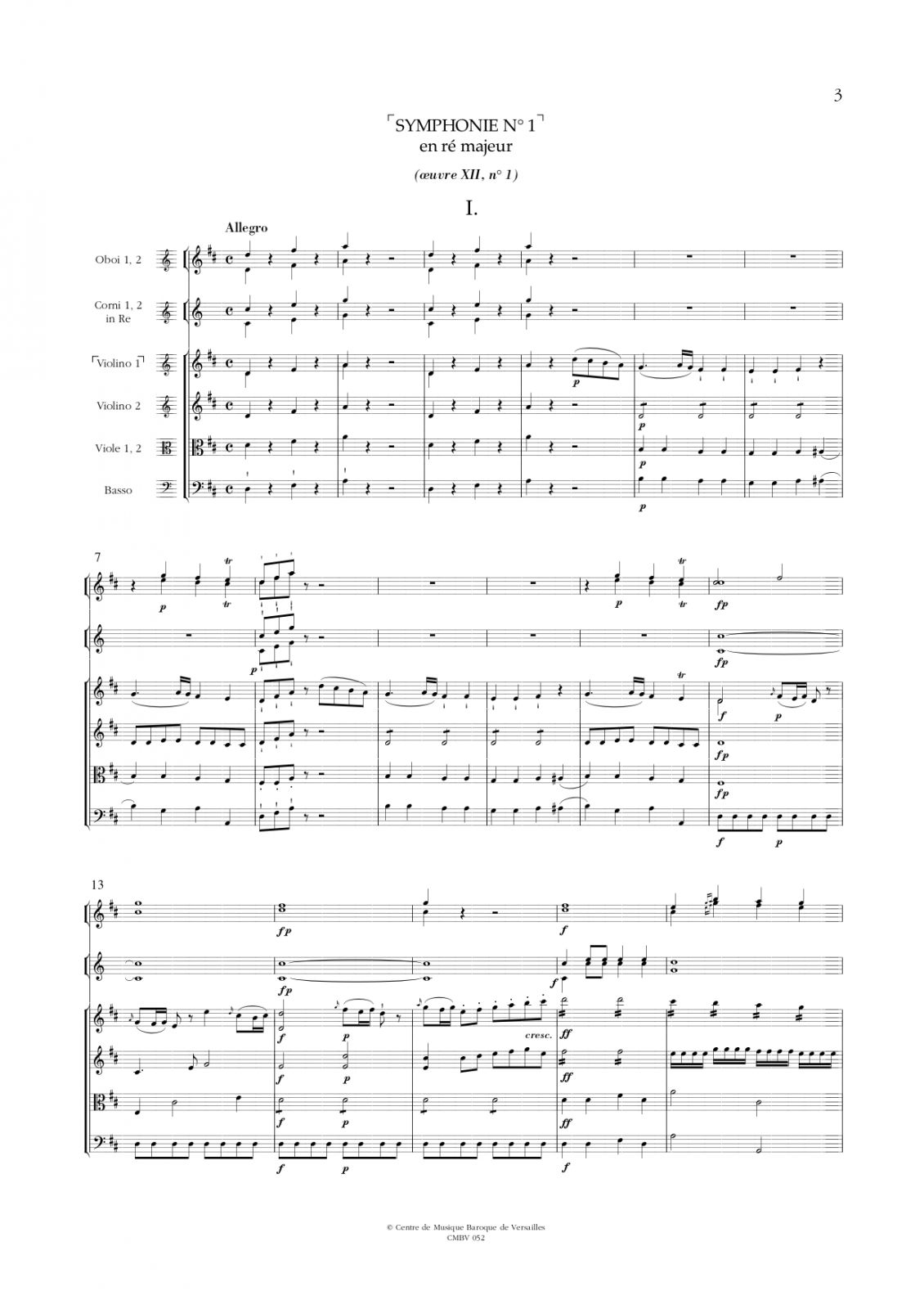
In his preface, Hervé Audéon describes the context of the nascent symphony in France in the light of numerous references. He also provides a detailed analysis of the delicate issues raised by late 18th-century editions and manuscripts, which is particularly useful in preparing a performance. Drawing on nearly fifteen sources preserved in France, Germany, Switzerland and Belgium, he rehabilitates these magnificent works with rigour and passion, making us forget the very free arrangements published in the 1930s.
This critical edition includes the 14 symphonies for orchestra published in Paris during the composer’s lifetime, a preface in French and English illustrated with 7 facsimiles, and critical apparatus. For each symphony, the separate parts required for performance are available for hire.
After studying music and musicology at the CNRS (doctoral thesis on Le Concerto pour piano à Paris entre 1795 et 1815), Hervé Audéon worked at the CMBV (1994–2006), then at the IRPMF. His work mainly concerns instrumental music in France in the 18th and 19th centuries (the piano and the orchestra, the study of their repertoires and related musical practices). He is currently preparing critical editions of the piano concertos by H. Jadin and L.-J.-F. Herold, as well as unpublished manuscripts by A. Reicha.
Born in Wertheim on the Main in 1741, Henri-Joseph Rigel received his musical education from his father, Niccolò Jommelli and Franz-Xaver Richter. Sent to Paris in 1767 to teach music to a child, the composer settled there permanently. Programmed at the Concert Spirituel and Concert des Amateurs, his oratorios, symphonies, harpsichord pieces, concertos and all his chamber music were widely performed – for example, a theme from one of his symphonies is found in the Andantino of Mozart’s Fantasia for piano in C minor, K 475. Also an editor and teacher, he was esteemed, sought after and recommended by the greatest. He died in 1799.
Alongside Gossec, Rigel was one of the most talented representatives of the French symphonic style. His music is unanimously recognised for its expressive sobriety, its formal conciseness, its balance between harmonic effect and the purity of an expansive melodic line with finely honed phrasing. This music richly deserves the attention of orchestras accustomed to the repertoire of Haydn and Mozart.
In his preface, Hervé Audéon describes the context of the nascent symphony in France in the light of numerous references. He also provides a detailed analysis of the delicate issues raised by late 18th-century editions and manuscripts, which is particularly useful in preparing a performance. Drawing on nearly fifteen sources preserved in France, Germany, Switzerland and Belgium, he rehabilitates these magnificent works with rigour and passion, making us forget the very free arrangements published in the 1930s.
This critical edition includes the 14 symphonies for orchestra published in Paris during the composer’s lifetime, a preface in French and English illustrated with 7 facsimiles, and critical apparatus. For each symphony, the separate parts required for performance are available for hire.
After studying music and musicology at the CNRS (doctoral thesis on Le Concerto pour piano à Paris entre 1795 et 1815), Hervé Audéon worked at the CMBV (1994–2006), then at the IRPMF. His work mainly concerns instrumental music in France in the 18th and 19th centuries (the piano and the orchestra, the study of their repertoires and related musical practices). He is currently preparing critical editions of the piano concertos by H. Jadin and L.-J.-F. Herold, as well as unpublished manuscripts by A. Reicha.
Pagination :
LXXV-318
Date de parution :
2009-06
Illustrations, fac similés (nbre) :
7
Introduction (langue) :
Français/Anglais
ISMN 979-0-707034-52-1
Les œuvres
Genre :
symphonie
Ton :
Ré Majeur
Durée :
entre 10' et 19'
Genre :
symphonie
Ton :
Sol Majeur
Durée :
entre 20' et 29'
Genre :
symphonie
Ton :
Do Majeur
Durée :
entre 20' et 29'
Genre :
symphonie
Ton :
do mineur
Durée :
entre 20' et 29'
Genre :
symphonie
Ton :
Mi bémol Majeur
Durée :
entre 10' et 19'
Genre :
symphonie
Ton :
Ré Majeur
Durée :
entre 20' et 29'
Genre :
symphonie
Ton :
sol mineur
Durée :
entre 20' et 29'
Genre :
symphonie
Ton :
Ré Majeur
Durée :
entre 20' et 29'
Genre :
symphonie
Ton :
ré mineur
Durée :
entre 20' et 29'
Genre :
symphonie
Ton :
Sol Majeur
Durée :
entre 10' et 19'
Genre :
symphonie
Ton :
Si bémol Majeur
Durée :
entre 20' et 29'
Genre :
symphonie
Ton :
Do Majeur
Durée :
entre 10' et 19'
Genre :
symphonie
Ton :
Fa Majeur
Durée :
entre 10' et 19'
Recommandations


26€
Disponible en version numérique


34€
Disponible en version numérique


26€
Disponible en version numérique
