

Partition
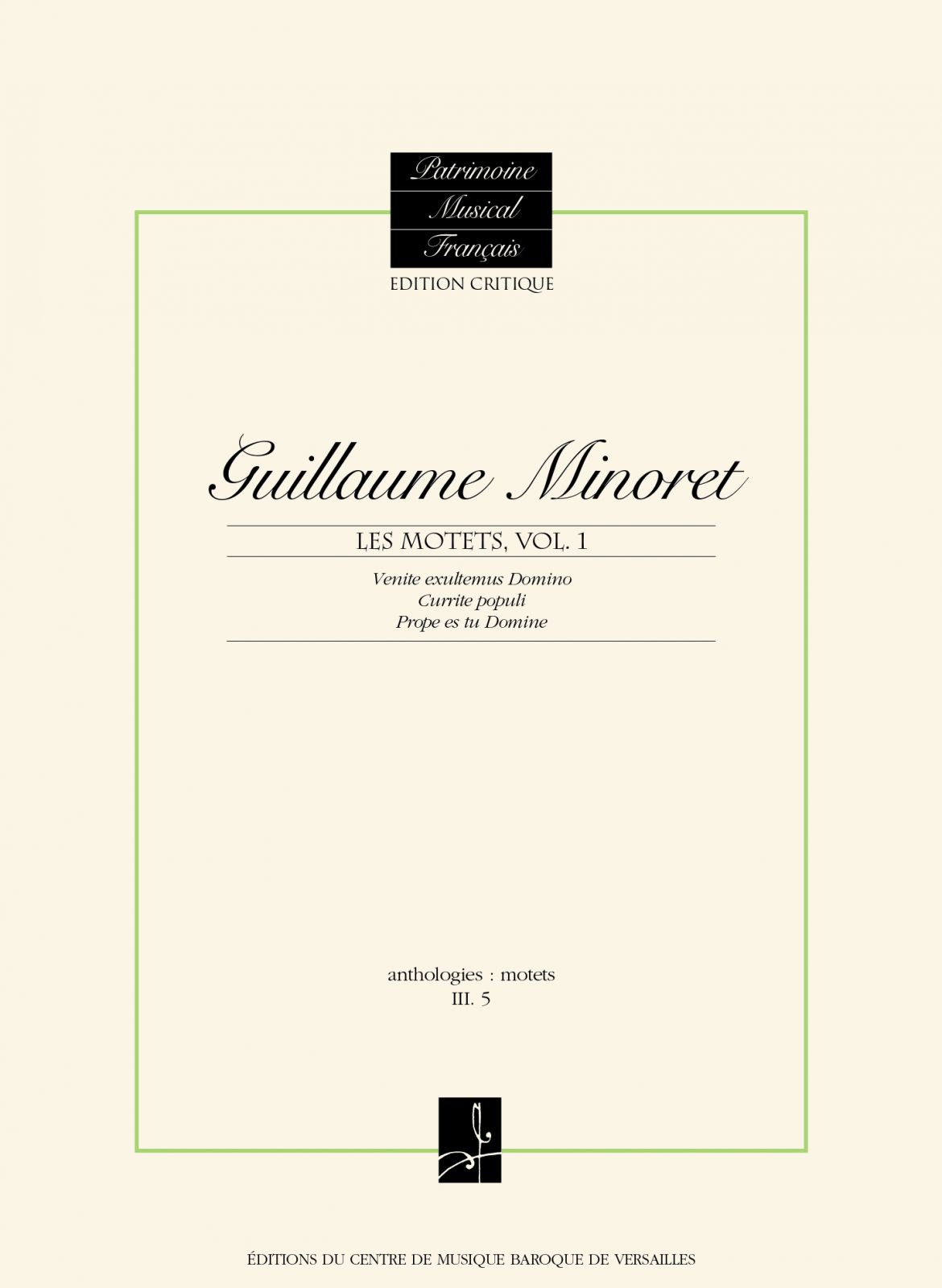
Les Motets, vol. 1 (Expodcast#1)
Guillaume MINORET
(av. 1650-1720)


Référence : CMBV_051
Format :
24,5x33,5 cm
Reliure : Broché
115,00 € TTC
En stock
Guillaume MINORET
(av. 1650-1720)
Editeur(s) :
Yuriko BABA
Collection :
Anthologies
Motets
Type d’édition :
Édition critique
Maison d'édition :
Editions du Centre de musique baroque de Versailles
Présentation :
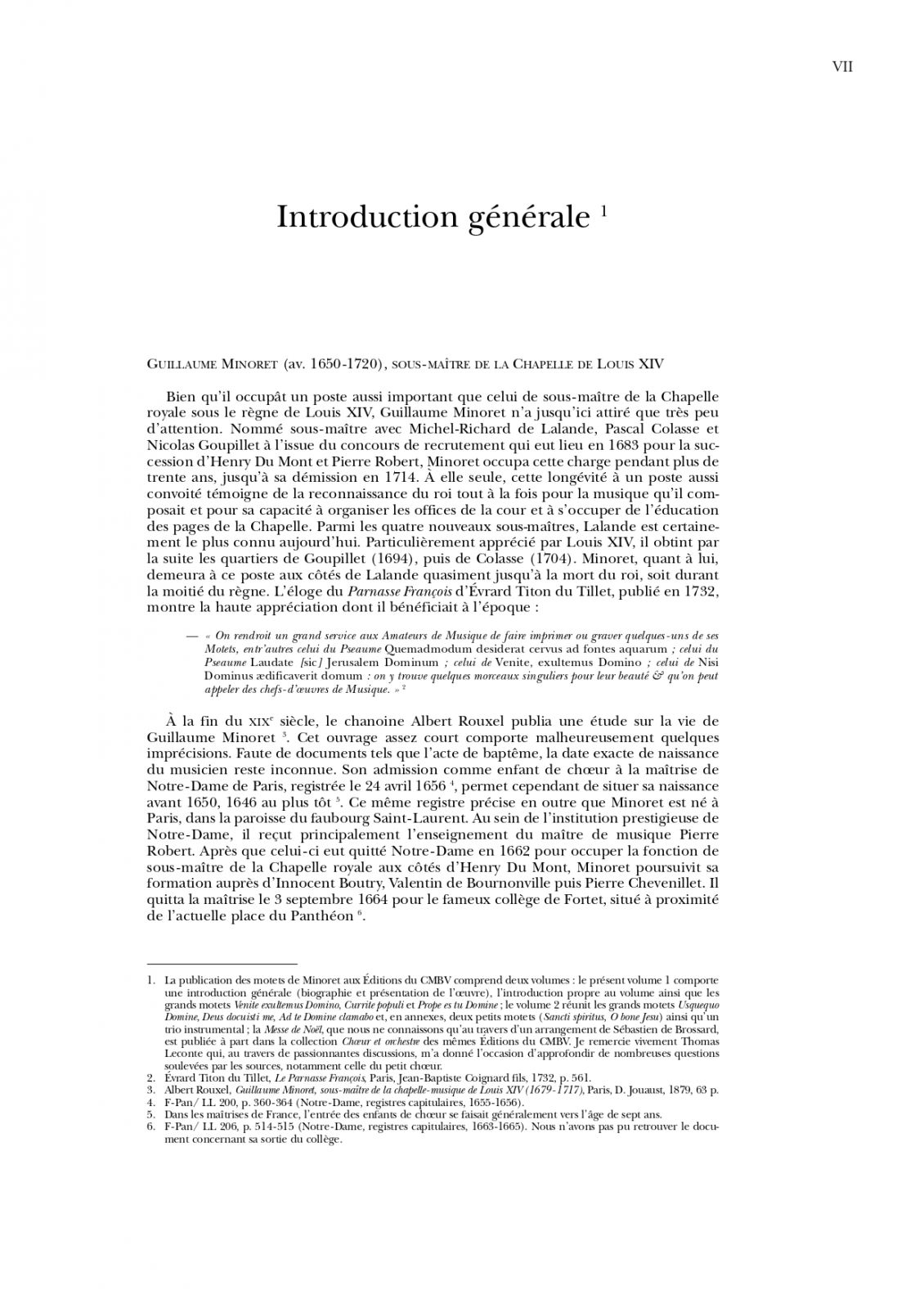
Guillaume Minoret was born before 1650 in Paris. A pupil of Pierre Robert at the Notre-Dame cathedral choir school, he became director of the Rodez cathedral choir school at an early age (between 18 and 22), then succeeded Étienne Moulinié at Saint-Sernin in Toulouse. After a short spell in Orléans, he was appointed to Saint-Germain-l’Auxerrois, the royal parish next to the Louvre. Noted for his Te Deum for the birth of the Duc de Bourgogne (1682), Louis XIV’s first grandson, he was appointed sous-maître of the Chapelle royale in 1683. He remained in the King’s service at Versailles for over thirty years, working alongside his illustrious colleague Michel-Richard de Lalande, before resigning in 1714. He died in 1720.
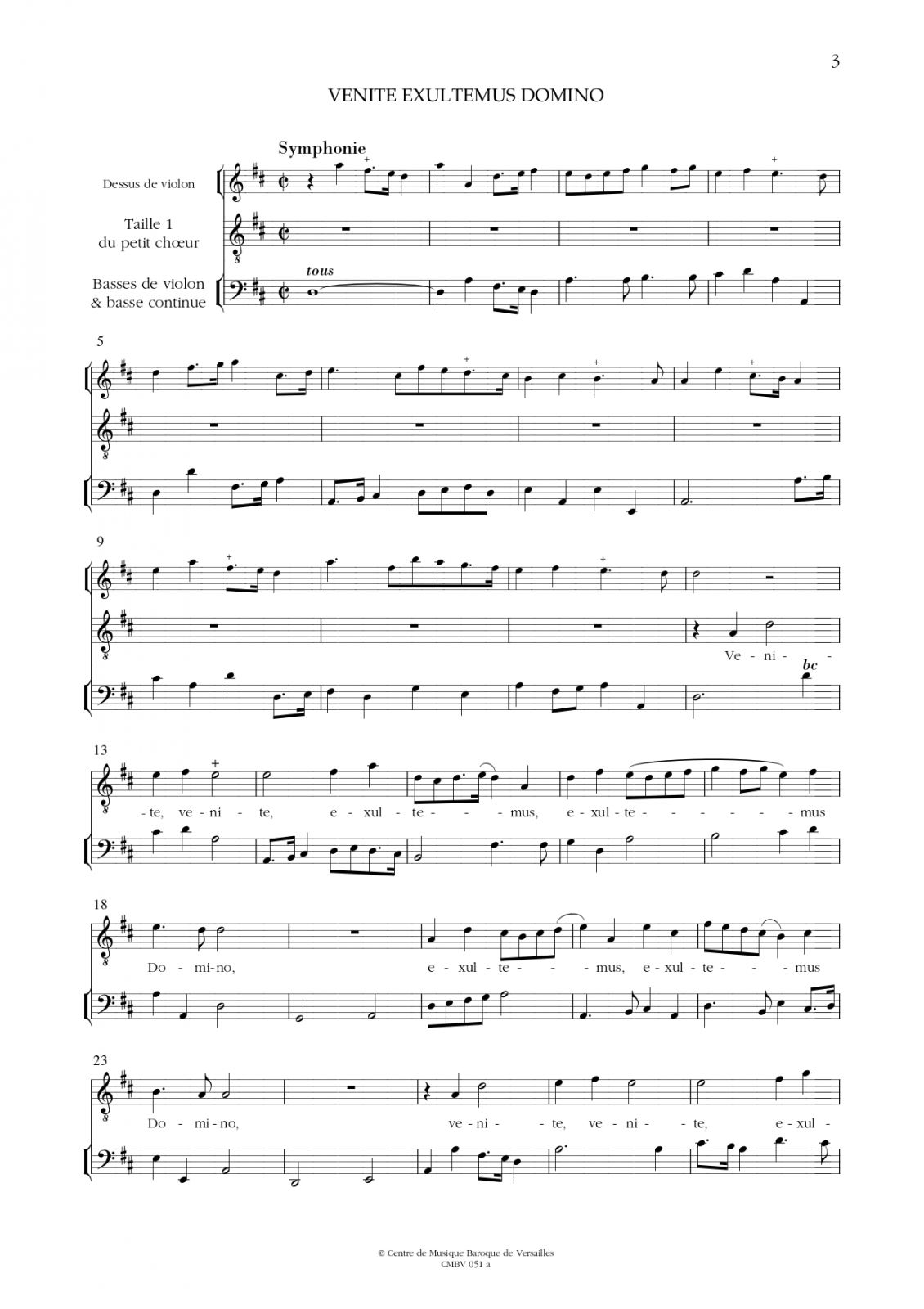
Minoret wrote with a keen sense of thematic unity and a characteristic play of colour between the orchestral middle parts. His motets are an important link between the grand motet bequeathed by his master Robert and the motet à numéros as we know it from Lalande. The critical volume edited by Yuriko Baba presents 3 of the 6 surviving grand motets. Of particular note is the choral majesty of the motet Venite exultemus Domino, interspersed with symphonies and duets, including the beautiful Ploremus coram Domino, later quoted in full by Nicolas Bernier. The more solemn Currite populi, set to neo-Latin poetry by Pierre Perrin, is probably one of the few works commemorating the death of Queen Marie-Thérèse, which occurred during Minoret’s first quarter in the service of Louis XIV. The more virtuosic Prope es tu Domine, for its part, gives pride of place to the petit chœur, entrusting it with superb solos before ending in apotheosis with a sumptuous double chorus.
Yuriko Baba presents this critical volume in the light of many new elements. She begins with a presentation of Minoret, his work and the few surviving sources, then proposes a dating of the 3 works published in the volume, an in-depth comparison of the sources, and a study of the literary texts. She comments on Nicolas Bernier’s astonishing borrowing, and studies the structure of the works, in particular the complex problems of the petit chœur; her work has led her to a new approach, which she puts into practice in her remarkable restitution of the music.
The volume contains the original preface in Japanese, as well as a translation into French and English, 5 facsimiles, the scores of the three great motets and a critical apparatus at the end of the volume. Each motet is available separately in a minimum number of copies for singers, and the separate parts are available for sale.
In 2003, Yuriko Baba defended her doctoral thesis in musicology Guillaume Minoret (ca.1650-1720), sous-maître de la Chapelle royale de Louis XIV: édition critique et analyse de son oeuvre, prepared in partnership between Elisabeth University of Music (Hiroshima, Japan) and the Centre de Musique Baroque de Versailles. From 2006 to 2008, she was a CNRS post-doctoral researcher at the CMBV. Now a lecturer at Elisabeth University of Music, she is pursuing her research into the forces of the Chapelle royale of Versailles and the development of the grand motet.
Minoret wrote with a keen sense of thematic unity and a characteristic play of colour between the orchestral middle parts. His motets are an important link between the grand motet bequeathed by his master Robert and the motet à numéros as we know it from Lalande. The critical volume edited by Yuriko Baba presents 3 of the 6 surviving grand motets. Of particular note is the choral majesty of the motet Venite exultemus Domino, interspersed with symphonies and duets, including the beautiful Ploremus coram Domino, later quoted in full by Nicolas Bernier. The more solemn Currite populi, set to neo-Latin poetry by Pierre Perrin, is probably one of the few works commemorating the death of Queen Marie-Thérèse, which occurred during Minoret’s first quarter in the service of Louis XIV. The more virtuosic Prope es tu Domine, for its part, gives pride of place to the petit chœur, entrusting it with superb solos before ending in apotheosis with a sumptuous double chorus.
Yuriko Baba presents this critical volume in the light of many new elements. She begins with a presentation of Minoret, his work and the few surviving sources, then proposes a dating of the 3 works published in the volume, an in-depth comparison of the sources, and a study of the literary texts. She comments on Nicolas Bernier’s astonishing borrowing, and studies the structure of the works, in particular the complex problems of the petit chœur; her work has led her to a new approach, which she puts into practice in her remarkable restitution of the music.
The volume contains the original preface in Japanese, as well as a translation into French and English, 5 facsimiles, the scores of the three great motets and a critical apparatus at the end of the volume. Each motet is available separately in a minimum number of copies for singers, and the separate parts are available for sale.
In 2003, Yuriko Baba defended her doctoral thesis in musicology Guillaume Minoret (ca.1650-1720), sous-maître de la Chapelle royale de Louis XIV: édition critique et analyse de son oeuvre, prepared in partnership between Elisabeth University of Music (Hiroshima, Japan) and the Centre de Musique Baroque de Versailles. From 2006 to 2008, she was a CNRS post-doctoral researcher at the CMBV. Now a lecturer at Elisabeth University of Music, she is pursuing her research into the forces of the Chapelle royale of Versailles and the development of the grand motet.
Pagination :
CVIII-193
Date de parution :
2008-12
Illustrations, fac similés (nbre) :
8
Introduction (langue) :
Français/Anglais/Japonnais
ISMN 979-0-707034-51-4
Annexes :
List of works by Minoret included in the collection of Motets et élévations pour la Chapelle du Roy, quarters of July 1705 and 1710
Composition of the source F-Pn (ex Pc)/H 477 of the motet Venite exultemus Domino by Nicolas Bernier
Examples of the handwriting of the various copyists of the manuscript F-Pn (ex Pc)/Rés F 932 I
Composition of the source F-Pn (ex Pc)/H 477 of the motet Venite exultemus Domino by Nicolas Bernier
Examples of the handwriting of the various copyists of the manuscript F-Pn (ex Pc)/Rés F 932 I
Les œuvres
Langue du texte :
Latin
Genre :
motet
Temps liturgique :
Psaume 94
Ton :
Ré Majeur
Durée :
entre 20' et 29'
Auteur texte :
Pierre PERRIN
Langue du texte :
Latin
Genre :
motet
Temps liturgique :
Textes divers (Vierge - Saint Louis - Sainte Thérèse)
Ton :
la mineur
Durée :
entre 10' et 19'
Langue du texte :
Latin
Genre :
motet
Temps liturgique :
Psaume 118
Ton :
Ré Majeur
Durée :
entre 20' et 29'
Recommandations


26€
Disponible en version numérique


27€
Disponible en version numérique
