

Sheet music
Symphonies de l'Europe galante
André CAMPRA
(1660-1744)
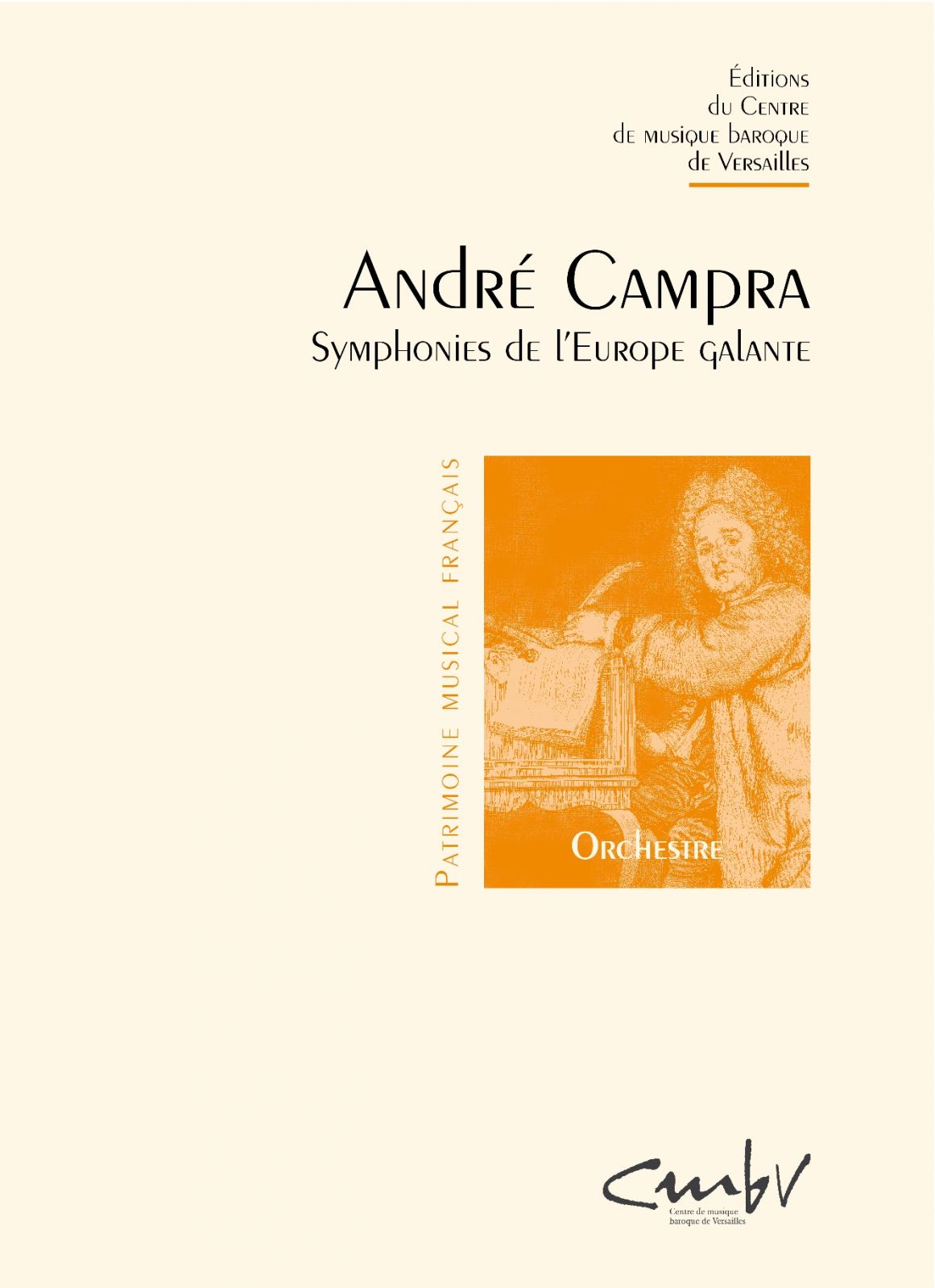


Reference: CAHIERS-216
Format:
22,5x31 cm
Binding: Paperback
22,40 € TTC
In stock
André CAMPRA
(1660-1744)
Editor(s):
Julien DUBRUQUE
Collection:
Orchestra
Type of publication:
Full score
Publisher:
Editions du Centre de musique baroque de Versailles
Presintation:
Born in 1660, André Campra studied music with Guillaume Poitevin, maître de chapelle at the Saint-Sauveur choir school at the cathedral of Aix-en-Provence, where he trained several renowned musicians (including Jean Gilles). After leaving Aix-en-Provence, Campra, whose life seems to have been eventful, obtained several appointments in the south of France. In 1694, he moved to Paris and was appointed Master of Notre-Dame Cathedral. He resigned in 1700 to devote himself freely to an equally exceptional operatic career, which led him to become director of the Académie royale de musique in 1730. In 1723, Philippe d’Orléans entrusted him with one of the quarters of the Chapelle royale, replacing Lalande. Campra composed or reworked most of the great motets that have come down to us. He died in 1744.
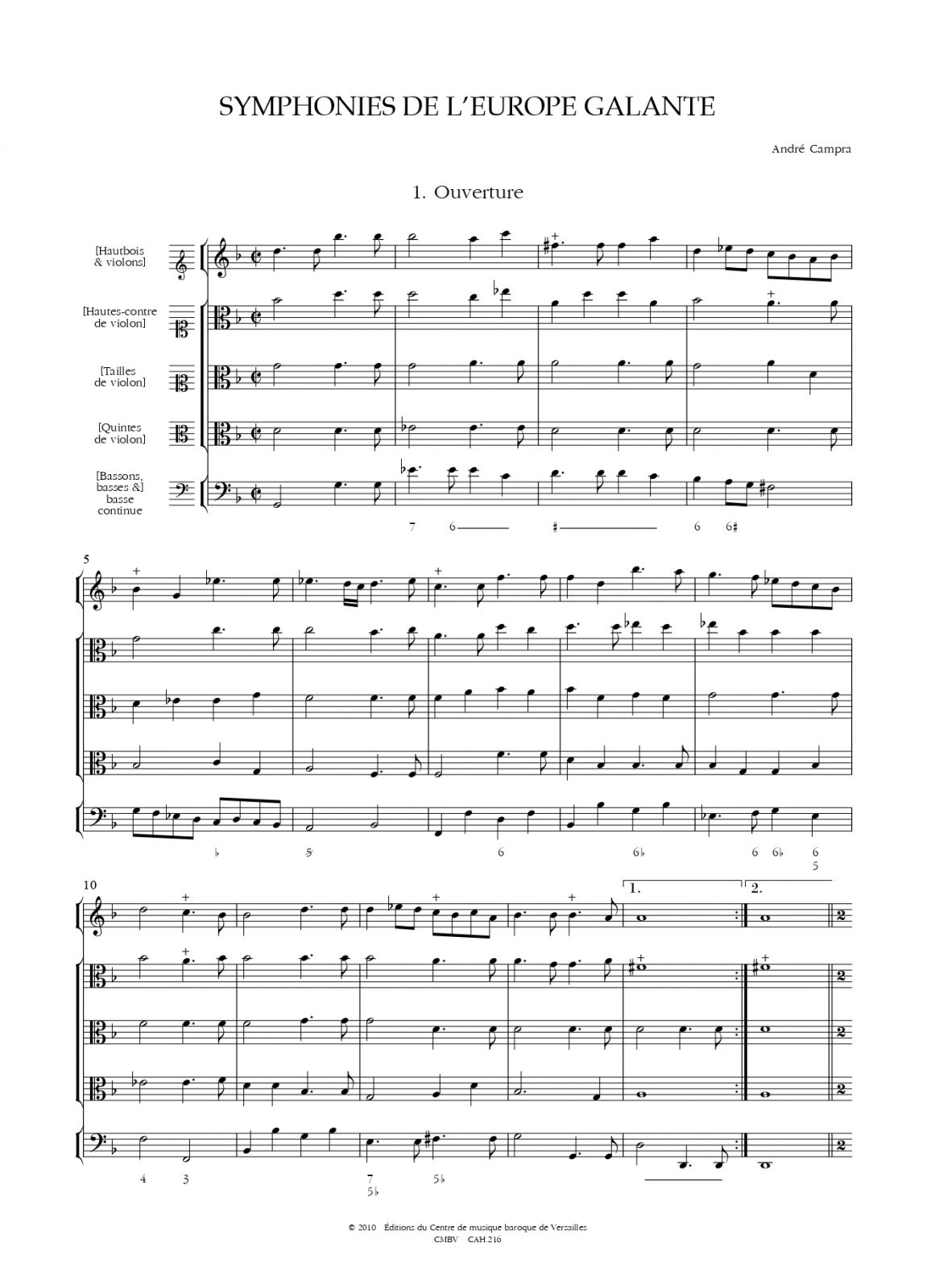
André Campra’s L'Europe galante is one of the major works of classical French opera. Premiered in 1697 to a libretto by Houdar de la Motte, it is considered the first true "ballet" performed at the Académie royale de musique. This genre, later called "opéra-ballet" to avoid confusion with the 19th-century "ballet", which is devoid of vocals, rapidly supplanted the tragédie en musique in favor with composers and audiences alike. Taken from this masterpiece, these symphonies are inspired by the common practice at the time of performing opera excerpts as an orchestral suite in a private setting. The overture, all the dances and the preludes, sufficiently developed to constitute separate pieces, are thus offered to the performers, in the original order of the pieces, giving them the opportunity to play them again, in chamber or orchestral concerts, with the separate parts proposed.
These Symphonies de l'Europe galante are written for a 5-part "French-style" orchestra (dessus, hautes-contre, tailles, quintes and basses de violon) with flutes, oboe and bassoon. The basso continuo was not used for instrumental pieces at the Académie royale de musique, but the 1724 edition, from which these symphonies are taken, includes one, leaving it to the performer to decide whether or not to use it.
André Campra’s L'Europe galante is one of the major works of classical French opera. Premiered in 1697 to a libretto by Houdar de la Motte, it is considered the first true "ballet" performed at the Académie royale de musique. This genre, later called "opéra-ballet" to avoid confusion with the 19th-century "ballet", which is devoid of vocals, rapidly supplanted the tragédie en musique in favor with composers and audiences alike. Taken from this masterpiece, these symphonies are inspired by the common practice at the time of performing opera excerpts as an orchestral suite in a private setting. The overture, all the dances and the preludes, sufficiently developed to constitute separate pieces, are thus offered to the performers, in the original order of the pieces, giving them the opportunity to play them again, in chamber or orchestral concerts, with the separate parts proposed.
These Symphonies de l'Europe galante are written for a 5-part "French-style" orchestra (dessus, hautes-contre, tailles, quintes and basses de violon) with flutes, oboe and bassoon. The basso continuo was not used for instrumental pieces at the Académie royale de musique, but the 1724 edition, from which these symphonies are taken, includes one, leaving it to the performer to decide whether or not to use it.
Pages:
69
Publication date:
2010-07
Introduction (language):
French
ISMN 979-0-56016-216-4
The works
Genre:
suite d'orchestre
Key:
sol mineur
Duration:
moins de 10'
Genre:
suite d'orchestre
Key:
la mineur
Duration:
moins de 10'
Genre:
suite d'orchestre
Key:
La Majeur
Duration:
moins de 10'
Genre:
suite d'orchestre
Key:
La Majeur
Duration:
moins de 10'
Genre:
suite d'orchestre
Key:
La Majeur
Duration:
moins de 10'
Genre:
suite d'orchestre
Key:
La Majeur
Duration:
moins de 10'
Genre:
suite d'orchestre
Key:
La Majeur
Duration:
moins de 10'
Genre:
suite d'orchestre
Key:
Sol Majeur
Duration:
moins de 10'
Genre:
suite d'orchestre
Key:
sol mineur
Duration:
moins de 10'
Genre:
suite d'orchestre
Key:
sol mineur
Duration:
moins de 10'
Genre:
suite d'orchestre
Key:
Sol Majeur
Duration:
moins de 10'
Genre:
suite d'orchestre
Key:
sol mineur
Duration:
moins de 10'
Genre:
suite d'orchestre
Key:
ré mineur
Duration:
moins de 10'
Genre:
suite d'orchestre
Key:
ré mineur
Duration:
moins de 10'
Genre:
suite d'orchestre
Key:
Sol Majeur
Duration:
moins de 10'
Genre:
suite d'orchestre
Key:
sol mineur
Duration:
moins de 10'
Genre:
suite d'orchestre
Key:
sol mineur
Duration:
moins de 10'
Genre:
suite d'orchestre
Key:
sol mineur
Duration:
moins de 10'
Genre:
suite d'orchestre
Key:
sol mineur
Duration:
moins de 10'
Genre:
suite d'orchestre
Key:
Sol Majeur
Duration:
moins de 10'
Genre:
suite d'orchestre
Key:
Sol Majeur
Duration:
moins de 10'
Genre:
suite d'orchestre
Key:
do mineur
Duration:
moins de 10'
Genre:
suite d'orchestre
Key:
sol mineur
Duration:
moins de 10'
Genre:
suite d'orchestre
Key:
Si bémol Majeur
Duration:
moins de 10'
Genre:
suite d'orchestre
Key:
Si bémol Majeur
Duration:
moins de 10'
Genre:
suite d'orchestre
Key:
Ré Majeur
Duration:
moins de 10'
Genre:
suite d'orchestre
Key:
ré mineur
Duration:
moins de 10'
Genre:
suite d'orchestre
Key:
Ré Majeur
Duration:
moins de 10'
Genre:
suite d'orchestre
Key:
ré mineur
Duration:
moins de 10'
Genre:
suite d'orchestre
Key:
Ré Majeur
Duration:
moins de 10'
Genre:
suite d'orchestre
Key:
Ré Majeur
Duration:
moins de 10'
Genre:
suite d'orchestre
Key:
Ré Majeur
Duration:
moins de 10'
Recommendations


28€
Available in a digital version


26€
Available in a digital version

27€
Available in a digital version


26€
Available in a digital version


35€
Available in a digital version