

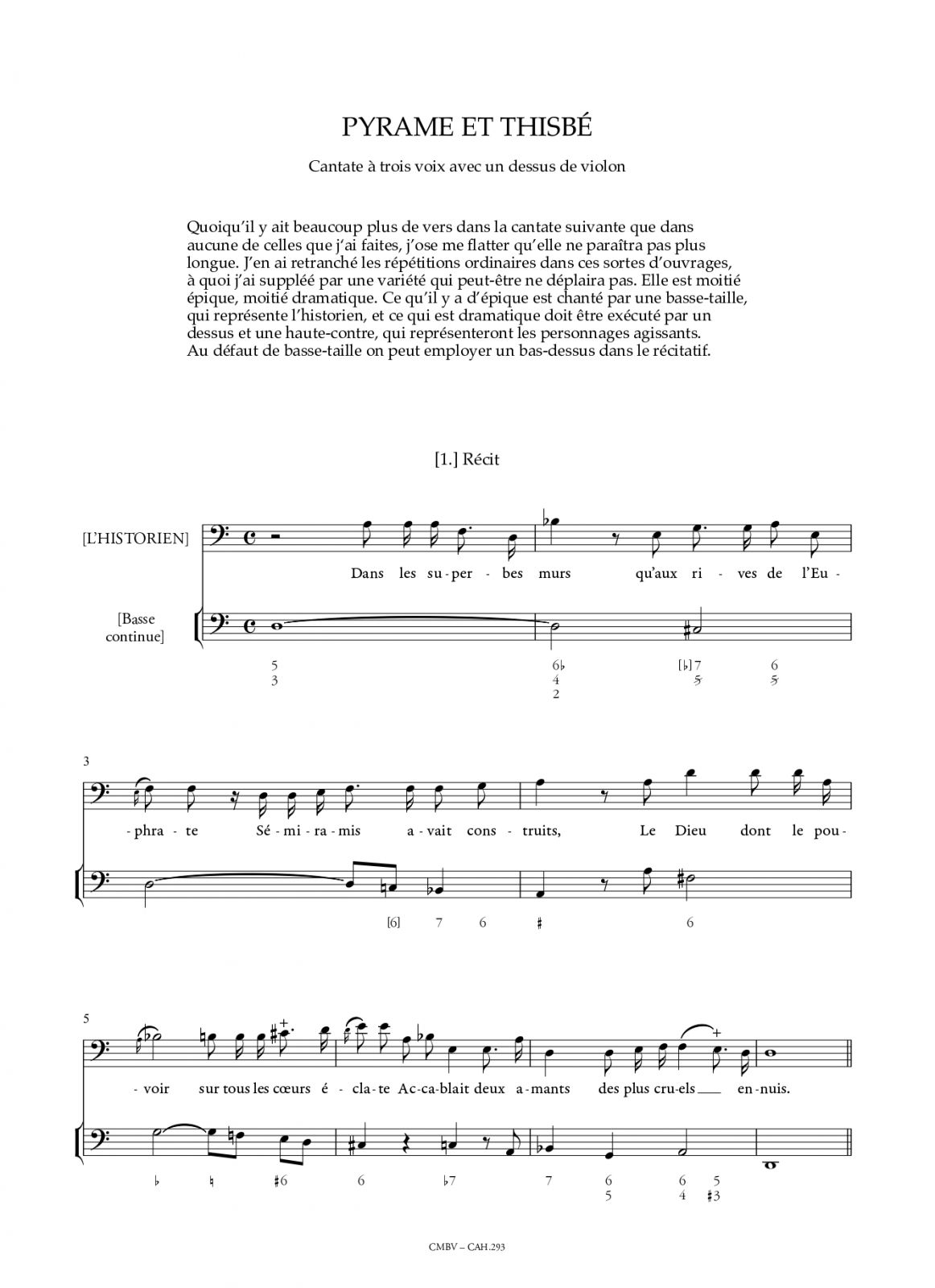
Pyrame et Thisbé
cantata for three voices and violin
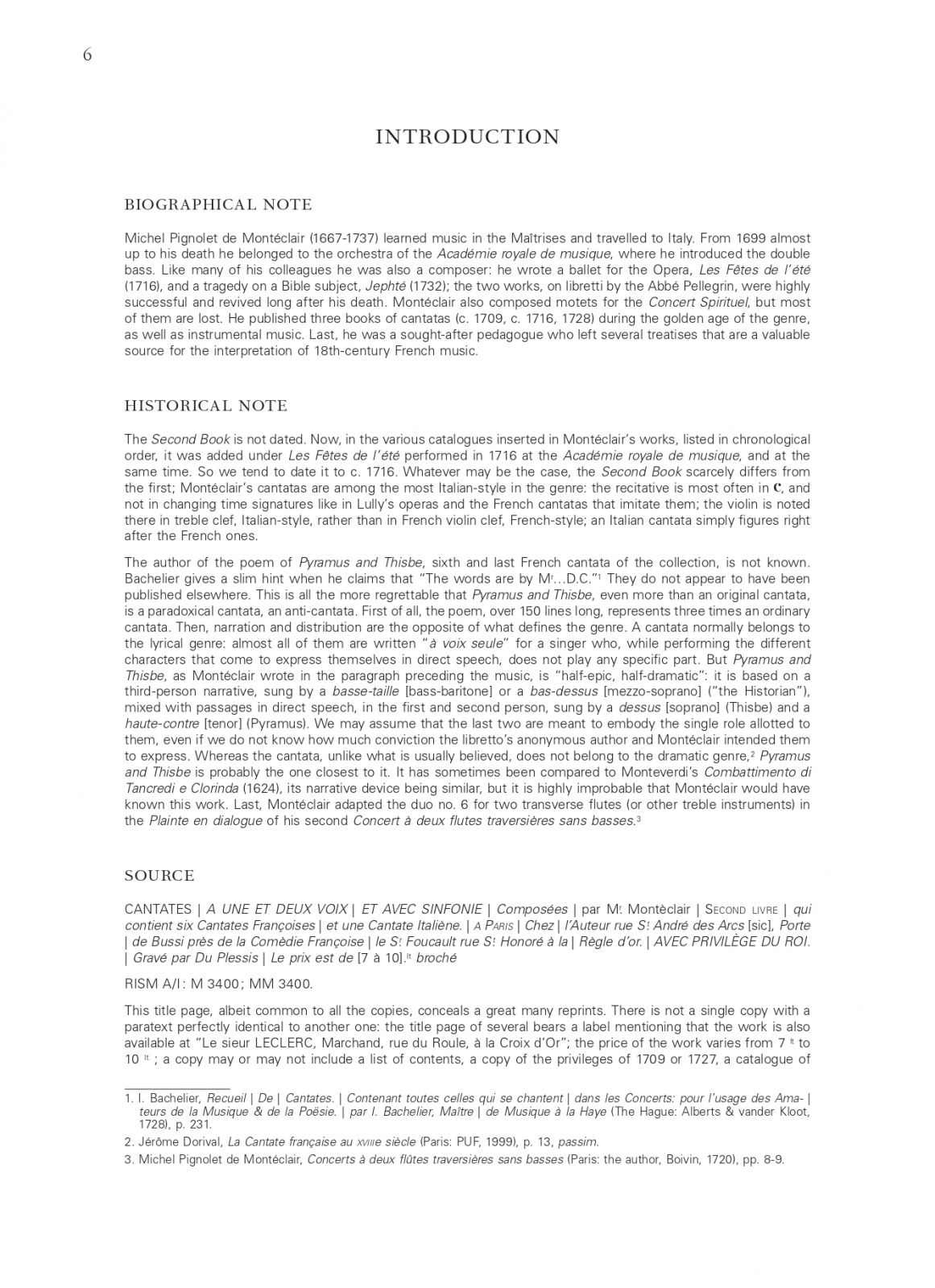
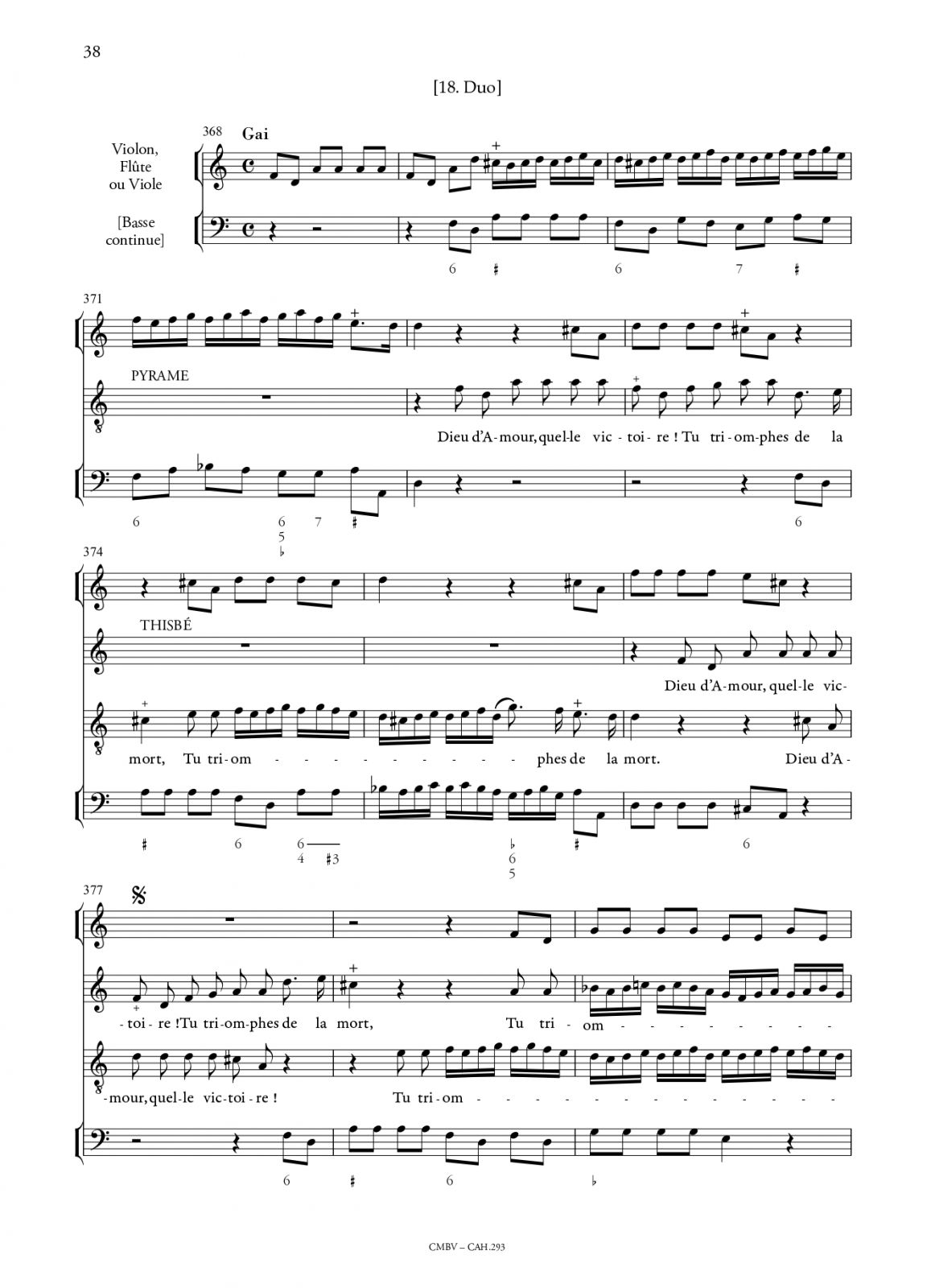


Montéclair’s cantatas, such as Pyrame et Thisbé, published here by the Centre de musique baroque de Versailles, remain among the most Italianate of the genre. Not only original, this sixth and final cantata of the composer’s second book is also paradoxical. The anonymous poem, more than 150 lines long, represents three times the length of an ordinary cantata. It is based on a third-person narration, sung by a basse-taille (bass) or a bas-dessus (low soprano) ("the storyteller"), mixed with passages of direct speech sung by a dessus (Thisbe) and an haute-contre (Pyramus) which brings the work closer to a dramatic genre, remote from the form of the French cantata. The arrangement is close to Monteverdi’s Combattimento di Tancredi e Clorinda (1624), but it is unlikely that Montéclair knew this work. Montéclair adapts the duet "Que d'alarmes ! Quel sort pour nos cœurs ! " for two transverse flutes (or other treble instruments) in the Complaint in dialogue of his second Concert for two transverse flutes without basses.
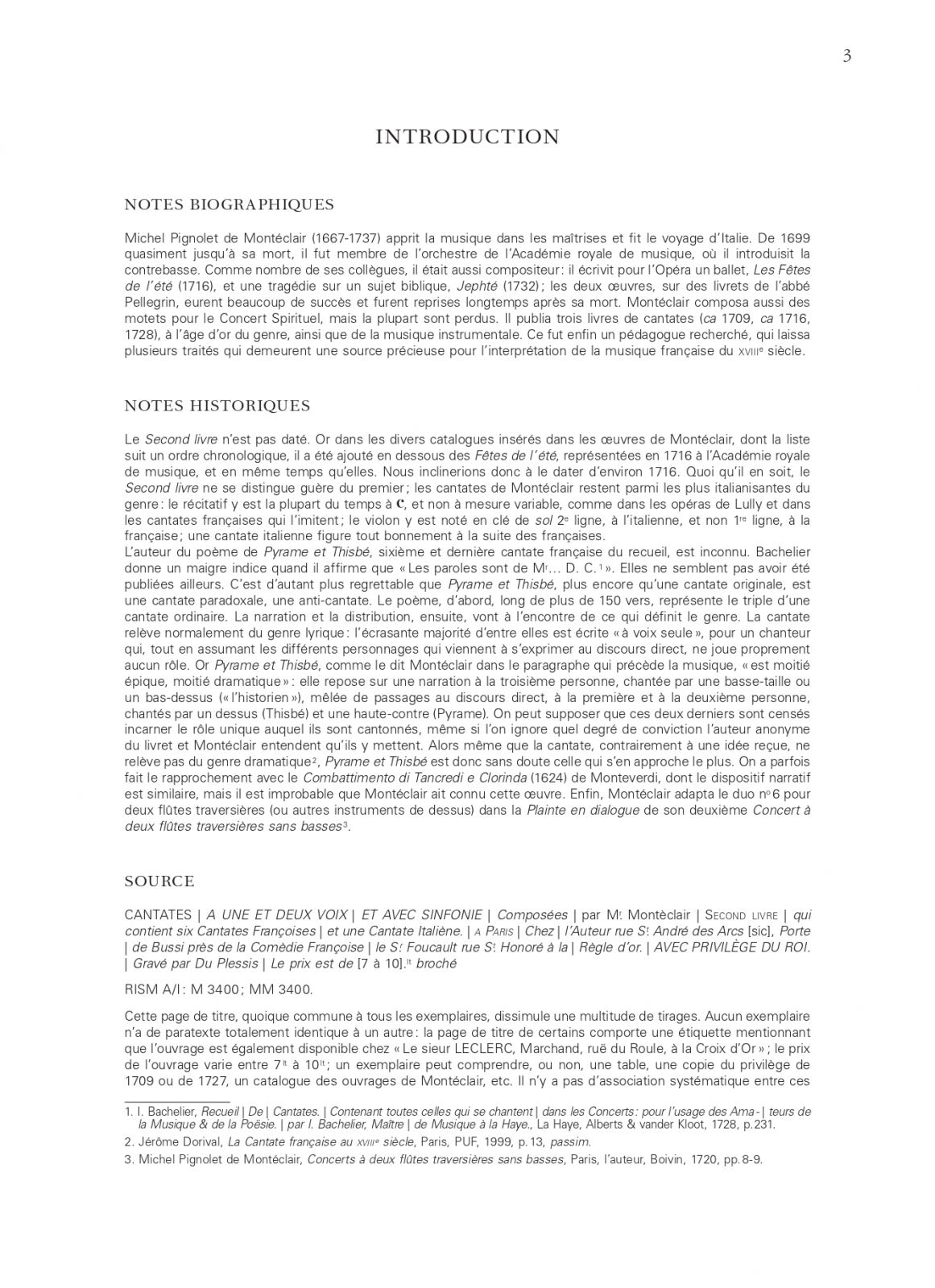
Michel Pignolet de Montéclair (1667–1737) learned music in the choirs and travelled to Italy. From 1699 almost until his death, he was a member of the orchestra of the Académie royale de musique, where he introduced the double bass. As a composer, he wrote a ballet, Les Fêtes de l'été (1716), and a tragedy on a biblical subject, Jephté (1732), with librettos by Abbé Pellegrin, which were very successful. Montéclair also composed motets for the Concert Spirituel, most of which have been lost. He published three books of cantatas in the golden age of the genre, as well as instrumental music. Finally, he was a sought-after teacher, who left several treatises that are still a valuable source for the interpretation of eighteenth-century French music.
Les œuvres
Recommandations


