

Sheet music
Messes des morts pour la cathédrale de Bordeaux
Charles LEVENS
(1689-1764)


Reference: CMBV_048
Format:
23x31 cm
Binding: Paperback
68,00 € TTC
In stock
Charles LEVENS
(1689-1764)
Editor(s):
Jean-Christophe MAILLARD
Type of publication:
Critical edition
Publisher:
Editions du Centre de musique baroque de Versailles
Presintation:
Charles Levens (1689–1764) followed the usual apprenticeship of a cathedral musician. Born in Marseille, he entered the cathedral of La Major there at the age of 11. At the age of 20, he began working for the various bishoprics of the kingdom: Bordeaux, Toulouse, Vannes and, once again, Toulouse, at Saint-Étienne Cathedral. In 1738, Levens was appointed to the Saint-André Cathedral in Bordeaux, where he remained until the end of his career. A modest, zealous man, kindly and even-tempered, as his employers described him, we can imagine him rigorous in his work and ambitious in his output.
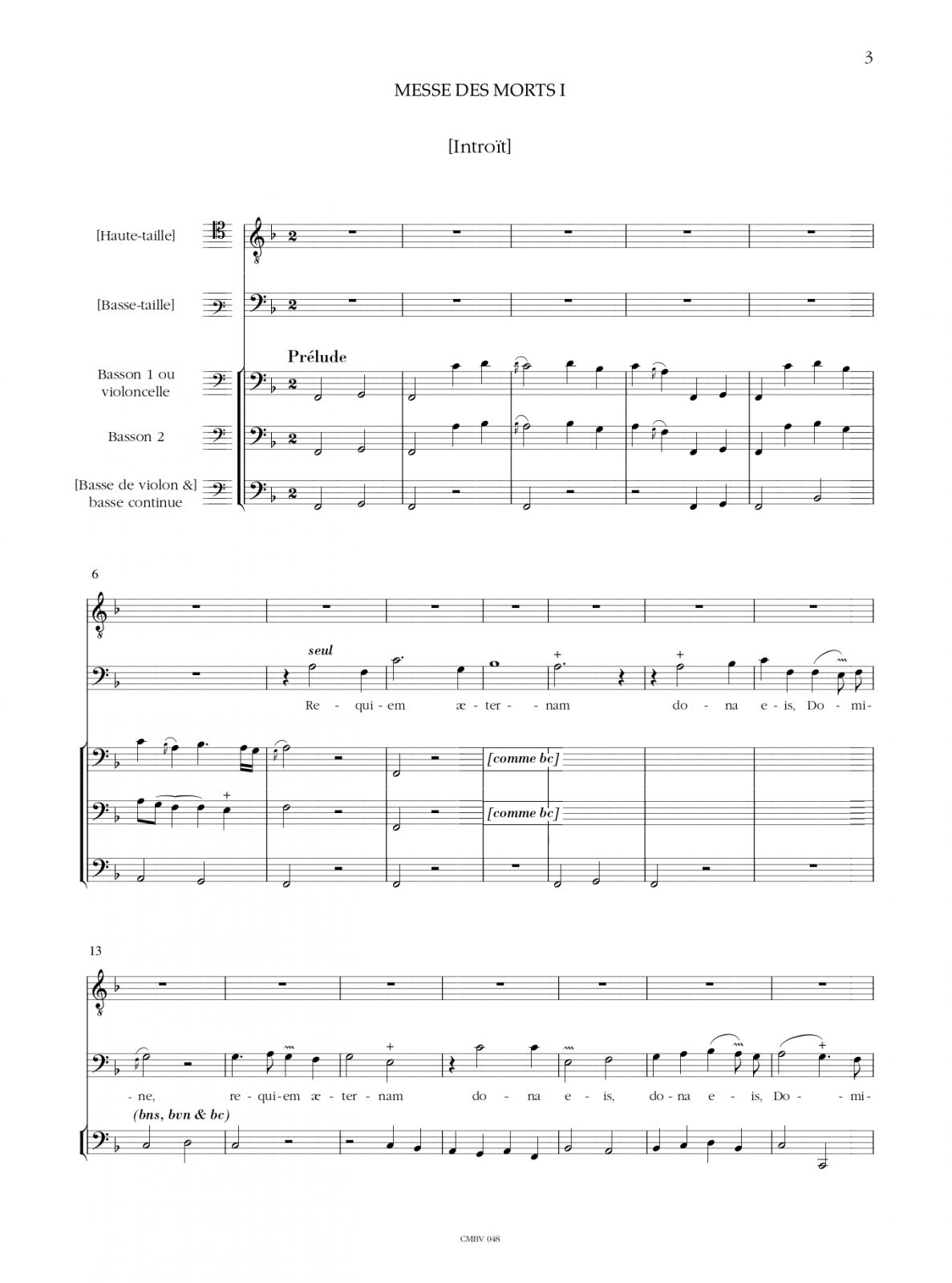
These two Messes des morts, written for Bordeaux’s Saint-André Cathedral, are admirable for their minimal instrumentation and dark instrumental colour, with two bassoons in dialogue with the soloists and choir, as well as their concentrated contemplation. Levens, however, knowing the unusual nature of the orchestra, suggested replacing one or both of the bassoons with cellos. This makes the work adaptable to any medium-sized ensemble: 4 soloists (dessus, haute-contre, haute-taille and basse-taille), a 5-part choir (dessus, hautes-contre, which can be replaced by altos, hautes-tailles, basses-tailles and basses) with a basso continuo consisting of a keyboard, a bowed bass (cello or viola da gamba), two bassoons or two cellos.
Jean-Christophe Maillard, lecturer at the Université de Toulouse Le Mirail and a specialist in the Baroque musette, draws on sources preserved at the Bibliothèque nationale de France (Conservatoire collection). In the preface, after a brief biography of the composer, he presents the particularities of his writing, from a historical and musical perspective, illustrated with facsimiles.
These two Messes des morts, written for Bordeaux’s Saint-André Cathedral, are admirable for their minimal instrumentation and dark instrumental colour, with two bassoons in dialogue with the soloists and choir, as well as their concentrated contemplation. Levens, however, knowing the unusual nature of the orchestra, suggested replacing one or both of the bassoons with cellos. This makes the work adaptable to any medium-sized ensemble: 4 soloists (dessus, haute-contre, haute-taille and basse-taille), a 5-part choir (dessus, hautes-contre, which can be replaced by altos, hautes-tailles, basses-tailles and basses) with a basso continuo consisting of a keyboard, a bowed bass (cello or viola da gamba), two bassoons or two cellos.
Jean-Christophe Maillard, lecturer at the Université de Toulouse Le Mirail and a specialist in the Baroque musette, draws on sources preserved at the Bibliothèque nationale de France (Conservatoire collection). In the preface, after a brief biography of the composer, he presents the particularities of his writing, from a historical and musical perspective, illustrated with facsimiles.
Pages:
XXXVII-100
Publication date:
2004-12
Illustrations, facsimiles (number):
4
Introduction (language):
French/English
ISMN 979-0-707034-48-4
The works
Text language:
Latin
Genre:
messe
Liturgical calendar
Défunts
Key:
Fa Majeur
Duration:
entre 30' et 39'
Organisation:
Moyen
General level:
Moyen
Commentary:
Cette première messe (cf. la Messe des morts 2 du même auteur) est plus longue que la seconde, écrite avec le même souci de variété. On notera le bel usage qui est fait du plain-chant aux instruments.
Les parties solistes peuvent être chantées par les meilleurs choristes. Les parties de hautes-contre de chœur, d'un ambitus réduit (la - sib), pourront être chantées par des alti (éventuellement coloré d'un ou deux ténors). Les parties des bassons sont sans difficulté. La basse-continue de préférance à l'orgue (on pourra utiliser un clavecin).
Counterpoint:
Moyen
Rhythm:
Moyen
Ranges:
Moyen
Text language:
Latin
Genre:
messe
Liturgical calendar
Défunts
Key:
Fa Majeur
Duration:
entre 20' et 29'
Organisation:
Moyen
General level:
Moyen
Commentary:
L'œuvre, avec son accompagnement original, fait toujours grand effet. Le discours est très varié mêlant la peinture de la douleur, la lumière de la trompette divine et la joie douceureuse du paradis promis.
Les parties solistes peuvent être chantées par les meilleurs choristes. Les parties de hautes-contre de chœur, d'un ambitus réduit (sib - la), pourront être chantées par des alti (éventuellement coloré d'un ou deux ténors). Les parties des bassons sont sans difficulté. La basse-continue de préférance à l'orgue (on pourra utiliser un clavecin).
Counterpoint:
Moyen
Rhythm:
Moyen
Ranges:
Moyen
Recommendations


26€
Available in a digital version


34€
Available in a digital version


35€
Available in a digital version