

Sheet music
Symphonies des Fêtes grecques et romaines
François COLLIN DE BLAMONT
(1690-1760)
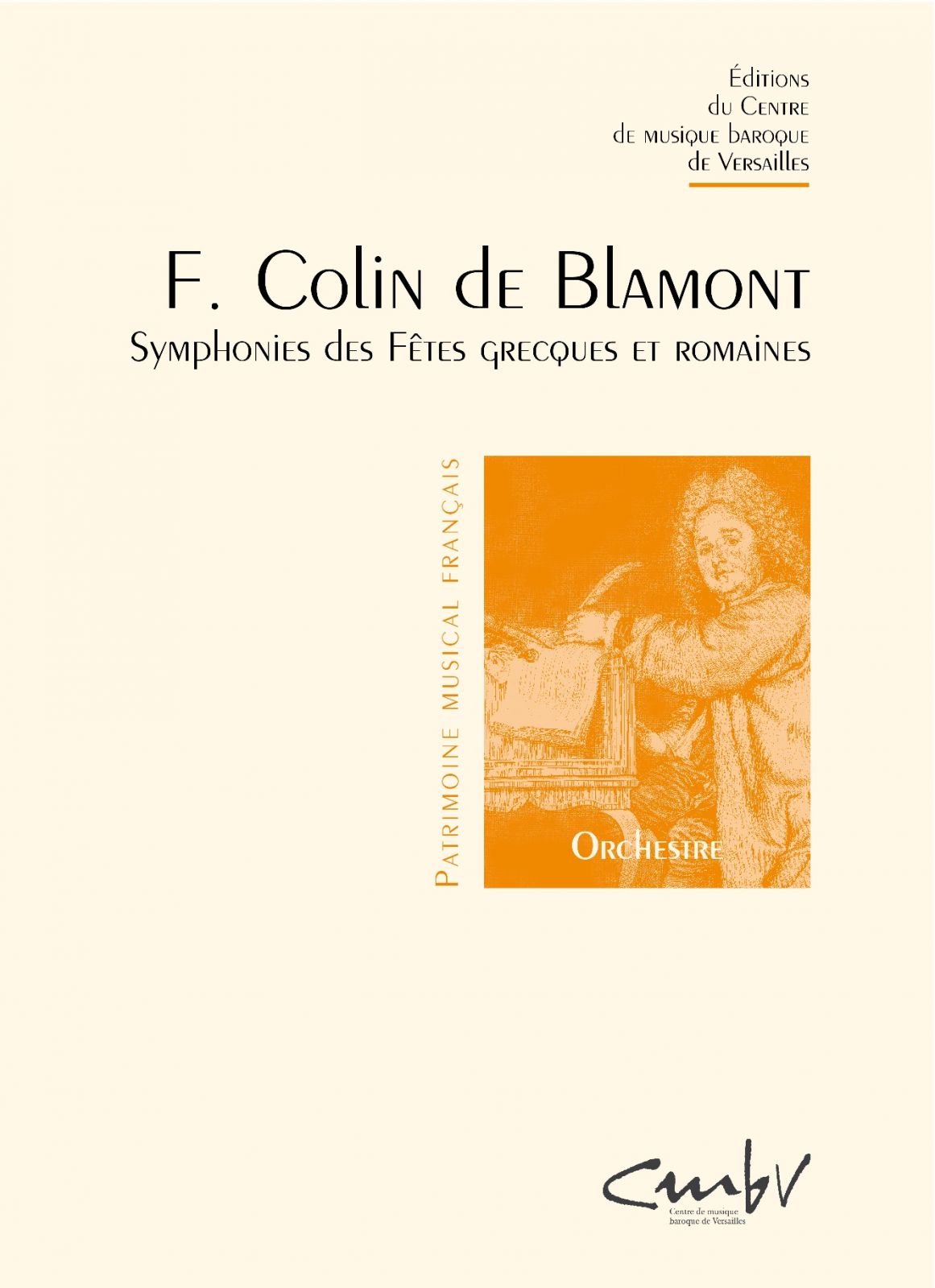
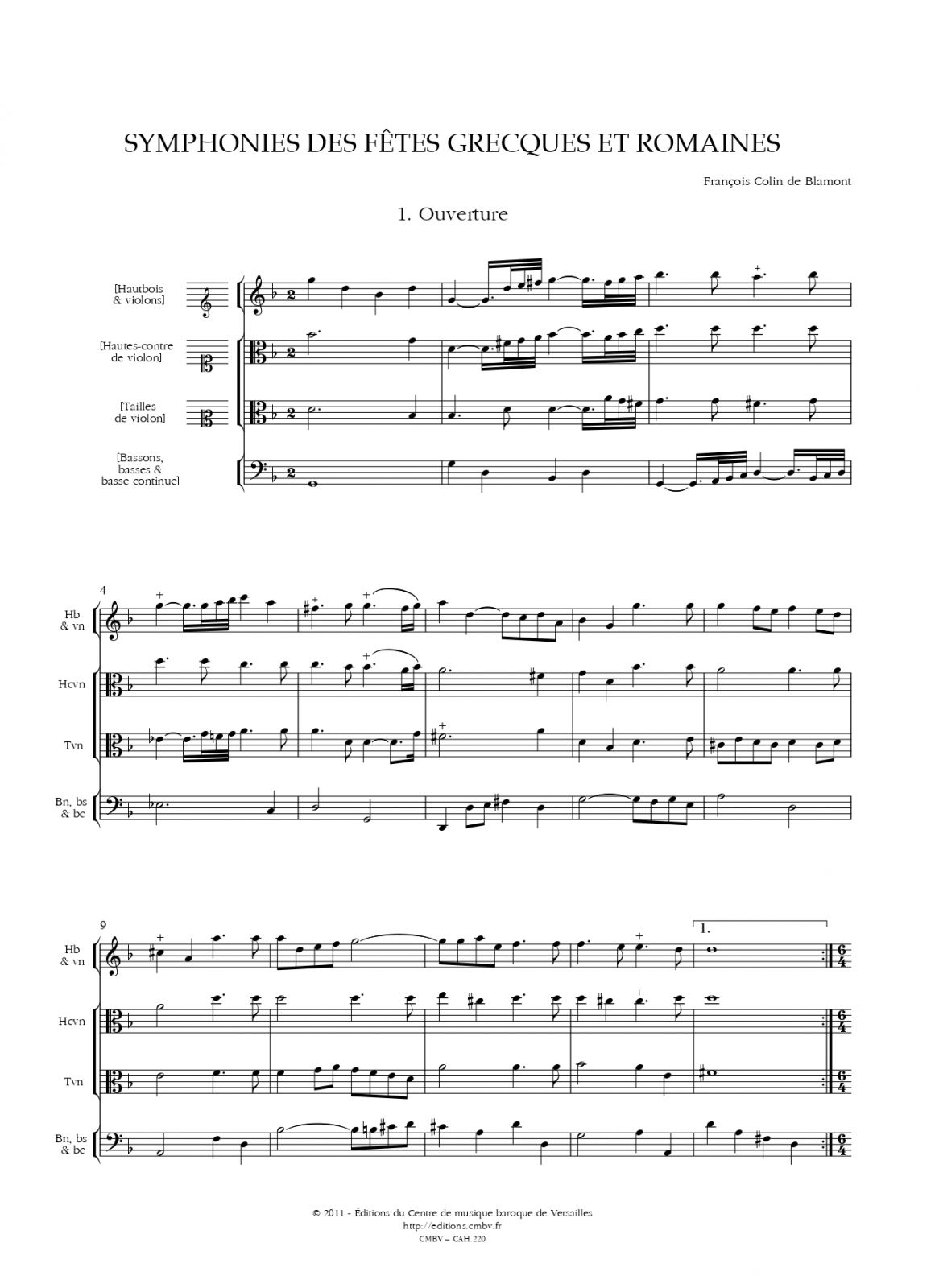


Reference: CAHIERS-220
Format:
22,5x31 cm
Binding: Paperback
20,20 € TTC
In stock
François COLLIN DE BLAMONT
(1690-1760)
Editor(s):
Julien DUBRUQUE
Collection:
Orchestra
Type of publication:
Full score
Publisher:
Editions du Centre de musique baroque de Versailles
Presintation:
François Collin (or Colin) de Blamont was born in Versailles in 1690 to musician parents, both ordinaries of the King’s Music. His apprenticeship was entrusted to Lalande, a friend of his father. Like Bernier, he took part in concerts given by the Duchesse du Maine at Sceaux and, from 1709, entered the service of the Court: haute-contre of the Chapelle royale choir, then taille at the Chambre du roi in 1717. Two years later, he took up the post of Superintendant de la Musique de la Chambre du roi, the position held by Lully’s son, alongside Destouches. He wrote for the Académie Royale de Musique and, through his duties, for the court entertainments provided by the weddings and births that marked the beginning of Louis XV’s reign. On Lalande’s death, he and Destouches shared responsibility for the education of the Pages. He also took part in the Concerts de la reine, which Marie Leczynska brought up to date. In 1732, the performance of his Te Deum, often repeated throughout the 18th century, contributed to the quarrel of precedence between the musicians of the Chambre and those of the Chapelle du roi. From 1744, he gradually withdrew from his duties in favor of François Francœur and Bernard de Bury, his godson and protégé. He was still in demand at Court, notably for the Dauphin’s wedding and the Marquise de Pompadour’s performances at her Théâtre des Petits-Appartements. In the 1750s, withdrawn from the Court for health reasons, he again took part in the Querelle des Bouffons. He died in Versailles in 1760, ennobled and decorated with the Cordon de l'Ordre de Saint-Michel by Louis XV.
Les Fêtes grecques et romaines, a heroic ballet by François Collin de Blamont to a libretto by Louis Fuzelier, premiered in July 1723 at the Académie royale de musique, was a huge success throughout the 18th century, both on the opera stage and at the fair. The choreography of the air des lutteurs and the air from the first minuet of the air des Bacchanales, which serves as the theme for the song "Chantez petit Colin..." (text by Voltaire), are among the influential pieces of their time. In addition to the innovative nature of this work – it was the first ballet héroïque, a genre that would compete with the opera-ballet created by André Campra in particular – it represents a milestone in French lyric theatre, a synthesis between the nobility of the tragédie lyrique created by Lully and the more playful tone, with its ariettes and choreographic divertissements, of the opéra-ballet created by Campra. Originally commissioned to celebrate the king’s coming of age, the work’s political agenda was equally ambitious. After the regency of Philippe d’Orléans, Louis XV was forced to perpetuate the pomp of the Sun King’s reign. He was to dance on stage in a mythological context as master of the world governing the four elements (prologue), among the victors of the Olympic Games (second entrée), as General of the Roman armies or as a lyrical poet of Antiquity.
The work’s instrumental pieces, including a chaconne, rigaudons, minuets, ritournelles, a bourrée, a rondeau des tambourins and more, offer a wide range of instrumentation. Mostly written for a 4-part orchestra (instrumental dessus, often divided, hautes-contre, tailles and basses), we also find timpani and trumpets, flutes, horns, and sometimes unusual scorings: an air and passepied for flutes and violins, a minuet for violins and violas, a minuet for oboe and two violins, a tambourin for two horns, strings and oboe. Added to the thematic originality of these entrées (Les Jeux olympiques, Les Bacchanales, Les Saturnales, and La Fête de Diane added in 1734), these symphonies will be of interest to any instrumental ensemble in a repertoire where nobility of tone is no less important than melodic expression, either in the form of a suite, as proposed, or by extracting separate pieces to create contrast in a concert of vocal works.
Les Fêtes grecques et romaines, a heroic ballet by François Collin de Blamont to a libretto by Louis Fuzelier, premiered in July 1723 at the Académie royale de musique, was a huge success throughout the 18th century, both on the opera stage and at the fair. The choreography of the air des lutteurs and the air from the first minuet of the air des Bacchanales, which serves as the theme for the song "Chantez petit Colin..." (text by Voltaire), are among the influential pieces of their time. In addition to the innovative nature of this work – it was the first ballet héroïque, a genre that would compete with the opera-ballet created by André Campra in particular – it represents a milestone in French lyric theatre, a synthesis between the nobility of the tragédie lyrique created by Lully and the more playful tone, with its ariettes and choreographic divertissements, of the opéra-ballet created by Campra. Originally commissioned to celebrate the king’s coming of age, the work’s political agenda was equally ambitious. After the regency of Philippe d’Orléans, Louis XV was forced to perpetuate the pomp of the Sun King’s reign. He was to dance on stage in a mythological context as master of the world governing the four elements (prologue), among the victors of the Olympic Games (second entrée), as General of the Roman armies or as a lyrical poet of Antiquity.
The work’s instrumental pieces, including a chaconne, rigaudons, minuets, ritournelles, a bourrée, a rondeau des tambourins and more, offer a wide range of instrumentation. Mostly written for a 4-part orchestra (instrumental dessus, often divided, hautes-contre, tailles and basses), we also find timpani and trumpets, flutes, horns, and sometimes unusual scorings: an air and passepied for flutes and violins, a minuet for violins and violas, a minuet for oboe and two violins, a tambourin for two horns, strings and oboe. Added to the thematic originality of these entrées (Les Jeux olympiques, Les Bacchanales, Les Saturnales, and La Fête de Diane added in 1734), these symphonies will be of interest to any instrumental ensemble in a repertoire where nobility of tone is no less important than melodic expression, either in the form of a suite, as proposed, or by extracting separate pieces to create contrast in a concert of vocal works.
Pages:
64
Publication date:
2011-01
Introduction (language):
French
ISMN 979-0-56016-220-1
The works
Genre:
suite d'orchestre
Key:
sol mineur
Duration:
moins de 10'
Genre:
suite d'orchestre
Key:
Sol Majeur
Duration:
moins de 10'
Genre:
suite d'orchestre
Key:
sol mineur
Duration:
moins de 10'
Genre:
suite d'orchestre
Key:
Sol Majeur
Duration:
moins de 10'
Genre:
suite d'orchestre
Key:
sol mineur
Duration:
moins de 10'
Genre:
suite d'orchestre
Key:
sol mineur
Duration:
moins de 10'
Genre:
suite d'orchestre
Key:
Ré Majeur
Duration:
moins de 10'
Genre:
suite d'orchestre
Key:
Ré Majeur
Duration:
moins de 10'
Genre:
suite d'orchestre
Key:
Ré Majeur
Duration:
moins de 10'
Genre:
suite d'orchestre
Key:
ré mineur
Duration:
moins de 10'
Genre:
suite d'orchestre
Key:
ré mineur
Duration:
moins de 10'
Genre:
suite d'orchestre
Key:
Ré Majeur
Duration:
moins de 10'
Genre:
suite d'orchestre
Key:
Sol Majeur
Duration:
entre 10' et 19'
Genre:
suite d'orchestre
Key:
sol mineur
Duration:
moins de 10'
Genre:
suite d'orchestre
Key:
sol mineur
Duration:
moins de 10'
Genre:
suite d'orchestre
Key:
Sol Majeur
Duration:
moins de 10'
Genre:
suite d'orchestre
Key:
Si bémol Majeur
Duration:
moins de 10'
Genre:
suite d'orchestre
Key:
Si bémol Majeur
Duration:
moins de 10'
Genre:
suite d'orchestre
Key:
Si bémol Majeur
Duration:
moins de 10'
Genre:
suite d'orchestre
Key:
Ré Majeur
Duration:
moins de 10'
Genre:
suite d'orchestre
Key:
ré mineur
Duration:
moins de 10'
Genre:
suite d'orchestre
Key:
Ré Majeur
Duration:
moins de 10'
Genre:
suite d'orchestre
Key:
Ré Majeur
Duration:
moins de 10'
Genre:
suite d'orchestre
Key:
Ré Majeur
Duration:
moins de 10'
Genre:
suite d'orchestre
Key:
la mineur
Duration:
moins de 10'
Genre:
suite d'orchestre
Key:
Do Majeur
Duration:
moins de 10'
Genre:
suite d'orchestre
Key:
Sol Majeur
Duration:
moins de 10'
Genre:
suite d'orchestre
Key:
Sol Majeur
Duration:
moins de 10'
Genre:
suite d'orchestre
Key:
Do Majeur
Duration:
moins de 10'
Genre:
suite d'orchestre
Key:
Do Majeur
Duration:
moins de 10'
Genre:
suite d'orchestre
Key:
Sol Majeur
Duration:
moins de 10'
Genre:
suite d'orchestre
Key:
la mineur
Duration:
moins de 10'
Genre:
suite d'orchestre
Key:
Ré Majeur
Duration:
moins de 10'
Genre:
suite d'orchestre
Key:
Sol Majeur
Duration:
moins de 10'
Genre:
suite d'orchestre
Key:
Sol Majeur
Duration:
moins de 10'
Recommendations


22€
Available in a digital version


35€
Available in a digital version


