

Partition
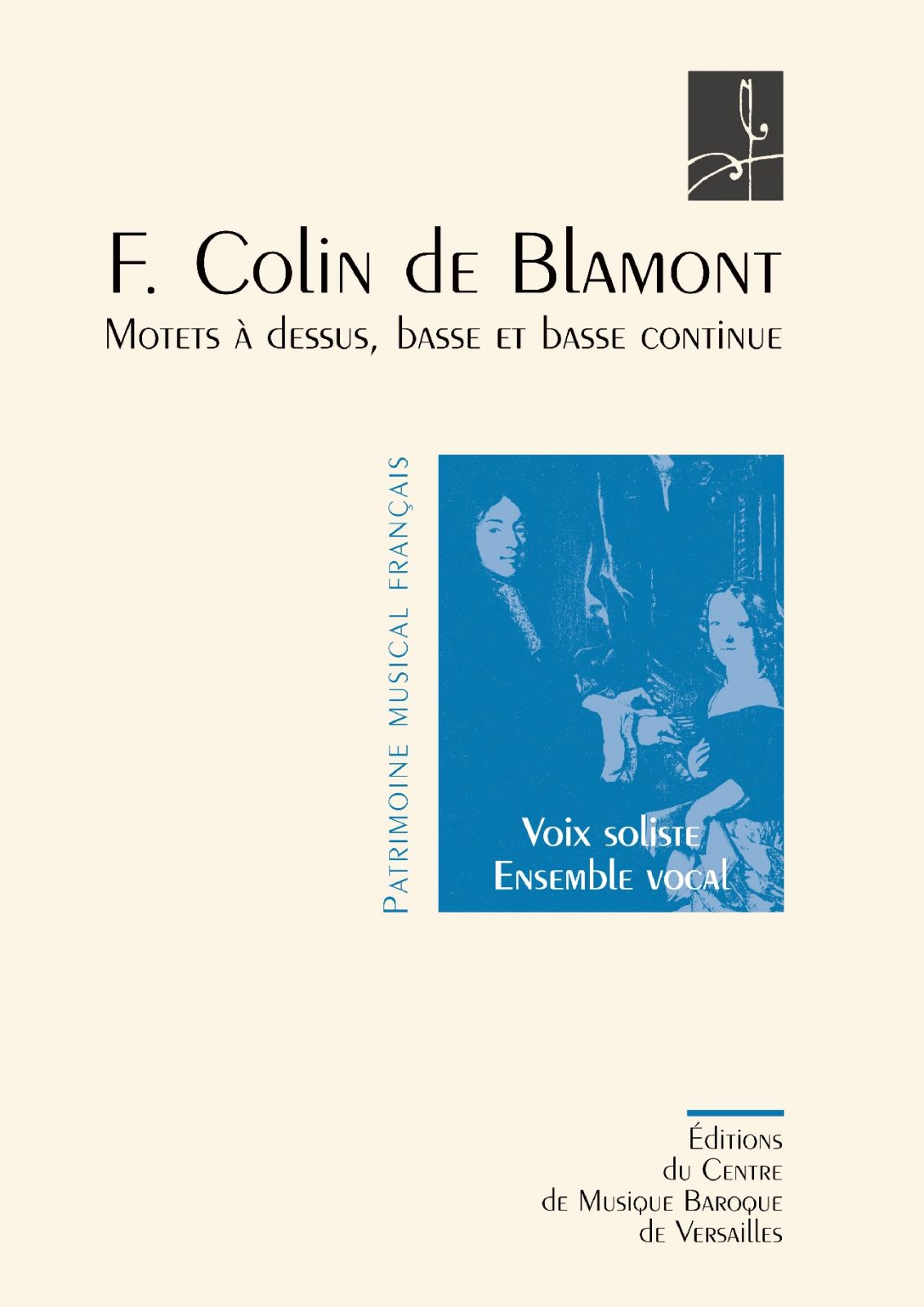
Motets à dessus, basse et basse continue
François COLLIN DE BLAMONT
(1690-1760)


Référence : CAHIERS-161
Format :
21x29,7 cm
Reliure : Broché
18,00 € TTC
En stock
François COLLIN DE BLAMONT
(1690-1760)
Collection :
Voix soliste / ensemble vocal
Type d’édition :
Conducteur
Maison d'édition :
Editions du Centre de musique baroque de Versailles
Présentation :
François Collin (or Colin) de Blamont was born in Versailles in 1690 to musician parents, both ordinaries of the King’s Music. His apprenticeship was entrusted to Lalande, a friend of his father. Like Bernier, he took part in concerts given by the Duchesse du Maine at Sceaux and, from 1709, entered the service of the Court: haute-contre of the Chapelle royale choir, then taille at the Chambre du roi in 1717. Two years later, he took up the post of Superintendant de la Musique de la Chambre du roi, the position held by Lully’s son, alongside Destouches. He wrote for the Académie Royale de Musique and, through his duties, for the court entertainments provided by the weddings and births that marked the beginning of Louis XV’s reign. On Lalande’s death, he and Destouches shared responsibility for the education of the Pages. He also took part in the Concerts de la reine, which Marie Leczynska brought up to date. In 1732, the performance of his Te Deum, often repeated throughout the 18th century, contributed to the quarrel of precedence between the musicians of the Chambre and those of the Chapelle du roi. From 1744, he gradually withdrew from his duties in favor of François Francœur and Bernard de Bury, his godson and protégé. He was still in demand at Court, notably for the Dauphin’s wedding and the Marquise de Pompadour’s performances at her Théâtre des Petits-Appartements. In the 1750s, withdrawn from the Court for health reasons, he again took part in the Querelle des Bouffons. He died in Versailles in 1760, ennobled and decorated with the Cordon de l'Ordre de Saint-Michel by Louis XV.
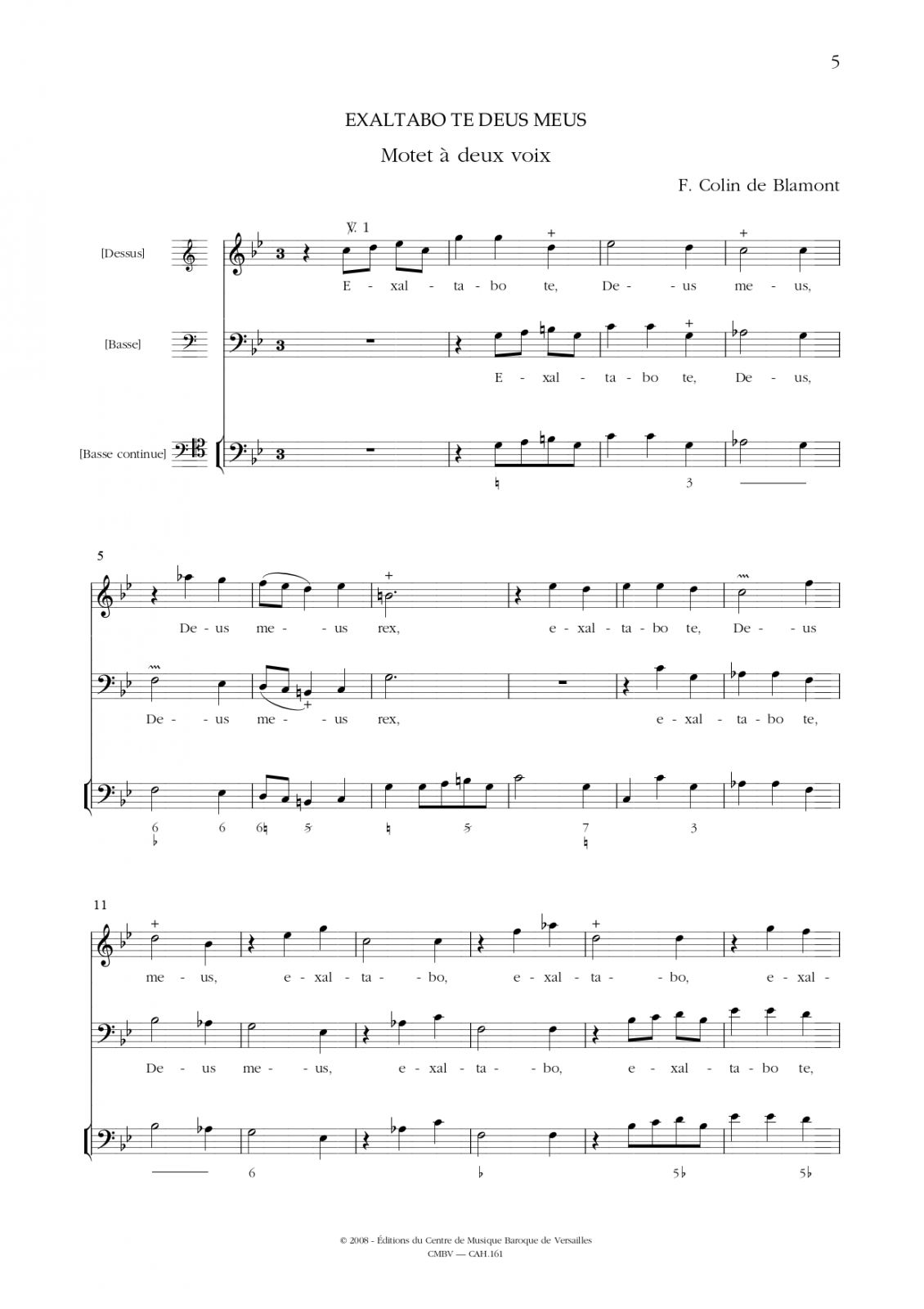
The two short motets in this volume are written for a vocal duo: a soprano and a bass accompanied only by basso continuo. The Exaltabo te Deus meus, taken from Psalm 144, gives prominence to the bass voice, particularly in the upper register. The duets alternate with recitatives for soprano and bass voices, with numerous shifts in timbre, rhythm and tone illustrating the text and highlighting its various emotions. The antiphon to the Virgin Regina cæli lætare is jubilant in character.
The two short motets in this volume are written for a vocal duo: a soprano and a bass accompanied only by basso continuo. The Exaltabo te Deus meus, taken from Psalm 144, gives prominence to the bass voice, particularly in the upper register. The duets alternate with recitatives for soprano and bass voices, with numerous shifts in timbre, rhythm and tone illustrating the text and highlighting its various emotions. The antiphon to the Virgin Regina cæli lætare is jubilant in character.
Pagination :
43
Date de parution :
2008-07
Introduction (langue) :
Français
ISMN 979-0-56016-161-7
Les œuvres
Langue du texte :
Latin
Genre :
motet
Temps liturgique :
Psaume 144
Ton :
do mineur
Durée :
entre 20' et 29'
Langue du texte :
Latin
Genre :
motet
Temps liturgique
Fêtes de la Vierge
Ton :
Fa Majeur
Durée :
entre 10' et 19'
Recommandations


27€
Disponible en version numérique


28€
Disponible en version numérique


