

Motets à II, III et IV parties (1681)
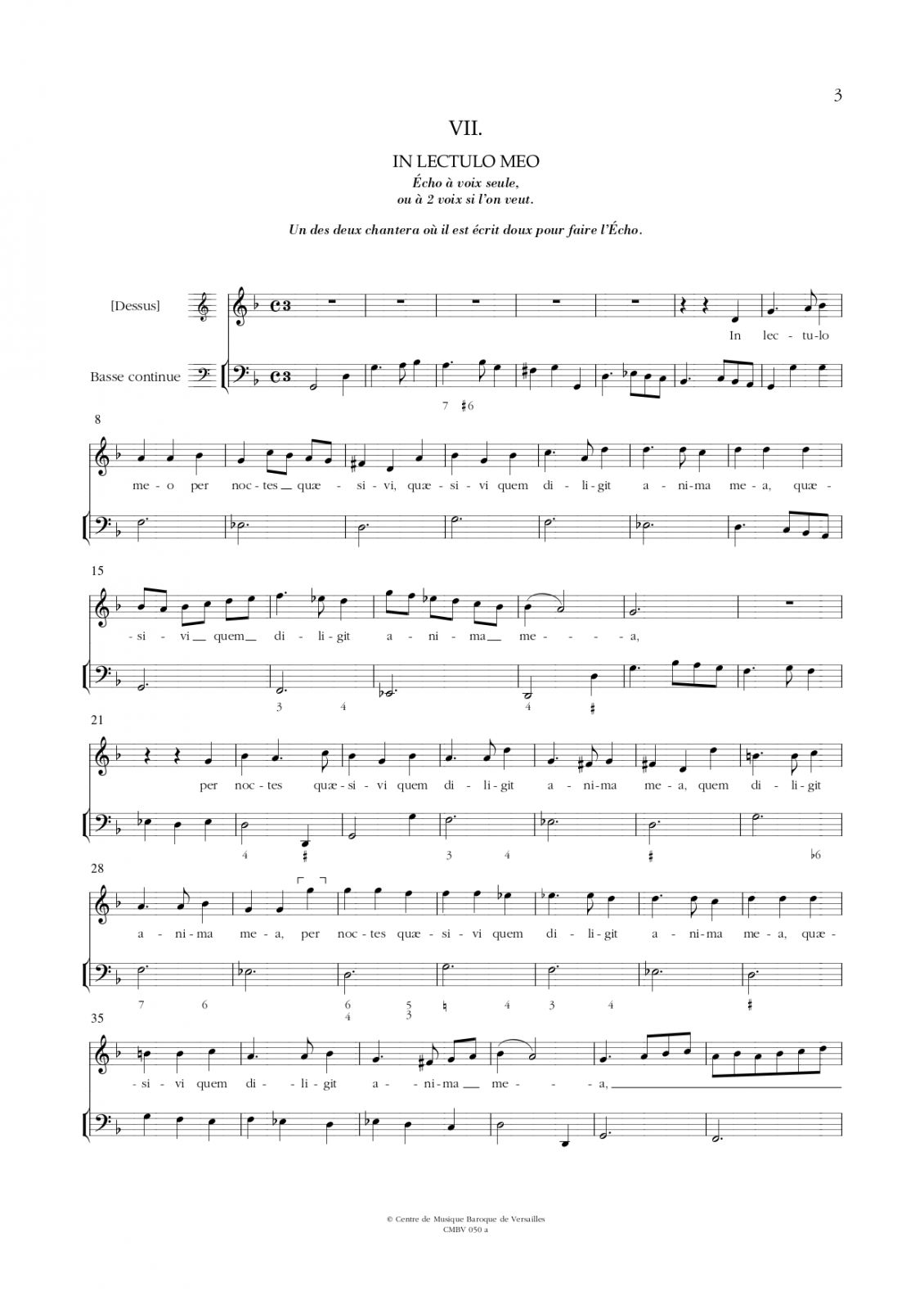


This collection, published by Christophe Ballard in 1681, is a representative sample of the repertoire performed at mass for Louis XIV before the Court moved to Versailles. Henry Du Mont, then aged 70, presents 37 motets and 3 instrumental pieces, mostly composed for Louis XIV’s daily mass. The composer organised and closely supervised this edition: the choice of works was sumptuous, and the sous-maître of the Chapelle royale, at the end of his career, could boast an extensive catalogue.
The volume contains motets for vocal forces ranging from 2 to 4 voices, as well as pieces for 1 voice and 4 motets that can be performed "à deux chœurs" (with double choir). Most are accompanied by instruments ad libitum – often 1 or 2 violins (or viols, the composer leaving ambiguity by using the abbreviation "viol.) – and some require "symphonies" (a small string orchestra). These works are elegant, varied in character and relatively easy to perform.
In a very detailed preface, the scholarly editor presents the numerous printed and manuscript sources of these motets, describing and comparing them in great detail. The question of the circulation of the works is addressed – in particular, the copies in the handwriting of the English composer John Blow, which themselves continued to be copied until the early 19th century – the dating of the works, the corrections the composer made to the printed copies, and his meticulous details for the performers. Also covered are the question of vocal and instrumental numbers, technical innovations in writing (slurs in the figured bass), ossias, bar numbers, the origin and attribution of the texts used etc.
In addition to the preface in French and English and the music, this volume contains all the texts of the motets (with their translation into French and English), 13 facsimiles and, at the end of the volume, a critical apparatus.
Laurence Decobert is curator in the Music Department of the Bibliothèque nationale de France and holds a doctorate in musicology from the Paris-Sorbonne University. Part of her research focuses on religious music in France in the second half of the 17th century, and she has also produced several volumes of Henry Du Mont’s grands motets for the Centre de Musique Baroque de Versailles, and is currently preparing a monograph on the sous-maître of Louis XIV. She is also interested in promoting the ancient collections of the Département de la Musique, and has just published an article on the Philidor collection in the Revue de musicologie.
Henry Du Mont proposes alternative settings for 12 of these motets. Presented in this critical edition as in the edition of 1681, they are transposed for performers in our "tirés-à-part" (offprints). The motet O nomen Jesu, for example, can be found in:
- Motets à 2 voix, vol. 1 (voix de dessus), original version for voix de dessus and bas-dessus ;
- Motets à 2 voix, vol. 3 (voix d'hommes, 1), for haute-contre and taille, the voices in this collection having been transposed to the lower octave, as suggested by Du Mont.
Les œuvres
Recommandations


