

Partition
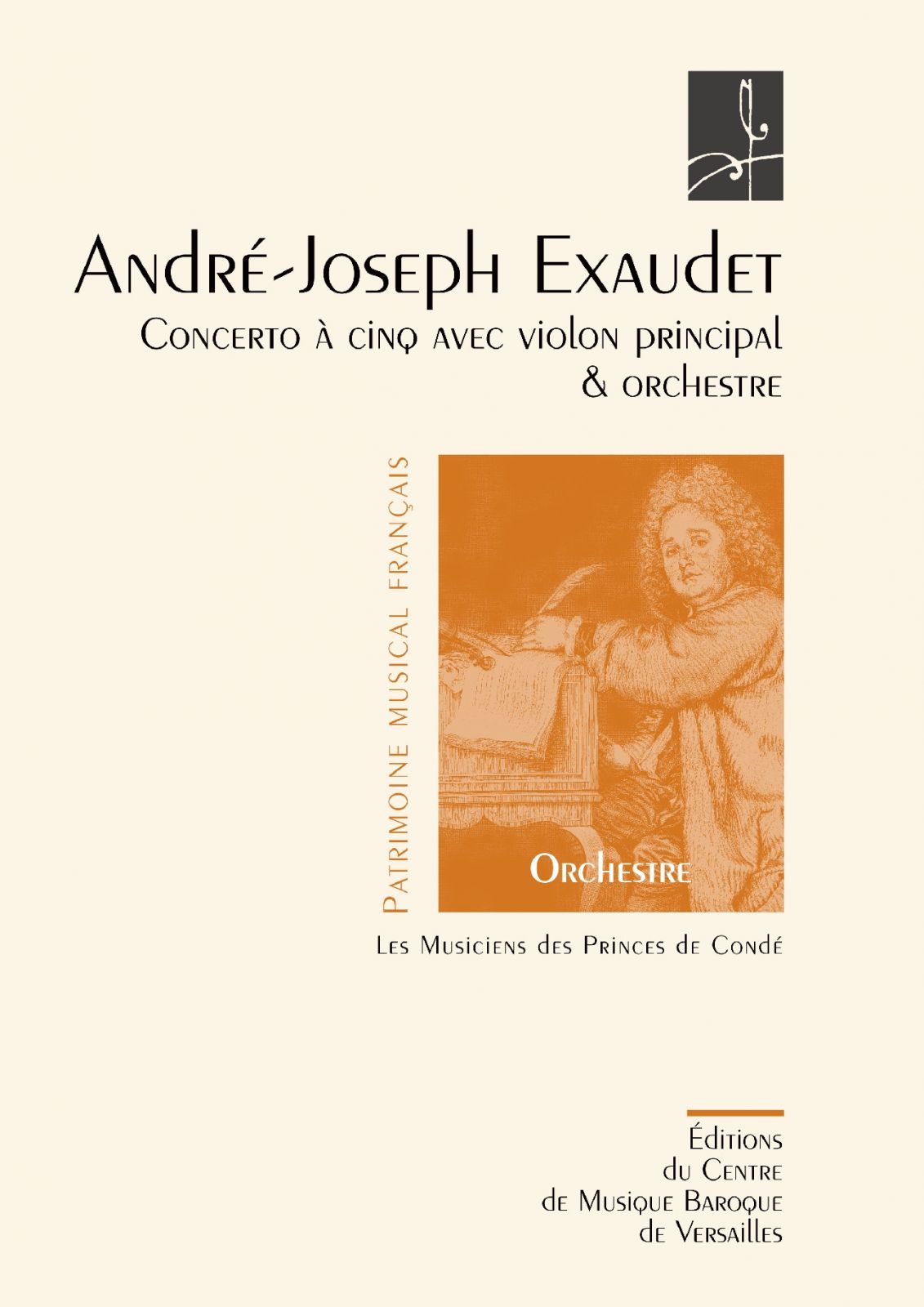
Concerto à cinq avec violon principal & orchestre
André-Joseph EXAUDET
(ca 1710-ca 1763)


Référence : CAHIERS-197
Format :
21x29,7 cm
Reliure : Broché
11,00 € TTC
En stock
André-Joseph EXAUDET
(ca 1710-ca 1763)
Editeur(s) :
Charles HÉNIN
Collection :
Orchestre
Type d’édition :
Conducteur
Maison d'édition :
Editions du Centre de musique baroque de Versailles
Présentation :
André-Joseph Exaudet, born in Rouen in 1710, was a renowned violinist. The first mention of him dates back to 1744, when he published his 6 Sonates pour le violon et basse while first violinist at the Académie de Musique de Rouen. He was a musician at the Opéra – Ordinaire de l'Académie Royale de Musique – and at the Concert Spirituel in Paris, as well as a member of the 24 Violons du Roi and participed concerts at court. He was also Symphoniste at the Concerts de la Reine and Maître de Violon to the Prince de Condé. He died around 1763.
Taking full advantage of the advances of the "18th-century French violin school" of the previous generation, under the talented influence of Jean-Marie Leclair, Exaudet’s work, mainly dedicated to the violin, testifies to an acute sense of phrasing, a certain virtuosity and great musical sensitivity. He was an innovator in both technique and form, and is credited with the first use of 9th and 10th harmonics, groups of semiquavers and demisemiquavers (16th and 32nd notes), and complex bowing. He wrote a minuet so popular that it was used over a hundred times in songs, and many soloists used it to showcase their improvisational skills in variation developments.
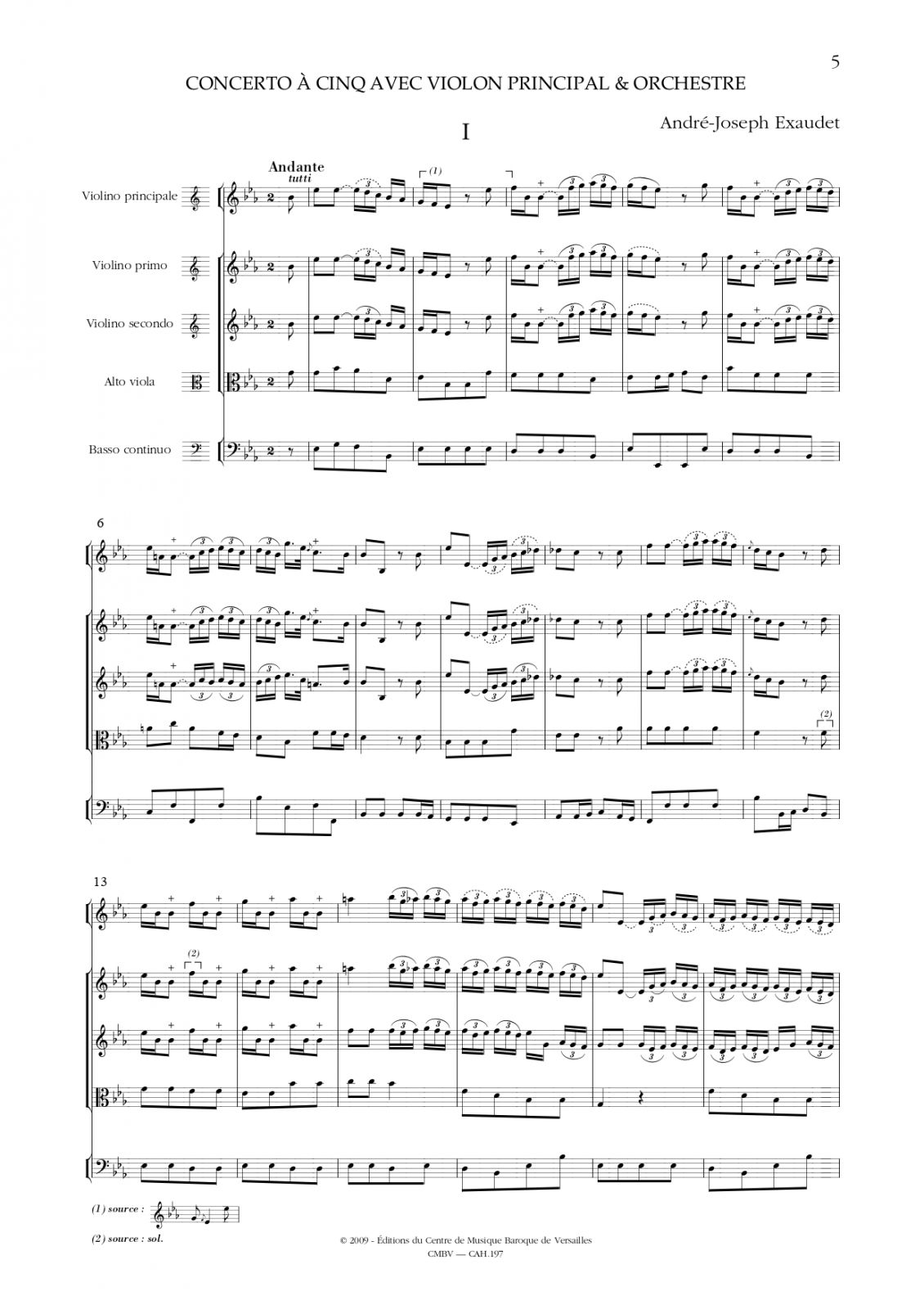
In the present concerto, which probably dates from the 1750s/60s, the violin soloist uses all registers of the instrument. As this is a concerto "à cinq" (in five parts), somewhere between a concerto grosso and a solo concerto, the violin sometimes leads the orchestra and sometimes has a solo role. Particularly noteworthy is the beautiful Largo second movement, for solo violin accompanied only by the orchestral violins, as well as a virtuoso and rather pleasing cadenza at the end of the first movement. The orchestra, two violins, viola and bass, is Italian in style, and does not require a very large orchestra. Despite the similarity of form with François Dieupart’s Concerto à cinq for violin and orchestra, the approach, 40 years apart, is very different. Lasting just ten minutes, in E-flat major, it is a beautiful orchestral piece.
Taking full advantage of the advances of the "18th-century French violin school" of the previous generation, under the talented influence of Jean-Marie Leclair, Exaudet’s work, mainly dedicated to the violin, testifies to an acute sense of phrasing, a certain virtuosity and great musical sensitivity. He was an innovator in both technique and form, and is credited with the first use of 9th and 10th harmonics, groups of semiquavers and demisemiquavers (16th and 32nd notes), and complex bowing. He wrote a minuet so popular that it was used over a hundred times in songs, and many soloists used it to showcase their improvisational skills in variation developments.
In the present concerto, which probably dates from the 1750s/60s, the violin soloist uses all registers of the instrument. As this is a concerto "à cinq" (in five parts), somewhere between a concerto grosso and a solo concerto, the violin sometimes leads the orchestra and sometimes has a solo role. Particularly noteworthy is the beautiful Largo second movement, for solo violin accompanied only by the orchestral violins, as well as a virtuoso and rather pleasing cadenza at the end of the first movement. The orchestra, two violins, viola and bass, is Italian in style, and does not require a very large orchestra. Despite the similarity of form with François Dieupart’s Concerto à cinq for violin and orchestra, the approach, 40 years apart, is very different. Lasting just ten minutes, in E-flat major, it is a beautiful orchestral piece.
Pagination :
17
Date de parution :
2009-02
Introduction (langue) :
Français
ISMN 979-0-56016-197-6
Les œuvres
Genre :
concerto
concerto à 5
concerto pour violon
Ton :
Mi bémol Majeur
Durée :
entre 10' et 19'
Recommandations


26€
Disponible en version numérique


26€
Disponible en version numérique


22€
Disponible en version numérique


34€
Disponible en version numérique
