

Motets pour chœur, vol. 8
Motets à 6 voix, 2 dessus instrumentaux et basse continue
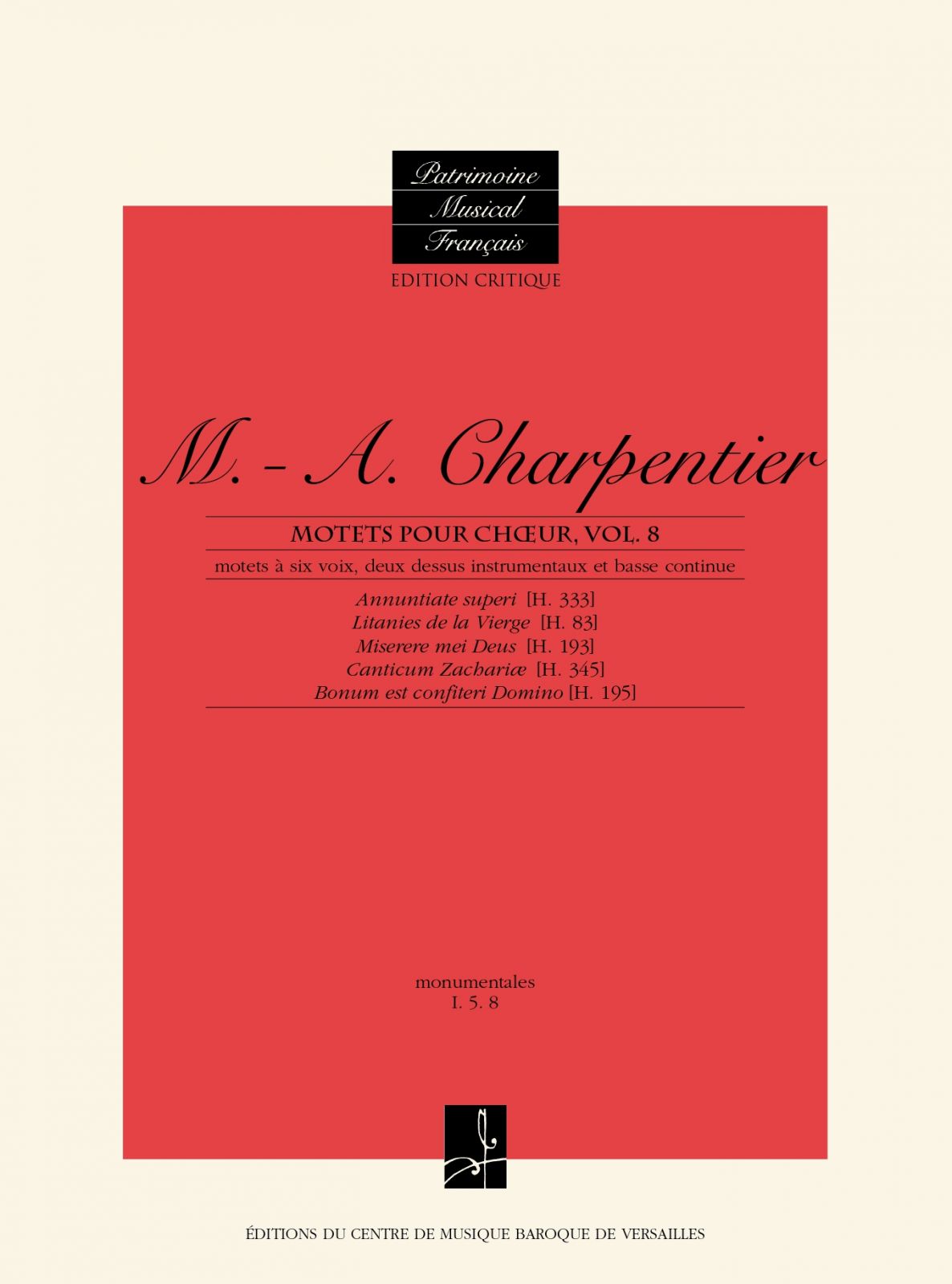
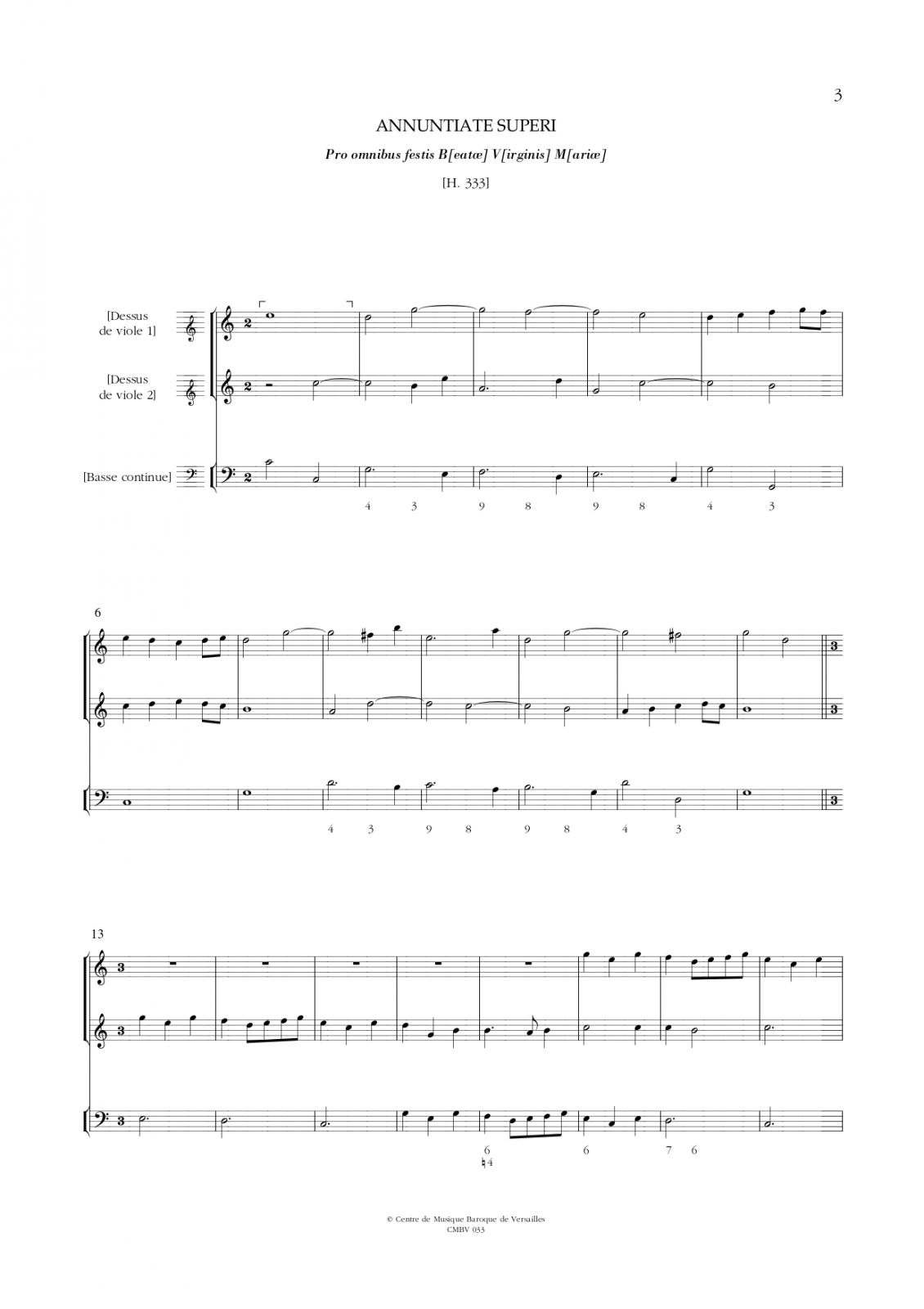


This volume brings together motets intended for a small 6-part choir (8 voices are required) accompanied by an instrumental trio. They were composed between 1684 and 1687 for the musical establishment of the prestigious house of Mlle de Guise. Charpentier takes advantage of the large, colourful scoring to play with timbre and spatialisation. On one side, a trio of women’s voices, on the other, a trio of men’s voices, who dialogue, reply, follow and complement each other throughout the works. The récits combine these voices in duets and trios, making use of their multiple possibilities. This unusual vocal line-up (found again in his Missa Assumpta est), enables Charpentier to develop an extremely fine counterpoint. These works are intended for solo ensembles.
Although the architecture of these motets is for 6 voices, only the Annuntiate superi can be sung by 6 singers: all the other motets are written for an ensemble of 8 singers, comprising 4 women’s voices (divided haut-dessus, dessus and bas-dessus) and 4 men’s voices (haute-contre, taille and divided basses), with only the extreme parts, in the absence of division, sung by two singers (two motets can also be sung by 9 singers, by division of the dessus). The labels of the female voice parts here refer to the contrapuntal role, not to their tessitura. As for the instrumentalists, the scholarly editor suggests a chamber ensemble consisting of two dessus de viole and basso continuo.
In her introduction, Théodora Psychoyou devotes particular attention to studying the different strata revealed by Marc-Antoine Charpentier’s sources. This remarkable investigation sheds light on the composer’s task when faced with revivals of his works in very different contexts (and therefore with different musical forces), and resolves the contradictions in Charpentier’s numerous annotations, particularly in the Miserere mei Deus [H.193] better known as the Miserere of the Jesuits, restored here to the original version composed for the house of Mlle de Guise.
With an introduction in French and English, the volume also contains the texts of the motets (and their French and English translations), 6 facsimile illustrations and critical apparatus in addition to the music.
Théodora Psychoyou is a lecturer at Paris IV-Sorbonne University and a research associate at the Centre de Musique Baroque de Versailles. She was a resident at the Académie de France in Rome (2005–2007) and a member of the RISM team (early music manuscripts) at the Bibliothèque nationale de France (1997–2005). Her work focuses on the history of musical theory in the 17th and early 18th centuries, on the economy and status of musical and theoretical sources, and on 17th-century religious music, particularly that of Charpentier. She is currently preparing the publication of a catalogue of theoretical writings in France, 1623–1722 (CMBV/Olms), accompanied by a database (CMBV-PHILIDOR).
Les œuvres
Recommandations


