

Partition
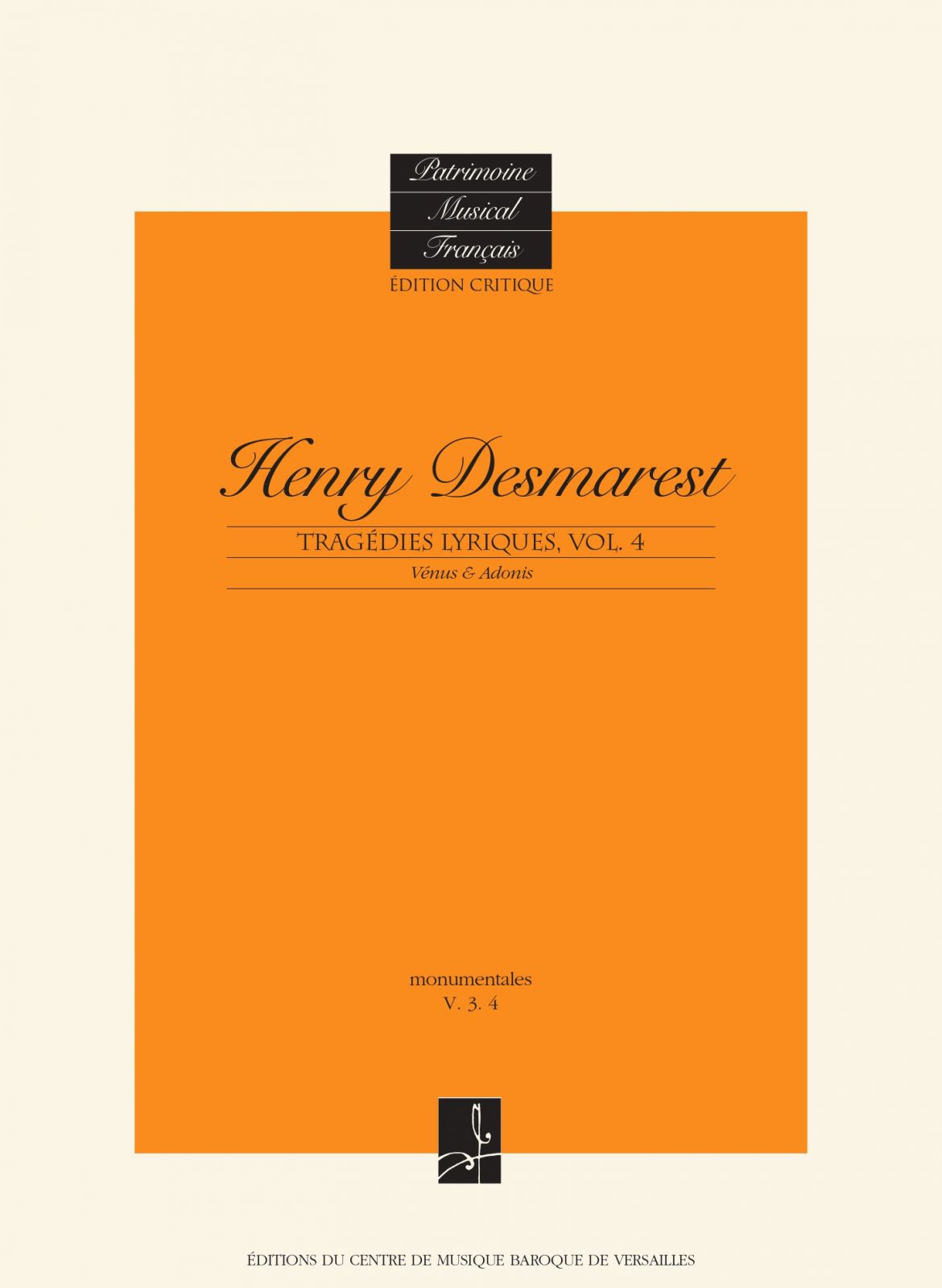
Tragédies lyriques, vol. 4 : Vénus & Adonis
Vénus & Adonis
Henry DESMAREST
(1661-1741)
Livret de Jean-Baptiste ROUSSEAU


Référence : CMBV_049
Format :
24,5x33,5 cm
Reliure : Relié
168,00 € TTC
En stock
Henry DESMAREST
(1661-1741)
Editeur(s) :
Jean DURON
Collection :
Monumentales
Henry Desmarest
Type d’édition :
Édition critique
Maison d'édition :
Editions du Centre de musique baroque de Versailles
Présentation :
Éditions du Centre de musique baroque de Versailles publishes a new volume in its monumental critical edition of Henry Desmarest’s works. The fourth and last lyric tragedy composed before the composer’s condemnation and exile from France, Vénus & Adonis is one of the musician’s most moving works, conceived at a very troubled time in his life. This edition is the culmination of a lengthy project that included the publication of a book devoted to the work (1); its 2006 re-creation at the Opéra de Nancy , under the musical direction of Christophe Rousset and staged by Ludovic Lagarde with the Talens Lyriques ensemble; and the release of a CD by the same team for Naïve in 2007 (2).
Henry Desmarest
Beyond Henry Desmarest’s extraordinary destiny, recounted by Michel Antoine in a fine biography (3), his music deserves special attention for its inspiration and density of writing. From the generation of Michel-Richard de Lalande and André Campra, Henry Desmarest, a former page of the Chapelle Royale, was a pure product of the Court of Louis XIV. He inherited the French style transmitted by its most eminent representatives: Jean-Baptiste Lully, Henry Du Mont and Pierre Robert. In this lyrical tragedy, premiered in 1697, on a libretto by Jean-Baptiste Rousseau, the composer paints a touching picture of the birth of love, both feared and desired.
Synopsis
Shepherds and shepherdesses are invited to pay homage to the king. They are singing of the innocent pleasures of love when Diana interrupts to teach them how love can lead to disaster: young Adonis, son of the King of Cyprus, makes Princess Cidippe languish with his indifference, while a feast is being prepared to welcome Venus. The goddess crowns the young man as the island’s new sovereign and declares to Cidippe her love for Adonis. The latter, troubled by the goddess, responds to her advances. Cidippe, enraged and seeking revenge, asks Jealousy to intervene with Mars. The god of war surprises Venus and Adonis but, ready to give vent to his fury, allows himself to be charmed and, without Cidippe’s intervention, would remain in the wrong. Venus, having to leave Cyprus, bids Adonis a tearful farewell. Mars appeals to Bellona, who rages against the people of the new sovereign, destroying Cyprus. To complete his vengeance, Mars asks Diana to send a monster to the island. Adonis, full of courage, sets off to confront it. A joyful chorus announces his victory. However, Cidippe tells Venus of Adonis' death and kills herself.
The volume
Having already published a study of the tragedy itself (1), scholarly editor Jean Duron devotes the volume’s preface (available in French and English) to performances of the work. This leads him to take a close look at the musical sources: versions, revivals, contexts and traditions lead him to detail the composer’s palette: ornaments, tonalities, orchestration. Literary sources are also studied, with a focus on recent work on 17th-century theatre, dealing with both the text in the score and the libretto distributed to the audience. The libretto is published in a critical, trilingual version (French, English and German from the 1725 revival in Hamburg). A number of facsimiles give an idea of the condition of the original documents. All the different configurations of the music are available for performance in vocal score and with orchestral parts.
The scholarly editor
Jean Duron works on music during the reign of Louis XIV, with a particular focus on how it was performed: scoring, counterpoint, composition and theory. His work focuses mainly on large-scale forms (grand motet, tragédie en musique), court music and the music of the kingdom’s great cathedrals. His research has led him to publish several texts on contemporary neo-Latin poetry. Founder and director of research at the CMBV (1989-2007), he is currently director of the institution’s book collections.
1: Vénus & Adonis, tragédie en musique by Henry Desmarest (1697), texts collected by Jean Duron and Yves Ferraton. Sprimont,
Mardaga, 2006
2: Desmarest - Venus & Adonis. Les Talens Lyriques – Christophe Rousset. CD Ambroisie (Naïve 2007).
3: Henry Desmarest (1661–1741). Biographie critique, Michel Antoine. Paris, A. et J. Picard & Cie, 1965 (Vie musicale en France
sous les rois Bourbons, 10).
Henry Desmarest
Beyond Henry Desmarest’s extraordinary destiny, recounted by Michel Antoine in a fine biography (3), his music deserves special attention for its inspiration and density of writing. From the generation of Michel-Richard de Lalande and André Campra, Henry Desmarest, a former page of the Chapelle Royale, was a pure product of the Court of Louis XIV. He inherited the French style transmitted by its most eminent representatives: Jean-Baptiste Lully, Henry Du Mont and Pierre Robert. In this lyrical tragedy, premiered in 1697, on a libretto by Jean-Baptiste Rousseau, the composer paints a touching picture of the birth of love, both feared and desired.
Synopsis
Shepherds and shepherdesses are invited to pay homage to the king. They are singing of the innocent pleasures of love when Diana interrupts to teach them how love can lead to disaster: young Adonis, son of the King of Cyprus, makes Princess Cidippe languish with his indifference, while a feast is being prepared to welcome Venus. The goddess crowns the young man as the island’s new sovereign and declares to Cidippe her love for Adonis. The latter, troubled by the goddess, responds to her advances. Cidippe, enraged and seeking revenge, asks Jealousy to intervene with Mars. The god of war surprises Venus and Adonis but, ready to give vent to his fury, allows himself to be charmed and, without Cidippe’s intervention, would remain in the wrong. Venus, having to leave Cyprus, bids Adonis a tearful farewell. Mars appeals to Bellona, who rages against the people of the new sovereign, destroying Cyprus. To complete his vengeance, Mars asks Diana to send a monster to the island. Adonis, full of courage, sets off to confront it. A joyful chorus announces his victory. However, Cidippe tells Venus of Adonis' death and kills herself.
The volume
Having already published a study of the tragedy itself (1), scholarly editor Jean Duron devotes the volume’s preface (available in French and English) to performances of the work. This leads him to take a close look at the musical sources: versions, revivals, contexts and traditions lead him to detail the composer’s palette: ornaments, tonalities, orchestration. Literary sources are also studied, with a focus on recent work on 17th-century theatre, dealing with both the text in the score and the libretto distributed to the audience. The libretto is published in a critical, trilingual version (French, English and German from the 1725 revival in Hamburg). A number of facsimiles give an idea of the condition of the original documents. All the different configurations of the music are available for performance in vocal score and with orchestral parts.
The scholarly editor
Jean Duron works on music during the reign of Louis XIV, with a particular focus on how it was performed: scoring, counterpoint, composition and theory. His work focuses mainly on large-scale forms (grand motet, tragédie en musique), court music and the music of the kingdom’s great cathedrals. His research has led him to publish several texts on contemporary neo-Latin poetry. Founder and director of research at the CMBV (1989-2007), he is currently director of the institution’s book collections.
1: Vénus & Adonis, tragédie en musique by Henry Desmarest (1697), texts collected by Jean Duron and Yves Ferraton. Sprimont,
Mardaga, 2006
2: Desmarest - Venus & Adonis. Les Talens Lyriques – Christophe Rousset. CD Ambroisie (Naïve 2007).
3: Henry Desmarest (1661–1741). Biographie critique, Michel Antoine. Paris, A. et J. Picard & Cie, 1965 (Vie musicale en France
sous les rois Bourbons, 10).
Pagination :
CLV-272
Date de parution :
2010-05
Illustrations, fac similés (nbre) :
53
Introduction (langue) :
Français/Anglais
ISMN 979-0-707034-49-1
Annexes :
Livret de Nancy (1707) - Livret de Paris (1717) - Livret de Hambourg (1725) - Livret de Lyon (1739) - Chorégraphie de Londres (1725)
Les œuvres
Langue du texte :
Français
Genre :
tragédie lyrique
Ton :
mi mineur
Durée :
plus de 50'
Recommandations


22.50€
Disponible en version numérique


26€
Disponible en version numérique

